The transfer lobe pump jams halfway through the recipe — and the batch is left hanging on the stuffer.
In a cured meat plant, the lobe pump is the part that decides whether the recipe reaches the stuffer whole or is left half-pushed. When a lobe wears or an abrasive lump gets in, the vibration signature changes minutes before the pressure gauge does. iLEAN Edge recognises it with a local CNN, alerts the shift manager, and the person decides whether to stop, adjust or carry on. The line never restarts by itself.
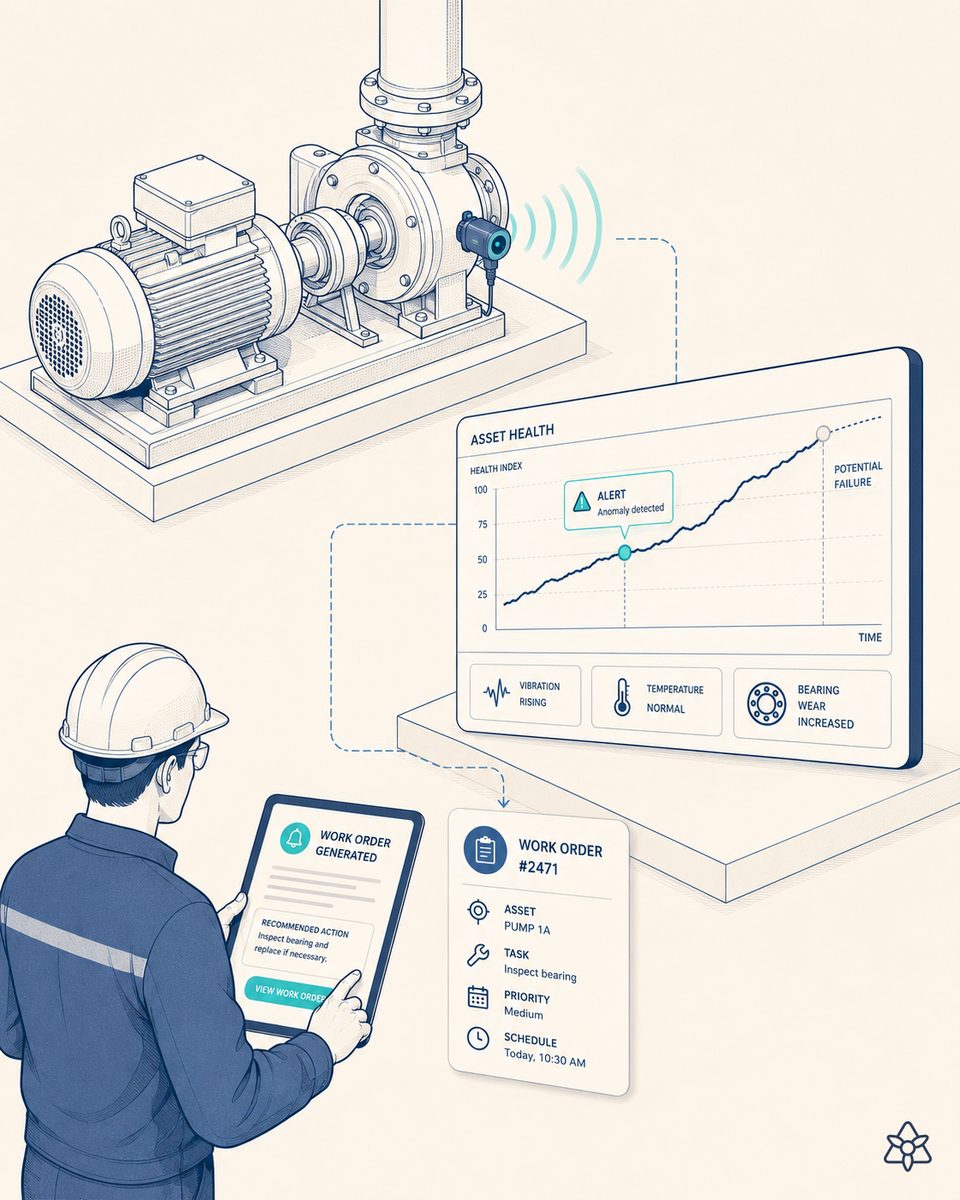
A pump stoppage halfway through a recipe is not a stoppage — it is a batch.
In cured meat, the lobe pump moves a difficult batter: a heterogeneous mince with back fat, spices, curing salts and ice. It is abrasive inside and demanding on pressure. When the pump starts to fail, you do not notice it in time in the measured flow — because the system compensates for a few seconds — but you do notice it in the vibration signature much earlier:
- Lobe wear — contact between lobes changes and lateral modulation appears in the lobe-passing band. The operator cannot tell it apart from normal noise.
- Jam or abrasive lump — a sliver of bone, a badly minced lump of back fat, a whole peppercorn: a non-periodic high-amplitude transient peak. The pump holds for an instant, then forces its way through.
- Broken emulsion or entrained air — a broadband rise, irregular actual flow. The batter reaching the stuffer is no longer the same.
If nothing is done, the recipe is left half-pushed in mid-process, the batter cooling in the pipe loses texture, and the next hanging cycle runs late. The shift manager ends up with three phone calls and a batch under review. The classic system — hours-based maintenance plus the veteran's eye — works 99% of the time. That 1% is the batch you lose.
iLEAN Edge does not replace the maintenance manager — it gives him the continuous ear he cannot have on his own.
The problem is not a lack of information: it is information living on an island (the pump casing) that, at the critical moment (the 2-3 minutes before the jam), never reaches the person who decides. iLEAN acts as the filler that closes that gap, without asking you to change the pump, the transfer panel or the recipe.
Edge hears what the operator cannot hear. Connect cross-references it with the batch composition and the recipe. The agent proposes stopping or adjusting before the jam. The person signs off — never the other way round.
The three iLEAN pieces applied to the transfer lobe pump:
- Edge — a terminal with a MEMS or piezoelectric sensor bolted to the pump casing. A CNN trained to recognise the three signatures (wear, jam, emulsion) on the vibration spectrum. It fires a dry contact to the transfer PLC in milliseconds. It works without a network: if the plant loses WiFi during the recipe, Edge keeps reading and keeps firing the alert.
- Connect — captures the context the signature alone cannot resolve: composition of the batch in progress (which mince, what percentage of back fat, which spices), the raw material batch received by email from the supplier, the stuffer schedule, the maintenance manager's spreadsheet with the last intervention on the lobes.
- Agent — cross-references the anomalous signature, the recipe in progress and the hanging schedule. If the wear signature has been climbing for several shifts, it proposes an intervention at the next recipe change. If a jam peak appears, it holds dosing and alerts the shift manager. The person validates, signs off, and the line carries on.
Hours-based maintenance vs. anticipation by vibration signature
| Aspect | Classic pump maintenance | With iLEAN Edge on the casing |
|---|---|---|
| Lobe wear detection | When flow drops visibly | At lateral modulation, days earlier |
| Abrasive jam detection | After stopping and disassembly | At the transient peak, before the jam sets in |
| Lobe set replacement | Every X calendar hours | When the signature justifies it |
| Interrupted recipe | Recoverable or not, depending on luck | Anticipated, adjusted or paused with time to spare |
| Operation without a network | n/a | Edge keeps running on panel power |
| Traceability for the IFS/BRC auditor | Maintenance report reconstructed after the fact | Signature history per recipe, automatic |
Impact estimate for your plant — to be validated with your numbers.
The block below is an estimate to be validated with the specific data of your plant. We set it out so the committee has an order of magnitude; we refine it during the diagnostic.
- Mid-sized cured meat plant with 2-3 lobe pumps at the head of transfer, multi-recipe (chorizo, salchichón, sobrasada, fuet) with SKU changes several times a day.
- Edge pilot on the most critical pump (sensor + trained CNN + dry contact to the PLC). First value expected within a few weeks: healthy signature recorded, first useful alert of wear or jam.
- Expected reduction of mid-recipe pump stoppages of ≥ 30% against the baseline of the last few years.
- Indicative payback between 4 and 9 months, depending on the historical frequency of documented jams and the average cost of a lost recipe or delayed hanging cycle.
- The hard lever is a single batch saved: batter that does not cool down in the pipe, a stuffer that is not left hanging, the next hanging cycle entering on time. One single recipe saved pays for the pilot.
And the maintenance manager's fair objection
«What if the CNN gets it wrong and orders a pump stop over a random peak?» — hallucination is a problem of free generation, not of anchored tasks. In tasks where the AI merely recognises a signature on the real sensor signal, the best models brought error below 1.5% [1]. And even so, what is critical is never decided alone: Edge alerts, the person signs off. The three safety rings exist precisely for this.
[1] OpenAI paper «Why Language Models Hallucinate», 2025 — on the reliability of AI in anchored tasks.
What people ask about lobe pump vibration in cured meat
Why is the lobe pump the bottleneck of transfer in cured meat production?
The lobe pump is the part that moves the viscous batter (minced meat, back fat, spices, curing salts, ice) between the bowl cutter or mixer and the stuffer, and between the different stages of the process. It works at high pressure with a non-homogeneous, abrasive fluid. When lobe wear or a jam appears, the vibration signature changes first — minutes before the actual flow drops and the recipe is left half-pushed, with batter sitting in the pipe losing temperature and texture.
What vibration signature indicates the lobe pump is about to fail?
Three distinct signatures that iLEAN Edge separates with a trained CNN: (1) lobe wear — lateral modulation growing in the lobe-passing band; (2) jam or abrasive lump — non-periodic high-amplitude transient peaks; (3) broken emulsion or entrained air — a broadband rise with irregular flow. All three appear well before the outlet pressure gauge reflects them, and well before the operator can hear them over plant noise.
How is Edge installed on the lobe pump without stopping the line?
The Edge terminal mounts on the outside, with a MEMS or piezoelectric sensor bolted or magnetically fixed to the pump casing — no drilling, no disassembly, no contact with product. Installation happens at the next scheduled stop or at shift change; there is no need to bring the line down. Wiring to the panel (a dry contact to the transfer PLC and optionally to the stuffer panel) is the same one your maintenance team already handles.
Does it work if the meat plant loses its network during a recipe change?
Yes. Edge is designed so that local inference does not depend on WiFi. As long as it has power, the CNN keeps recognising the failure pattern on the real sensor signal and keeps firing the alert to the panel. When the connection returns, it uploads the history to Central so the agents can cross it with the specific recipe, the batch composition and the stuffer schedule. What is critical on the plant floor never depends on WiFi being available — that is an axiom, not an option.
How long does it take to see the first real saving in a cured meat plant?
A few weeks for the first useful alert, the baseline pattern recorded and the CNN tuned to the specific type of batter your pump moves. The hard saving shows up with the first anticipated jam: the recipe is not left half-pushed, the batch is not lost to a temperature drop, the next hanging cycle is not delayed. Indicative payback in a meat plant with several transfer pumps is between 4 and 9 months depending on the historical frequency of stoppages — we close that with your numbers in 48h.
More cases in ilean edge
- Inline pH in acid neutralization reactors — the set-point is not chased from the control room, it is held in the reactor.iLEAN Edge reads inline pH in the acid neutralization reactor and prevents overshoot — zero excess…
- KTL degrease bath conductivity — one out-of-band reading, one batch of paint lost in e-coat.iLEAN Edge tracks the KTL alkaline degrease bath conductivity online in automotive and warns before…
- Tanning bath pH — a uniform leather batch should not depend on which shift walks in.iLEAN Edge measures tanning bath pH in the tannery drum and keeps the leather batch uniform across…
- Magnetic flow meter in reagent dosing — discharge is adjusted in the reactor, not at the inspection.iLEAN Edge reads reagent magnetic flow in industrial wastewater plants and holds over-dosing before…
- Microelectronics cleanroom humidity — one sensor out of band, one thin board into rework.iLEAN Edge tracks microelectronics cleanroom humidity cell by cell to prevent ESD and rework on thin…
- Muffle furnace temperature in steel tempering — hardness is not prayed for, it is measured and signed.iLEAN Edge tracks muffle furnace temperature in steel tempering and leaves the tempering curve auditable…
Tell us about your case and within 48h we'll send you the estimated ROI of this AI project for your meat plant.
We work on the real data of your plant, not ours. Diagnostic with no strings attached.
Request estimated ROI in 48h See iLEAN Edge