Muffle furnace temperature in steel tempering — hardness is not prayed for, it is measured and signed.
In steel quenching and tempering, the batch's Rockwell hardness depends on a real curve (temperature, ramp rate, soak time) that almost never fully matches the curve drawn on the SCADA. iLEAN Edge measures that real curve zone by zone, cross-checks it against the batch recipe and leaves an auditable record per load. The person signs the hardness — instead of praying for it at the end of the shift.
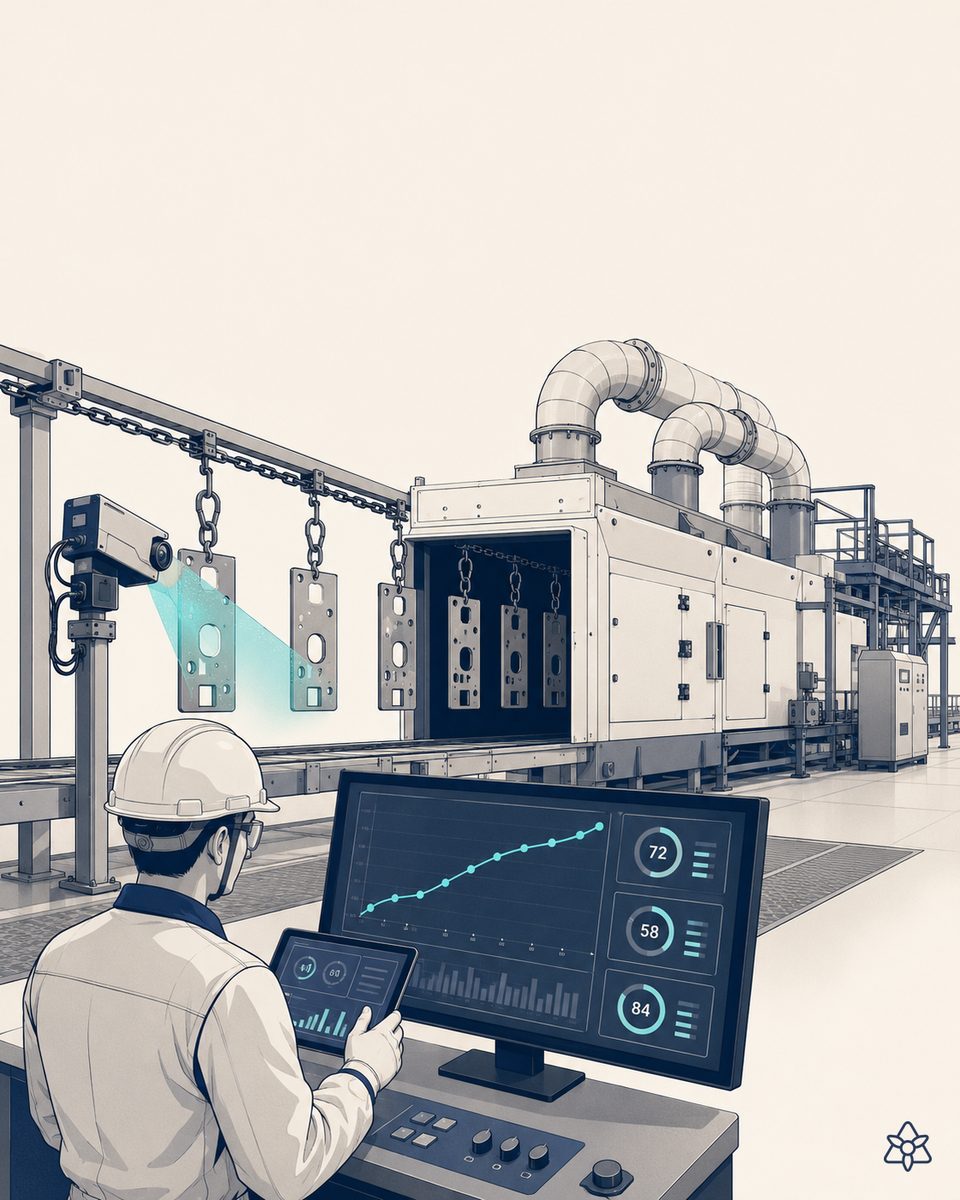
The curve the SCADA draws and the curve the steel actually suffers are not the same one.
A batch of tempered steel comes out right or comes out brittle depending on a real curve that crosses three things:
- The muffle furnace temperature by zone — not the PLC setpoint, the real one. Thermocouples drift, the load stacks heat unevenly, and the cold zone at the back never hears about the setpoint at the front.
- The soak time — real soak, not theoretical soak. If the door stays open five minutes halfway through the curve, effective soak time is no longer the programmed one.
- The heating and cooling ramp rate — what decides whether martensite forms as it should and whether tempering reaches the target Rockwell hardness, or whether the batch comes out brittle or soft.
The veteran in the heat treatment shop knows how to read that gap and compensates for it by eye. But his judgement lives in no system: it lives in his head. When he retires it leaves with him, and the muffle furnace gives no warning. The day the Rockwell test lands outside the window — because someone loaded the furnace differently, or a thermocouple drifted out of calibration with nobody noticing — the batch is scrap or rework, and the automotive customer applies the 25 PPM standard [1]. There is no margin.
iLEAN Edge doesn't touch the PLC — it seals the crack between the drawn curve and the real curve.
The problem in tempering is not missing data: what's missing is data cross-checked against the batch recipe and available at second zero. The SCADA draws the theoretical curve, the thermocouples measure, the Rockwell tests are done by sampling and the recipe lives in a spreadsheet or in a vertical MES. Four islands. iLEAN Edge is the filler that closes the gap between all of them, without asking you to change furnaces, PLC or SCADA.
Edge measures the real curve by zone. Connect captures the load recipe wherever it comes from — the ERP, the MES or the heat treatment master's spreadsheet. The agent cross-checks, compares against the process window and, if something drifts out, holds the batch in the record. The person signs — never the other way round.
The three iLEAN pieces applied to the tempering muffle furnace:
- Edge — a terminal with its own thermocouples in the furnace's critical zones, running in parallel to the PLC loop. It measures temperature, computes ramp rate and effective soak time, and fires an alert to the local panel in milliseconds if the real curve drifts away from the recipe. It works with no network.
- Connect — captures the load recipe (steel grade, target hardness, theoretical curve, process window) wherever it comes from: the ERP, the vertical heat treatment MES or the master's spreadsheet. And it also captures what arrives from outside: a new specification from the automotive customer, a change in the aerospace standard. Second zero.
- Agent — cross-checks real curve, recipe, Rockwell tests and customer specification. It generates the record per load (theoretical vs. real curve, door events, linked hardness, signature) ready for an IATF 16949 or Nadcap audit. If the curve doesn't add up, it holds the batch and alerts the supervisor. The person validates.
Muffle furnace with a logbook vs. muffle furnace with an auditable iLEAN curve
| Aspect | Classic tempering + logbook + SCADA | With iLEAN Edge + Connect + Agent |
|---|---|---|
| Tempering curve | The one the SCADA draws — setpoint, not reality | Real curve by zone, measured in parallel |
| Door events or thermal anomalies | If the operator notices, they write it down by hand | Automatic timestamped log in the record |
| Cross-check against the batch recipe | The master keeps it in his head or in a spreadsheet | Recipe linked to the batch from the ERP/MES |
| Traceability for IATF 16949 / Nadcap | Manual reconstruction weeks later | Record per load ready in seconds |
| Operation with no network | SCADA depends on the server | Edge keeps measuring on cabinet power alone |
| The veteran's know-how | Leaves with him the day he retires | Captured as a pattern in the system |
Impact estimate for your plant — to be validated with your own numbers.
The block below is an estimate to be validated with your plant's specific data. We lay it out so your committee has an order of magnitude; we refine it during the diagnostic.
- Heat treatment shop with 2 to 4 muffle furnaces, batches of tool steel and machined parts for automotive or aerospace, Rockwell testing today by sampling.
- Edge pilot on one muffle furnace (thermocouples in the critical zones + integration with the batch recipe + alert actuator). First value expected within a few weeks.
- Expected reduction in loads rejected for an out-of-window curve of ≥ 30% against the baseline we will measure during the immersion.
- Indicative payback between 4 and 9 months, depending on the historical frequency of loads with out-of-tolerance hardness and the average cost of rework or return.
- The hard lever is a single rejected load avoided: steel re-tempered, extra tests, customer return. With demanding customers, one load pays for the pilot.
And the quality manager's reasonable doubt
«What if the AI gets it wrong and lets through a load with hardness out of tolerance?» — hallucination is a problem of free generation, not of anchored tasks. In tasks where the AI merely compares a measured value against a process window (reading the real curve and checking it against the recipe), the best models brought error below 1.5% [2]. And even then, nothing critical is decided alone: iLEAN holds the batch in the record and the person signs. The three safety rings exist precisely for this.
[1] Automotive quality standard in the order of 25 PPM (parts per million). Source: Symestic.
[2] OpenAI paper «Why Language Models Hallucinate», 2025 — on the reliability of AI in anchored tasks.
What people ask about muffle furnace temperature in steel tempering
Why can't the muffle furnace tempering curve be left to the veteran's eye?
Because the final hardness of tempered steel depends on three variables that move together — soak temperature, soak time and heating and cooling ramp rate — and a veteran watching the PLC setpoint sees only one of them. If a thermocouple drifts, if the load is heterogeneous, if the door stays open five minutes too long, the real curve separates from the curve drawn on the panel and the batch's Rockwell hardness falls outside the window. The day that veteran retires, his judgement leaves with him — and the muffle furnace gives no warning. iLEAN Edge captures the real curve, not the programmed one, and files it next to the recipe so any quality auditor can review it.
Does Edge replace the furnace SCADA or the PLC cycle?
No. iLEAN Edge does not touch the PLC or the SCADA and does not compete with the furnace control loop. It is a terminal wired in parallel, with its own thermocouples and an optional passive-mailbox connection to the furnace's own sensors. It measures reality — temperature by zone, ramp rate, soak time — and cross-checks it against the batch recipe (which steel, which target hardness, which theoretical curve). If the real curve deviates from the theoretical one beyond the process threshold, it raises an alert and logs the event. The person decides whether to stop or continue, not the algorithm.
How do you audit the traceability of the tempering curve after the fact?
Every muffle furnace load keeps its own evidence record: theoretical curve vs. real curve overlaid, temperature by zone and by minute, door-opening events, linked Rockwell hardness tests, and the supervisor's signature. The paper logbook and the SCADA screenshot are over: when the IATF 16949 or Nadcap auditor arrives, the load record comes out in seconds, not in weeks of reconstruction. If you request a retained sample of the batch, you know which shift, which furnace and which curve produced it — and why the hardness landed where it did.
Does Edge work if the plant loses its network or the SCADA goes down?
Yes. The non-negotiable design principle of iLEAN Edge is that the critical capture-and-intervention cycle does not depend on connectivity. If the plant loses WiFi, Internet or SCADA, as long as Edge has power it keeps reading the thermocouples, keeps cross-checking against the loaded recipe and keeps firing the alert to the local panel. In a factory, what is critical cannot depend on WiFi being up. When the network returns, it syncs the history back into the record.
What payback is reasonable for an Edge pilot in steel tempering?
The order of magnitude is that of any Edge pilot on a bounded line: an investment covering the terminal + thermocouples + integration with the ERP/MES recipe + alert actuator, plus an annual licence. The hard lever is a single rejected load avoided — the steel re-tempered, the extra hardness test, the customer who returns the parts. Across the Pareto of a heat treatment shop, indicative payback runs to several months; we send you the estimated ROI within 48h using your plant's real data, not ours.
More cases in ilean edge
- The transfer lobe pump jams halfway through the recipe — and the batch is left hanging on the stuffer.iLEAN Edge reads the vibration of the lobe pump transferring viscous meat batter in cured meat plants to…
- Magnetic flow meter in reagent dosing — discharge is adjusted in the reactor, not at the inspection.iLEAN Edge reads reagent magnetic flow in industrial wastewater plants and holds over-dosing before…
- Microelectronics cleanroom humidity — one sensor out of band, one thin board into rework.iLEAN Edge tracks microelectronics cleanroom humidity cell by cell to prevent ESD and rework on thin…
- Multi-cavity injection mold — per-cavity hydraulic pressure keeps short shots out of scrap.iLEAN Edge closes hydraulic pressure per cavity in multi-cavity injection molds and keeps short shots…
- Edge ultrasound on wine bottling inertisation — catch the leak before the batch oxidises.iLEAN Edge with ultrasound detects the nitrogen leak in wine bottling inertisation before oxygen reaches…
- If the extractor bearing goes, the booth loses negative pressure — and the oven goes down with it.iLEAN Edge watches the PVD paint booth extractor bearing with a thermal camera: the curing oven stays up…
Tell us about your case and within 48h we'll send you the estimated ROI of this AI project for your heat treatment shop.
We work on your plant's real data, not on ours. Diagnostic with no commitment.
Request estimated ROI within 48h See iLEAN Edge