If the extractor bearing goes, the booth loses negative pressure — and the oven goes down with it.
On a PVD paint line, the booth extractor motor is what holds the negative pressure that keeps the line operational. Once its bearing starts running hot, the road to a line stop is short. iLEAN Edge watches that bearing with a thermal camera and recognises the anomalous pattern days ahead. Maintenance schedules the change without urgency; the booth keeps working, the oven holds, the line does not stop. The person signs off.
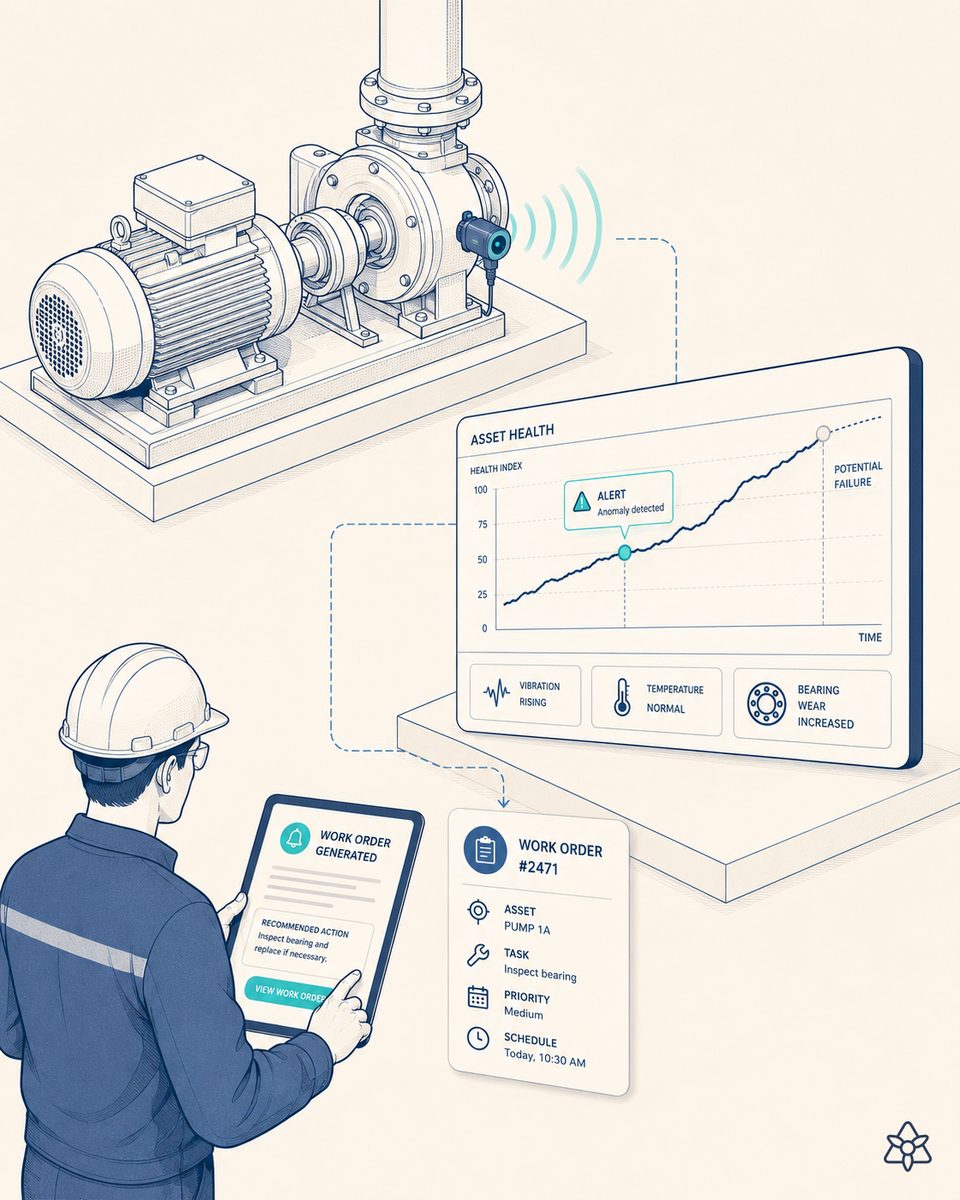
The extractor bearing is the cheap part that drags down the most expensive asset on the line.
On a PVD line, the paint booth sets the pace: if it loses negative pressure, particles escape into the room, the parts that follow no longer come out in condition, and the downstream curing oven goes into a controlled stop (or its cycle breaks, which is worse). And that negative pressure depends on one small part — the extractor motor — which in turn depends on two bearings. The road to the stop works like this:
- Lubrication degradation — the bearing climbs a few degrees above its own history. Nothing trips, because it stays below the thermal protection relay.
- Thermal asymmetry — the motor-side bearing rises relative to the fan-side one (or the other way round). The gradient opens up.
- Aerodynamic overload — if the filters are saturated on top of that, the motor compensates with more current, the bearings climb faster, and degradation accelerates.
- Thermal trip or seizure — the negative pressure drops, the booth falls out of class, the oven has to stop.
The classic setup — a handheld pyrometer on the round, a thermal protection relay, the maintenance manager's eye — only reads the snapshot, not the film. And the film runs for days. When the extractor goes down, it is not one motor that fails: half the line goes with it, and the oven right behind.
iLEAN Edge does not replace the maintenance technician — it gives him the permanent eyes he cannot have on his own.
The problem is not a lack of instrumentation: there is a thermal protection relay and there is a round. The problem is that nobody can be watching the extractor bearings 24/7, and the thermal signature lives on an island — the motor housing — between two rounds. iLEAN acts as the filler that closes that gap, without asking you to change the booth, the oven or the line SCADA.
Edge watches the bearings continuously, with a thermal camera and a local CNN. Connect cross-references the filter cycle, the paint recipe and the shutdown calendar. The agent proposes intervening in the next window. The person signs off — never the other way round.
The three iLEAN pieces applied to the PVD booth extractor bearing:
- Edge — a terminal with a fixed thermal camera aimed at the body of the extractor motor (motor side + fan side). A CNN trained to separate the "filter saturation" pattern from the "incipient bearing failure" pattern. It works without a network: if the plant loses WiFi, Edge keeps seeing and keeps firing the alert to the control panel.
- Connect — captures the context: the paint recipe running (more solids = more aerodynamic load), the hours since the last filter change noted in the booth supervisor's spreadsheet, the shutdown calendar of the downstream oven, the shift production report. All cross-referenced at second zero.
- Agent — cross-references the anomalous thermal signature with the shutdown calendar and the criticality of the recipe running. It proposes an intervention in the next window — before the thermal trip, without urgency. And it prepares the work order with the right part and the right procedure. The person validates and signs off.
Pyrometer round vs. continuous thermography with a CNN
| Aspect | Classic extractor maintenance | With iLEAN Edge thermal on the motor |
|---|---|---|
| Temperature reading | Handheld pyrometer + thermal protection relay | Continuous thermal camera, 24/7 |
| Filter vs. bearing separation | Manual inference by the technician | CNN trained to tell the patterns apart |
| Early detection | Only if the round catches it | Pattern recognised against history, days ahead |
| Alert to the downstream oven | Reactive, after the thermal trip | Proactive, scheduling the window |
| Operation without a network | n/a | Edge keeps running on the panel supply |
| Traceability for an IATF/ISO auditor | Manual round sheet | Thermal history per bearing, automatic |
Impact estimate for your plant — to be validated with your numbers.
The block below is an estimate to be validated with the actual data of your plant. We put it forward so the committee has an order of magnitude; we refine it during the diagnostic.
- A PVD paint plant or a liquid paint plant in automotive/appliances with 1-2 booths, an extractor motor on each one, and a curing oven downstream.
- Edge pilot on the extractor of the most critical booth (thermal camera + trained CNN + dry contact to the panel). First expected value in a few weeks: baseline thermal history, first useful degradation alert.
- Expected reduction of unplanned stops caused by the extractor of ≥ 30% against the baseline of the last few years.
- Indicative payback between 4 and 9 months, depending on the documented historical frequency of stops and the average cost of a line stop (oven + booth + backlogged hangers).
- The hard lever is a single unplanned stop avoided: a downstream oven that does not go down, a production window respected, a bearing change scheduled in the next shutdown. One single non-urgent intervention pays for the pilot.
And the maintenance manager's fair objection
"What if the CNN confuses filter saturation with a bearing failure and orders a healthy extractor to be stopped?" — hallucination is a problem of free generation, not of anchored tasks. On tasks where the AI is limited to recognising a pattern on the real image from the camera, the best models brought the error below 1.5% [1]. And even so, nothing critical is decided alone: Edge alerts in time, maintenance signs off the intervention in the next window. The three safety rings are there for exactly this.
[1] OpenAI paper "Why Language Models Hallucinate", 2025 — on the reliability of AI in anchored tasks.
What people ask about thermography on PVD booth extractors
Why is the PVD paint booth extractor motor such a critical part?
The extractor motor holds the negative pressure of the PVD paint booth — without it, paint particles escape into the room, the booth loses its class and, most expensive of all, the downstream line (including the curing oven) stops operating inside its process window. When the extractor bearing fails, it is not the paint that fails: the negative pressure drops, the whole line drops, and the oven has to go into a controlled stop or its cycle is broken. It is the small part that drags down the big asset.
How does iLEAN Edge detect an extractor bearing that is about to fail?
Edge is a terminal with a fixed thermal camera aimed at the body of the extractor motor and at its two bearings (motor side and fan side). A CNN recognises the anomalous heating pattern against the history and against the symmetric side — it does not stop at an absolute threshold. Days before the failure, the thermal signature of one bearing starts to separate from the other or from the stable history. Edge alerts maintenance and the booth supervisor, with the inferred root cause (lubrication, misalignment, aerodynamic overload).
Does thermography work with the booth closed and the extraction filters saturated?
Yes. The camera is mounted on the motor housing, outside the booth and outside the loaded air flow. The CNN is trained on the real duty cycle — including the moments when the filters saturate and the motor compensates with more load — and separates the filter saturation pattern from the bearing failure pattern. That is the difference from a simple threshold: the threshold confuses the two and forces a manual round; the CNN tells them apart.
Do we have to replace the extractor or the booth control panel?
No. Edge is installed outside the extractor on a light bracket, wired to the booth control panel through a dry contact for the alert and optionally to the SCADA through whatever legacy integration you already have. If your extractor is old and only has a thermal protection relay, Connect acts as a bridge to read that signal and complete the context. We do not ask you to replace the motor or the drive in order to start measuring.
How long does it take to see the first real saving in a plant with a PVD booth?
A few weeks for the first useful alert. The pilot starts with the camera installed, the baseline thermal history recorded during the first cycles and the CNN tuned to your specific extractor (power, duty regime, filter saturation frequency). The hard saving appears from the first bearing caught in time — a change scheduled in a maintenance stop instead of the oven and the line going down. Indicative payback in a plant with one or two PVD booths is between 4 and 9 months; we close the number with your data in 48h.
More cases in ilean edge
- Muffle furnace temperature in steel tempering — hardness is not prayed for, it is measured and signed.iLEAN Edge tracks muffle furnace temperature in steel tempering and leaves the tempering curve auditable…
- Multi-cavity injection mold — per-cavity hydraulic pressure keeps short shots out of scrap.iLEAN Edge closes hydraulic pressure per cavity in multi-cavity injection molds and keeps short shots…
- Edge ultrasound on wine bottling inertisation — catch the leak before the batch oxidises.iLEAN Edge with ultrasound detects the nitrogen leak in wine bottling inertisation before oxygen reaches…
- Beverage end-of-line palletizer — the shift ends with no stop because the motor current warned days earlier.iLEAN Edge reads the motor current of the beverage end-of-line palletizer and warns before the late…
- Powder metallurgy compaction — parts in tolerance shift after shift, not just in the SPC sample.iLEAN Edge tracks hydraulic pressure on the powder metallurgy compaction press and keeps parts in…
- SMT reflow oven thermal profile — every PCB has its own window, not the one of the last board in.iLEAN Edge tracks the SMT reflow oven thermal profile board by board to keep every PCB inside the IPC…
Tell us your case and in 48h we will send you the estimated ROI of this AI project for your PVD line.
We work on the real data of your plant, not on ours. Diagnostic with no commitment.
Request estimated ROI in 48h See iLEAN Edge