Beverage end-of-line palletizer — the shift ends with no stop because the motor current warned days earlier.
The robot palletizer that goes down at the end of the shift almost never fails all at once — its motor tells the story shift after shift in the current signature. iLEAN Edge reads that signal on the plant floor, learns its normal shape per format and SKU, and warns the shift manager before the late alarm becomes a stop. The person signs; the shipment does not slip to the next day.
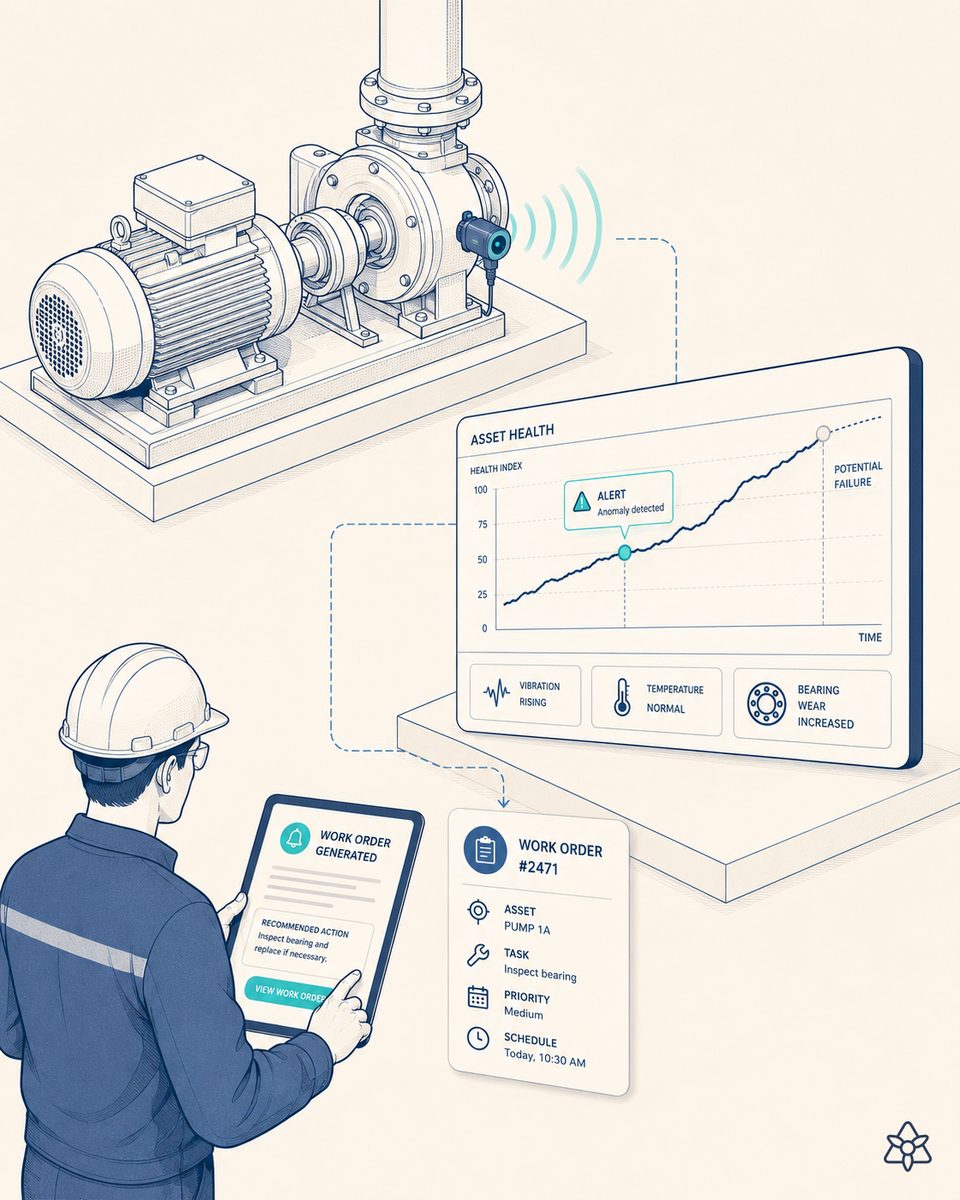
The palletizer's warning arrives late because nobody compares shifts.
The beverage end-of-line palletizer has been working without complaint for years. It builds its pallet, it does the format changeover, and nobody looks at it until one Friday at 19:40, with two trucks waiting, the drive alarm trips and an axis stops moving. What happened could have been read two days earlier — but the mimic only shows the snapshot of the moment:
- The loaded-axis current had already been rising a stable step shift after shift on the same format — a clear symptom of a bearing, a misaligned axis or a gearbox asking for service.
- The cadence of the line upstream (filler, labeller) changed subtly — more small micro-stops, a jumpier burst of bottles — and forced the palletizer to work flat out for days.
- Last week's SKU changeover introduced a taller, heavier format, and nobody retrained the drive alarm for the new profile.
The classic system (drive alarm + monthly maintenance check) works 99% of the time. That 1% is Friday at 19:40 — and it translates into maintenance team overtime, a shipment that does not leave, and a salesperson facing the customer the next day. It is not a lack of maintenance; it is a lack of criteria in time.
iLEAN Edge does not add another dashboard — it seals the crack between the drive, the cadence MES and the production plan.
The piece that solves the pain is iLEAN Edge: a physical terminal in the palletizer's cabinet that reads the loaded-axis motor current the way a maintenance manager who walks the line every day would read it. It carries a neural network trained on the normal current signature per format and SKU, and cross-checks it in real time with the cadence arriving from upstream.
Edge sees the palletizer's current. Connect reads the production plan and the SKU changeover wherever it lives. The agent cross-checks the drift with the available maintenance window and hands it to the shift manager. The person signs — the palletizer does not stop by itself.
The three iLEAN pieces applied to the palletizer's motor current:
- Edge — a terminal in the palletizer's cabinet, reading RMS current, active power and estimated torque of the loaded axis. The CNN learns the normal signature per format and per SKU, not a fixed threshold. When the signature rises a stable step over several shifts, it raises a warning. It works with no network: if the plant loses WiFi, Edge keeps watching the current and recording the ramp, because what is critical cannot depend on WiFi.
- Connect — captures the production plan and the SKU changeover whether it comes from the ERP, the MES, or a spreadsheet the planning manager updates in the morning. It also captures the filler micro-stop upstream, the email from the new format's supplier and last week's message from the maintenance manager with the observation nobody turned into a work order.
- Agent — cross-checks the current ramp with the scheduled maintenance window, the SKU changeover in the plan and the team's availability. It proposes to the shift manager: “there is a 35-minute window at 17:30 between formats to inspect the axis, it avoids a stop at tomorrow's closing”. The manager signs. The system does not stop the palletizer on its own — except where the management team decides to raise autonomy.
Palletizer with a drive alarm vs. palletizer with iLEAN Edge on the motor current
| Aspect | Drive + monthly check | With iLEAN Edge on the palletizer current |
|---|---|---|
| Signal that triggers the reaction | Fixed drive threshold, the same for every format | Learned current signature per format and SKU |
| Warning horizon | Only when drift is already severe — minutes before stopping | Days earlier — the slow ramp is visible when it starts |
| Shift-to-shift comparison | Does not exist, except in the veteran manager's head | Edge keeps it always, per format and product |
| Production plan cross-checked | No — maintenance is planned separately | The agent proposes real windows from the plan |
| Operation with no network | Local alarm yes, context no | Edge keeps watching the current with the cabinet's power |
| Post-incident dossier | Rebuilt by hand | Current ramp, decisions and human signatures, automatic |
Impact estimate for your plant — to be validated with your numbers.
The block below is an estimate to be validated with your plant's actual data. We lay it out so the committee has an order of magnitude; we refine it during the diagnostic.
- Beverage bottling plant (water, soft drinks, beer, wine) with 1-3 lines and a multi-format end-of-line robot palletizer, with one or two stop incidents from a late alarm per quarter.
- Edge pilot on the palletizer (clamp-on current sensor + integration with the drive, the cadence MES and the production plan). First expected value in a few weeks: detection of the current ramp days before the drive threshold.
- Indicative payback between 4 and 9 months, depending on the frequency of documented incidents and the average cost of a stop at the end of shift (lost shipment + overtime + unfinished format).
- Expected reduction in stops from a late palletizer alarm of ≥ 30% in the first year, depending on the maturity of the maintenance plan. The hard lever is a single shipment saved — it pays for the pilot.
And the plant manager's reasonable doubt
“What if the AI invents a ramp that does not exist and makes me stop the palletizer for no reason?” — the proposal does not execute itself. iLEAN works on anchored tasks: it reads a physical signal that exists (current) and compares it with the product's learned signature. On anchored tasks, the best models brought error below 1.5% [1]. And even so, the shift manager sees the ramp, sees the proposal, and signs. The palletizer does not stop by itself — except where the management team configures it.
[1] OpenAI paper “Why Language Models Hallucinate”, 2025 — on the reliability of AI in anchored tasks.
What people ask about palletizer motor current in beverage
Why does the palletizer go down right at the end of the shift on a beverage line?
Because the end of shift stacks up the worst-case scenario: taller pallets still to be closed, a format changed mid-afternoon, a gearbox that has been heating up for eight hours and a bearing on the loaded axis that started drifting two hours earlier without the plant mimic showing it. The motor current rises steadily shift after shift, but nobody compares shifts — only the snapshot of the moment is looked at. By the time the drive alarm trips, there is already a half-formed pallet, two trucks waiting and a shipment that slips to the next day.
Which signal does iLEAN Edge use to anticipate the palletizer's late alarm?
The RMS current and estimated torque of the loaded-axis motor (main z and, depending on the palletizer, the x/y approach axes) read from the drive or from a clamp-on current transformer. Edge learns the palletizer's normal current signature per format and per SKU, and cross-checks it with the cadence of the line upstream (CIP, filler, labeller). The late-alarm signature is very recognisable: peak current rises a stable step shift after shift with no format change. That is the ramp that ends in a stop — Edge sees it days before the drive does.
Why Edge on the plant floor and not the robot vendor's predictive maintenance system?
Because the vendor's predictive system looks at its own axis in isolation and often lives in the manufacturer's cloud with per-machine licences. iLEAN Edge looks at your entire line across the board — palletizer + filler + labeller + CIP — and learns the palletizer's current signature in the real context of how the bottles reach it. It lives on the plant floor, on top of the OT network, and works even if cloud connectivity drops. What is critical cannot depend on WiFi.
Does the AI stop the palletizer on its own if it sees drift?
No. iLEAN proposes — the person signs. Edge detects the drift, the agent cross-checks the current signature with shift history, production plan and format-changeover gaps, and hands the shift manager a concrete proposal: “in the SKU changeover window scheduled for 17:30 there is room to inspect the axis, it saves you stopping the line at the end of tomorrow”. The manager decides and signs. The palletizer does not stop by itself — except at criticality levels the management team configures.
How much does the pilot cost on a beverage line and when does it pay back?
The order of magnitude of an Edge pilot on an end-of-line palletizer is close to that of any Edge pilot on the plant floor: terminal + clamp-on current sensor + integration with the drive and with the MES/SCADA that holds cadence, plus an annual licence. The reasonable payback to present to the committee is several months — the hard lever is a single palletizer stop avoided at the end of shift (lost shipment, maintenance team overtime, unfinished format). We ask for your line's data and send you the estimated ROI within 48h.
More cases in ilean edge
- Multi-cavity injection mold — per-cavity hydraulic pressure keeps short shots out of scrap.iLEAN Edge closes hydraulic pressure per cavity in multi-cavity injection molds and keeps short shots…
- Edge ultrasound on wine bottling inertisation — catch the leak before the batch oxidises.iLEAN Edge with ultrasound detects the nitrogen leak in wine bottling inertisation before oxygen reaches…
- If the extractor bearing goes, the booth loses negative pressure — and the oven goes down with it.iLEAN Edge watches the PVD paint booth extractor bearing with a thermal camera: the curing oven stays up…
- Powder metallurgy compaction — parts in tolerance shift after shift, not just in the SPC sample.iLEAN Edge tracks hydraulic pressure on the powder metallurgy compaction press and keeps parts in…
- SMT reflow oven thermal profile — every PCB has its own window, not the one of the last board in.iLEAN Edge tracks the SMT reflow oven thermal profile board by board to keep every PCB inside the IPC…
- Operator presence in the risk zone of a stamping press — automatic cycle inhibit without losing rhythm.iLEAN Edge detects operator presence in the risk zone of a stamping press and blocks the cycle in…
Tell us about your case and within 48h we'll send you the estimated ROI of this AI project for your palletizer.
We work on your plant's real data, not on ours. Diagnostic with no commitment.
Request estimated ROI within 48h See iLEAN Edge