Edge ultrasound on wine bottling inertisation — catch the leak before the batch oxidises.
A nitrogen leak in the inertisation of a wine bottling line cannot be seen, smelled or heard — until the winemaker tastes the batch weeks later and the oxidative note is there. iLEAN Edge with ultrasound detects the leak the moment it happens, quantifies it, and the agent proposes stopping, watching closely or switching to the redundant line depending on how sensitive the wine in progress is. The line manager, together with the winemaker, signs the decision.
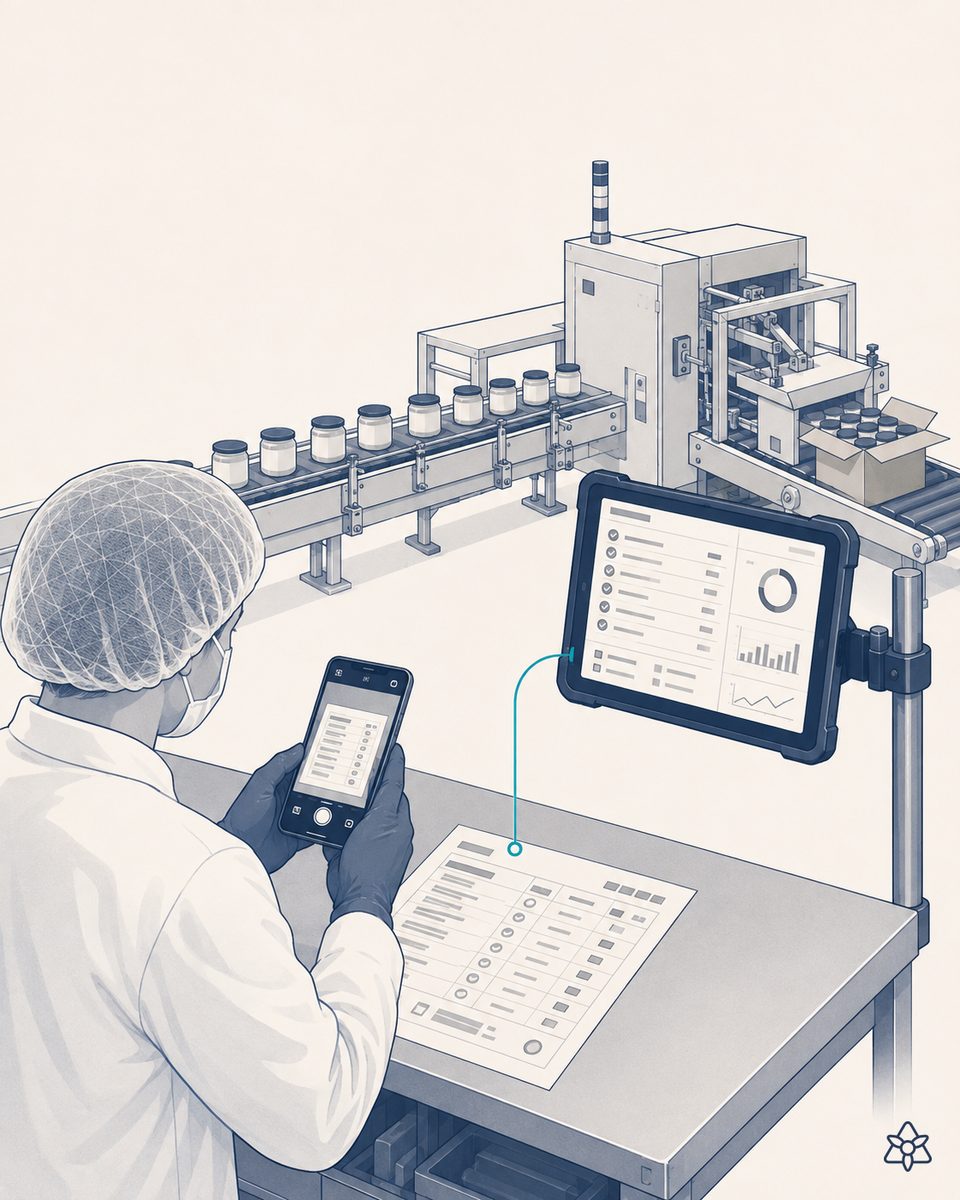
The leak cannot be seen, smelled or heard — and the batch oxidises.
Wine bottling lives obsessed with oxygen: TPO (Total Package Oxygen) decides whether the batch ages well or shows oxidative notes within four months. Nitrogen inertisation is the barrier, and the leak is the silent enemy:
- Nitrogen is distributed through hoses, quick connectors and valves at three points of the line (pre-tank sparging, jetting under the cork, headspace pressure).
- A loose hose or an old gasket creates a leak that cannot be seen, cannot be smelled and cannot be heard by ear.
- The operator notices high nitrogen consumption at the end of the shift —if they notice at all—, but by then 8,000 bottles of young white have already been bottled with dissolved O₂ off target.
- The winemaker tastes it four months later. The batch has oxidative notes. The winery absorbs it as a loss or releases it to market and pays later in brand image.
The line manager and the winemaker know this. Their people know it. What is missing is a sensor that sees the leak the moment it happens and an agent that decides whether that specific wine can take it or not — because a premium young white is not the same as an aged red with high free sulphur. The veteran winemaker's knowledge about which wines are sensitive and which are not does not digitise itself.
iLEAN Edge does not replace the winemaker — it gives them the data they could never have in real time.
The nitrogen problem is not a lack of investment in inertisation: premium wineries have been investing in jetting, vacuum and headspace pressure for years. What is missing is a layer that sees the leak at second zero and cross-references it with the sensitivity of the batch in progress. iLEAN is that filler that closes what the bottling line SCADA, the winery MES and the winemaker's notebook left exposed.
Edge hears the leak. Connect captures the recipe and the sensitivity of the batch. The agent cross-references and proposes. The winemaker signs. The batch does not oxidise.
The three iLEAN pieces applied to nitrogen leaks in wine bottling:
- Edge — terminal with ultrasonic sensor mounted fixed over the inertisation area (quick connectors, critical valves) or portable for start-of-batch inspection. A CNN trained to tell a real nitrogen leak signature from the normal noise of the bottling line, estimate the flow rate and map the point. Works with no network: it keeps looking and alerting through the panel light.
- Connect — captures from inside the wine recipe held in the winery MES (young/aged/reserve, free sulphur, pH), the historical nitrogen consumption per batch and the data from the inertisation head itself. And it captures from outside the winemaker's note on which whites are extra-sensitive this harvest, the importer's email with their maximum TPO threshold, the maintenance manager's WhatsApp about the hose replaced last week.
- Agent — cross-references the detected leak with the sensitivity of the batch in progress and proposes a decision: watch closely (small leak on a non-sensitive batch), stop and repair (moderate leak on a premium young white), switch to the redundant line (large leak with a high-value batch in progress). The line manager, usually together with the winemaker, signs. The line does not restart by itself on a critical batch.
Inertisation by ear vs. inertisation with Edge leak mapping
| Aspect | Classic bottling | With iLEAN Edge ultrasound |
|---|---|---|
| Leak detection | High consumption at the end of the shift, if spotted | The moment it happens, at the inertisation head |
| Decision per batch | Fixed rules — every batch treated the same | Cross-referenced with the sensitivity of the wine in progress |
| Expected TPO | Random within a wide range | Under control, with an alarm if the leak compromises it |
| Oxidation detection | Winemaker's tasting, weeks later | Anticipated at the moment of bottling |
| Winemaker's knowledge | In their notebook and their nose | Captured as an agent rule |
| Operation with no network | n/a | Edge keeps alerting through the panel light |
Impact estimate for your plant — to be validated with your numbers.
The block below is an estimate to be validated with the actual data of your winery. We set it out so the committee has an order of magnitude; we refine it during the diagnostic.
- Mid-sized winery with 1-2 bottling lines, full nitrogen inertisation (sparging + jetting + headspace), a mixed portfolio (premium young whites + aged + reserve) with very different sensitivity to O₂.
- Edge pilot on the main line + integration with the winery MES and the nitrogen head SCADA. First value expected within a few weeks: the first leak map and the first agent decisions validated by the winemaker.
- Indicative payback between 4 and 9 months, assuming the cost of historical losses and returns due to oxidation.
- Expected reduction of off-target TPO incidents ≥ 30% against baseline over the first full campaign.
- Hard lever: a single batch of premium young white saved from oxidation pays for the pilot comfortably. And you avoid the damage to brand image, which never shows on an invoice but weighs more in the medium term.
And the winemaker's reasonable doubt
«What if the AI stops my line on a batch that was running fine?» — hallucination is a problem of free generation, not of anchored tasks. On tasks where the AI limits itself to reading an ultrasonic sensor, classifying the signature and cross-referencing it with the sensitivity of the batch, the best models brought error below 1.5% [1]. And even so, what is critical is never decided alone: iLEAN proposes, the winemaker or the line manager signs. On non-sensitive batches the agent can operate with self-approval; on premium young whites, human validation is mandatory. The sensitivity of the wine decides the sensitivity of the system.
[1] OpenAI paper «Why Language Models Hallucinate», 2025 — on the reliability of AI in anchored tasks.
What people ask about Edge ultrasound for nitrogen leaks in wine bottling
Why does nitrogen inertisation matter so much in a wine bottling line?
In wine bottling, dissolved oxygen (TPO, Total Package Oxygen) is one of the few parameters that decides whether the bottle ages well or the batch oxidises within months. Nitrogen inertisation —sparging in the pre-tank, jetting into the neck before corking, headspace pressure— keeps oxygen out. A nitrogen leak on a line (hose, quick connector, worn valve) means more O₂ entering the batch and, weeks later, oxidative notes the winemaker detects when it is already too late.
How does ultrasound detect a nitrogen leak that the nose cannot?
Nitrogen is inert, odourless and invisible. A leak on the line generates the same ultrasonic signature as any pressurised gas (20-100 kHz, high-frequency turbulence). iLEAN Edge integrates an ultrasonic sensor that locates the source, estimates the leak flow rate and translates it into real nitrogen cost and, most relevant of all, into TPO risk for the batch in progress. The winemaker's nose confirms it weeks later — the sensor confirms it in seconds.
What does iLEAN do when it detects a leak during bottling?
Edge fires an alert to the line panel and to the line manager's phone with the location and the criticality. The agent cross-references the leak with the wine recipe (a young white is more sensitive than an aged red), the batch phase (just before corking is more critical than the initial sparging) and proposes: carry on under close watch, stop and repair, or switch to the redundant line. The person —the line manager, usually together with the winemaker— signs the decision. The line does not stop by itself during a critical batch changeover.
Does Edge leak mapping work with the bottling line at full throughput?
Yes. Ultrasound (20-100 kHz) sits outside the audible range and above practically all the mechanical noise of the bottling line (conveyors, cappers, cork controls). The trained CNN filters real leak signatures from the normal turbulence of the process. And because Edge is a physical terminal on the line, it keeps working if the plant loses WiFi: what is critical cannot depend on connectivity when the batch in progress is 8,000 bottles of a young white.
How much does an Edge ultrasound pilot cost in a wine bottling plant?
The order of magnitude of an Edge pilot in a bottling plant is comparable to any Edge pilot in a food and beverage plant: an initial investment covering the terminal with ultrasonic sensor + integration with the bottling line SCADA and the MES + annual licence. Payback is measured in a few months because the hard lever is a single batch saved from oxidation: any premium white batch pays for the pilot comfortably. We run the ROI with your winery's data in 48h.
More cases in ilean edge
- Microelectronics cleanroom humidity — one sensor out of band, one thin board into rework.iLEAN Edge tracks microelectronics cleanroom humidity cell by cell to prevent ESD and rework on thin…
- Muffle furnace temperature in steel tempering — hardness is not prayed for, it is measured and signed.iLEAN Edge tracks muffle furnace temperature in steel tempering and leaves the tempering curve auditable…
- Multi-cavity injection mold — per-cavity hydraulic pressure keeps short shots out of scrap.iLEAN Edge closes hydraulic pressure per cavity in multi-cavity injection molds and keeps short shots…
- If the extractor bearing goes, the booth loses negative pressure — and the oven goes down with it.iLEAN Edge watches the PVD paint booth extractor bearing with a thermal camera: the curing oven stays up…
- Beverage end-of-line palletizer — the shift ends with no stop because the motor current warned days earlier.iLEAN Edge reads the motor current of the beverage end-of-line palletizer and warns before the late…
- Powder metallurgy compaction — parts in tolerance shift after shift, not just in the SPC sample.iLEAN Edge tracks hydraulic pressure on the powder metallurgy compaction press and keeps parts in…
Tell us about your case and within 48h we'll send you the estimated ROI of this AI project for your bottling line.
We work on the real data of your winery, not on ours. Diagnostic with no commitment.
Request estimated ROI in 48h See iLEAN Edge