Microelectronics cleanroom humidity — one sensor out of band, one thin board into rework.
Humidity out of band in a microelectronics cleanroom is ESD waiting to happen, and ESD on thin boards is rework when the board survives it and scrap when it does not. iLEAN Edge tracks humidity cell by cell, cross-checks it with airlock openings and occupancy, and warns before the next tray goes through. The person signs.
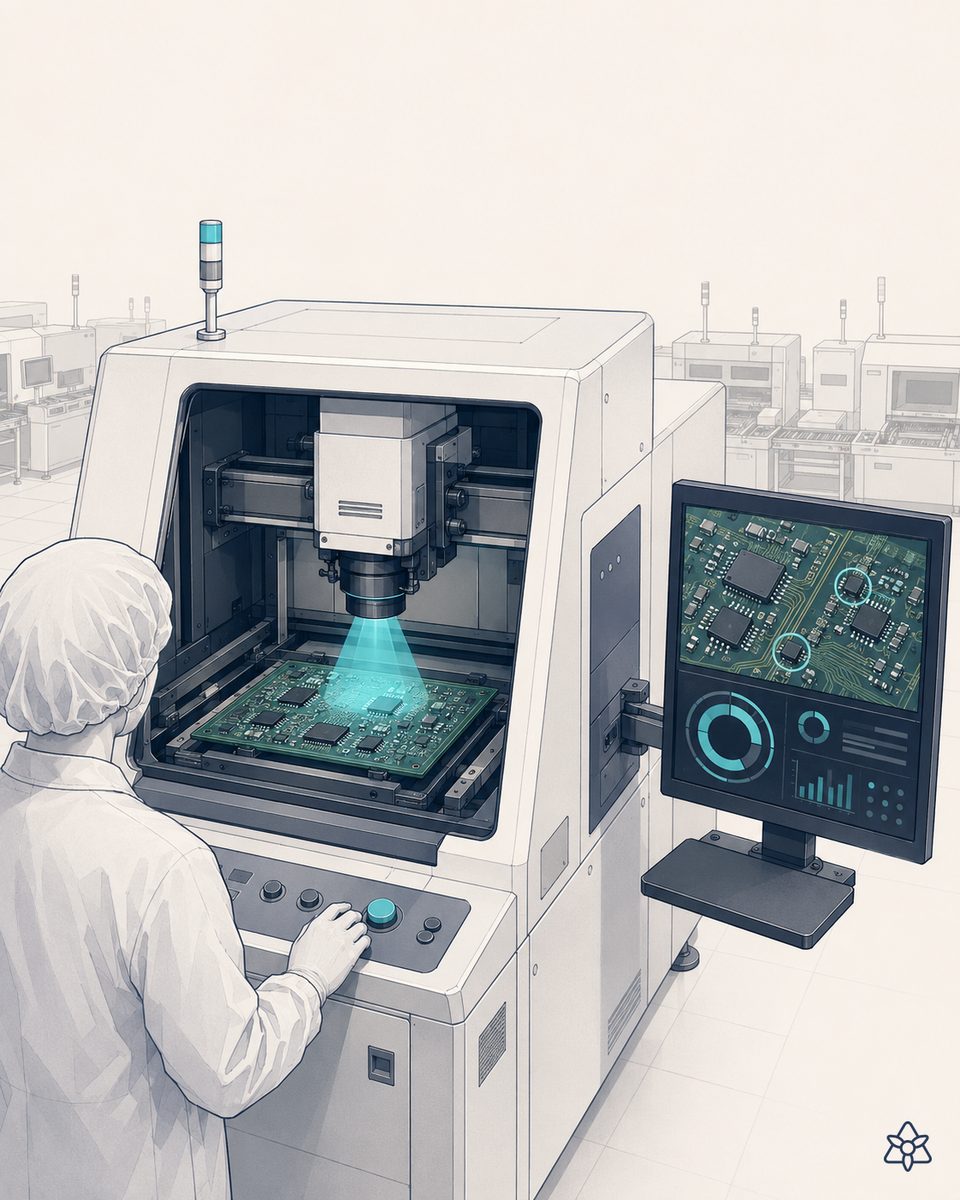
The cleanroom is not uniform: the humidity that matters is the humidity at the station.
In a microelectronics cleanroom, relative humidity is not a room-level parameter — it is a map that shifts with every airlock opening, every shift change, every dry winter day. The band recommended by the process standard (typically between 30 and 60 % RH depending on the sector) protects against ESD; dropping below it at the station sitting next to the air return means an ordinary operator movement is enough to damage a BGA. And the symptom does not show up in the room: it shows up as a field failure weeks later.
- What happens inside the room — humidity per cell, airlock openings, occupancy, ventilation. The BMS handles them separately and rarely cross-checks them station by station.
- What comes into the room — the world outside (dry winter days), the SKU changeover from the MES, the shift change. Data that never reaches the BMS.
- What leaves the room — thin boards heading to integration, BGAs that have to survive the field. And the cost of a hidden ESD is invisible until the first customer failure.
The process engineer knows this — but an average-humidity dashboard does not protect the critical SMT station. What is critical is the drift per cell, the one you notice once there are already trays full of suspect components.
iLEAN does not replace the BMS — it seals the cracks between the air, the station and the batch.
The cleanroom humidity problem is not a lack of HVAC control: it is that the per-cell humidity reading, the airlock event, the SKU changeover and the criticality of the process live on islands and nobody cross-checks all four before the next tray goes through. iLEAN acts as the filler that closes those gaps, without asking you to change your BMS or your MES.
Edge sees humidity cell by cell every second. Connect reads the events from the BMS, from access control and from the MES. The agent cross-checks them against SKU criticality and, if humidity goes out of band in the critical cell, it holds the line until the supervisor signs.
The three iLEAN pieces applied to the microelectronics cleanroom:
- Edge — a terminal integrating hygrometers distributed cell by cell and station by station across SMT. It reads humidity and temperature every second, raises an alert when the critical cell goes out of band and, if the SKU demands it, holds the next tray. It works with no network. If the BMS goes down, Edge keeps reading and keeps holding with the panel light.
- Connect — captures the events from the BMS and from access control (every airlock opening, every entry of personnel), the SKU changeover orders from the MES and, from outside, the weather report (dry winter days are the difficult ones). And it captures the process engineer's knowledge — the mental rule about which cell is the first to drift when a maintenance crew walks in.
- Agent — cross-checks humidity, events, occupancy and SKU criticality. If the critical cell goes out of band on a critical tray, it holds the line and alerts the supervisor. And it leaves an automatic dossier every shift with the real humidity, the events and the signatures: the batch file for the auditor.
Humidity by dashboard vs. humidity cell by cell with iLEAN
| Aspect | BMS + room dashboard | With iLEAN Edge + Connect + Agent |
|---|---|---|
| Granularity | One central reading per room | One reading per cell, with gradient |
| Reaction to drift | Dashboard alert to the process engineer | Tray held at the critical cell |
| Cross-check with airlock/occupancy | In separate heads | Cross-checked by the agent, in line |
| Detection of potential ESD | By inference after the failure | Before the next tray goes through |
| Batch file | Daily averages in a PDF | Automatic dossier with evidence per tray |
| Operation without BMS | n/a | Edge keeps reading and holding with the panel light |
Impact estimate for your plant — to be validated with your numbers.
The block below is an estimate to be validated with the specific data from your cleanroom. We put it forward so the committee has an order of magnitude; we refine it during the diagnostic.
- ISO 7 cleanroom with SMT lines and manual inspection areas, dry peaks in winter and frequent SKU changeovers.
- Edge pilot over the cleanroom (hygrometers distributed cell by cell + integration with BMS and MES + automatic per-batch dossier). First value expected within a few weeks.
- Reduction of rework from suspected ESD ≥ 30 % on the recurring incident (the other failure modes remain a matter of design and process).
- Indicative payback between 4 and 9 months, depending on the frequency of ESD-driven rework and the average cost of reworking / of a field failure discovered late.
- The hard lever: a single critical batch avoided pays for a good part of the pilot.
And the IT director's reasonable doubt
«What if the AI holds trays that were fine and patches over our productivity?» — hallucination is a problem of free generation, not of anchored tasks. On tasks where the AI simply cross-checks a measured reading against the standard band for that station, the best models brought error below 1.5 % [1]. And even so, what is critical is never decided alone: iLEAN holds and the supervisor signs. The three safety rings are there for exactly this.
[1] OpenAI paper «Why Language Models Hallucinate», 2025 — on the reliability of AI in anchored tasks.
What people ask about microelectronics cleanroom humidity
Why does cleanroom humidity govern ESD risk?
Because relative humidity sets how much static charge a body, a gown or a surface can build up in the room. Below the humidity band recommended by the process standard, the static electricity generated by an ordinary movement becomes enough to damage sensitive components. And on thin boards with BGA and 0201 components that damage is invisible to the naked eye — it shows up as a field failure weeks later.
Why isn't a single sensor in the middle of the room enough?
Because cleanroom humidity is not uniform: airlock openings, occupancy, the position of the diffusers and the activity at each station create micro-climates. A central reading gives you an average that is right on average and wrong for the SMT station sitting right in front of the air return. Fine control requires measuring cell by cell and seeing the gradient, not the average.
How does iLEAN Edge cross-check humidity with airlock openings, occupancy and ventilation?
Edge integrates hygrometers distributed cell by cell and connects to the room BMS. Connect reads airlock opening and floor-change events from the access control system, and captures from outside the external weather report (dry winter days) and the SKU changeover orders from the MES. The agent cross-checks the three sources and, if humidity in a cell drops before the next tray goes through, it holds the line and alerts the supervisor.
How does Edge fit the batch file for the defence or aero electronics auditor?
For every tray and every shift, the iLEAN agent leaves an automatic dossier with the real humidity per cell, the airlock openings, the BMS events, the supervisor's actions and the human signature. It is the «batch file for the auditor» that defence, aero or medical electronics expects to see: traceability of environmental conditions backed by evidence, not by a PDF of daily averages.
What does an Edge cost in a microelectronics cleanroom?
An order of magnitude close to an Edge in a high-criticality electronics plant: an initial investment covering terminal + distributed hygrometers + integration with BMS and MES, plus an annual licence. A reasonable payback to present to the committee is several months — the hard lever is the rework avoided from ESD and the cost of field failures discovered late. Send us your cleanroom data and we will get you the estimated ROI within 48h.
More cases in ilean edge
- Tanning bath pH — a uniform leather batch should not depend on which shift walks in.iLEAN Edge measures tanning bath pH in the tannery drum and keeps the leather batch uniform across…
- The transfer lobe pump jams halfway through the recipe — and the batch is left hanging on the stuffer.iLEAN Edge reads the vibration of the lobe pump transferring viscous meat batter in cured meat plants to…
- Magnetic flow meter in reagent dosing — discharge is adjusted in the reactor, not at the inspection.iLEAN Edge reads reagent magnetic flow in industrial wastewater plants and holds over-dosing before…
- Muffle furnace temperature in steel tempering — hardness is not prayed for, it is measured and signed.iLEAN Edge tracks muffle furnace temperature in steel tempering and leaves the tempering curve auditable…
- Multi-cavity injection mold — per-cavity hydraulic pressure keeps short shots out of scrap.iLEAN Edge closes hydraulic pressure per cavity in multi-cavity injection molds and keeps short shots…
- Edge ultrasound on wine bottling inertisation — catch the leak before the batch oxidises.iLEAN Edge with ultrasound detects the nitrogen leak in wine bottling inertisation before oxygen reaches…
Tell us your case and within 48h we will send you the estimated ROI of this AI project for your cleanroom.
We work on the real data from your cleanroom, not on ours. Diagnostic with no commitment.
Request estimated ROI within 48h See iLEAN Edge