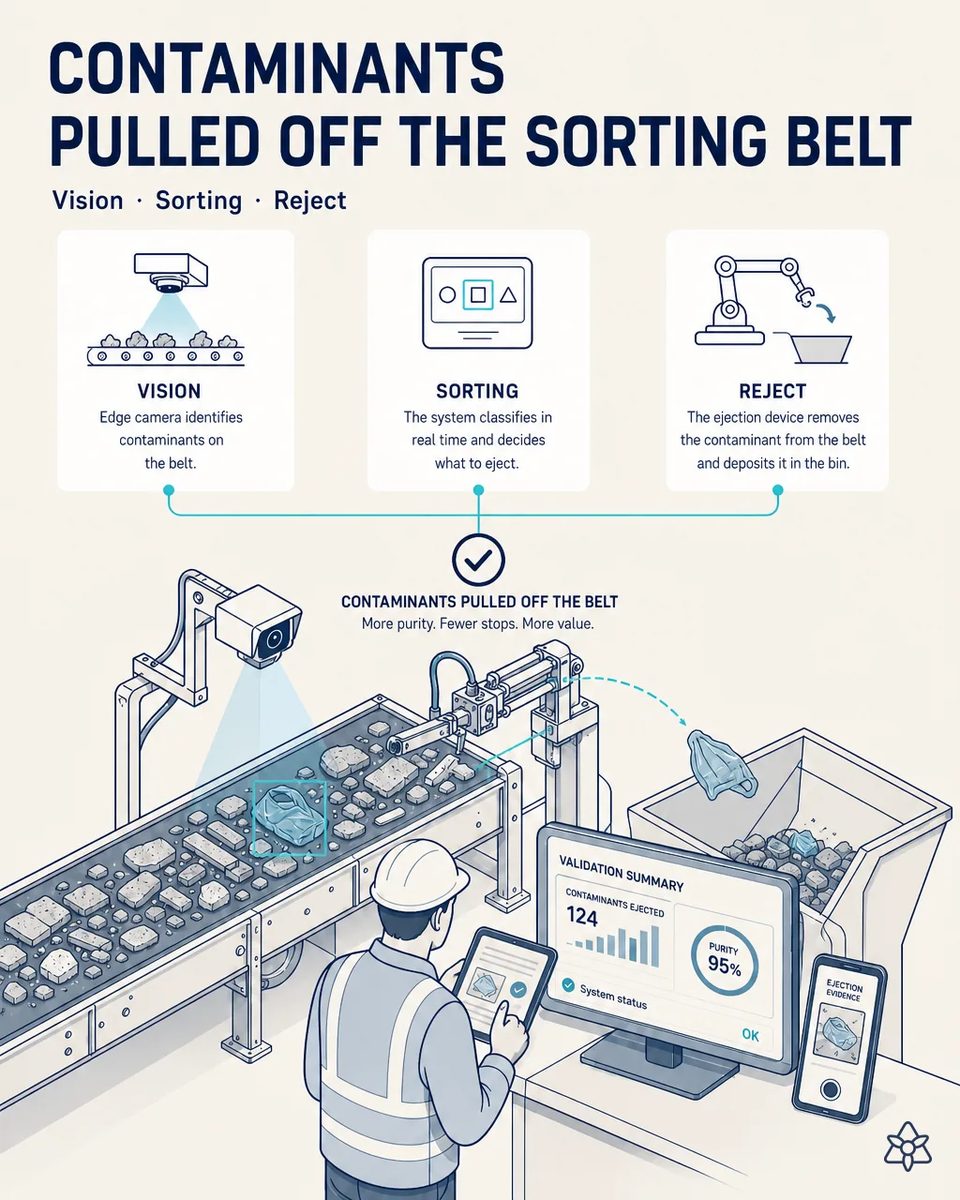
Contaminants pulled off the sorting belt
At the sorting belt's pace, the human eye lets contaminants slip through to the crusher. iLEAN Edge places a camera over the belt and infers in milliseconds to reject them beforehand.
The picking cabin cannot see everything the belt carries.
Fully manual sorting is impossible to do without gaps at the belt's real pace. Partial visual sampling leaves holes that translate into lower-quality aggregate, and contaminants (plastic, wood, plaster) can make an entire batch fail the required grading.
- In the picking cabin, sorters pull wood, plastic, gypsum and metal off the belt by hand. At the belt's real pace, that is sampling, not sorting.
- What slips through goes straight to the crusher and ends up inside the recycled aggregate, where it can no longer be separated. The crusher turns a removable piece of wood into fines that stay in the product.
- Gypsum is the most treacherous: a few kilos of gypsum or wood are enough for a whole batch to fail the required grading and contaminant limits, and be downgraded or sent to landfill, with the gate fee paid on top of the lost sale.
- And the sorters' attention drops over the shift, exactly when the heaviest mixed loads tend to arrive. Nobody blames the sorters; the pace is simply beyond the human eye.
Edge — local vision over the sorting belt, inferring per segment in milliseconds.
Edge: local CNN vision, with no need to send images to the cloud (latency, cost, bandwidth), trained on the plant's own waste flow. It infers per belt segment and flags or rejects the contaminant before it reaches the crusher.
Inference runs at the plant, in a box next to the belt, not in the cloud: no latency, no bandwidth bill, no dependence on the yard's network. The model is trained on your own waste flow, so it knows your concrete, your brick and your contaminants. Every reject is logged against its batch, so the contaminant count is no longer an estimate.
Picking by eye versus Edge vision ahead of the crusher
| Aspect | Today | With iLEAN Edge |
|---|---|---|
| Share of the flow inspected | Partial, depends on the sorters | 100% of the belt |
| Wood and plastic film | Missed when the belt is loaded | Flagged per segment |
| Gypsum and plaster fragments | Hard to tell from mortar | Classified by texture and color |
| Where it is caught | After the crusher, in the batch | Before the crusher |
| Batches rejected for impurities | A recurring loss | Drastically fewer |
| Images sent to the cloud at a C&D recycling plant | — | None: inference on site |
Partial visual sampling → continuous control over 100% of the belt's flow. Aggregate batches rejected for impurities → drastic reduction.
Impact estimate — to be validated with your volume and aggregate price.
The block below is an estimate to be validated against your plant's actual data. We put it forward so the committee has an order of magnitude; we refine it during the assessment.
- Estimated payback 5-12 months, depending on processed volume and the sale price of the aggregate, which sets what every degraded batch costs.
- Fewer recycled aggregate batches degraded or rejected for impurities, which is where most of the value sits.
- Continuous control over 100% of the belt's flow instead of partial visual sampling, with a contaminant count logged per batch.
- And the sorters' attention goes to the borderline cases the camera escalates, not to everything that passes.
Estimated payback 5-12 months depending on processed volume and aggregate sale price, fewer degraded batches. *Estimate to validate*.
And the fair question from the production manager
“What if it rejects good concrete?” — the false positive is the real risk, which is why the model is trained on your own waste flow and lighting, not on a generic catalog. Telling plastic film or wood from mineral material is a well-bounded visual task — the same kind of anchored problem where the best models drop below 1.5% error [1] — and uncertain objects, the ones the model is not sure about, are flagged to the cabin instead of being ejected. Every decision, right or wrong, feeds the next training round.
[1] OpenAI paper "Why Language Models Hallucinate", 2025 — on the reliability of AI in anchored tasks.
What people ask about vision on the sorting belt
Does it replace the sorters in the picking cabin?
No. It takes the bulk of the obvious contaminants and leaves the sorters the borderline cases, which is where their judgment is worth most. The cabin keeps its crew; what changes is what reaches them.
Does it work with the dust of a C&D plant?
The housing and lighting are designed for it, and the model is trained with dusty images from your own belt, not clean lab samples. A periodic lens clean is part of the routine maintenance.
Can it tell gypsum from mortar?
It is one of the classes trained explicitly, because gypsum is the contaminant that most often makes a batch fail. Texture and color separate them where the eye hesitates. Doubtful fragments are flagged rather than rejected.
Does it need an ejector, or can it just flag?
Both work, and the choice is yours. Many plants start with a flag on the cabin screen and add an air jet or a pusher once they trust the results. The flag alone already gives the contaminant count per batch.
What happens when the incoming waste changes?
The model is retrained with the new flow; images from the plant feed that retraining, so it improves with the mix you actually receive. A new contractor with an unusual flow is the typical trigger.
More cases from this series
- Site or carrier alert in secondsA contractor's WhatsApp message or a carrier's email warning of a critical change reaches one person who…
- The delivery note that self-loadsThe weighbridge operator photographs the carrier's delivery note and the waste identification form…
- Foreman's hands-free headsetThe plant supervisor spends the whole day walking between sorting, mobile plants and the landfill with…
- Photo of the weighbridge intake formEvery truck entering a C&D waste plant carries a hand-filled waste identification form. That paper…
- The aggregate quality Excel flies to ERPThe quality manager fills in a spreadsheet every batch with grading, contaminant and moisture data for…
- Validate in two taps at the scaleNothing iLEAN captures enters the central system before a human has seen it. In the scale booth, a…
Tell us how many aggregate batches you downgraded last quarter for impurities.
We work on your plant's real data, not ours. Assessment with no commitment.
Request estimated ROI within 48h ‹ See all cases of C&D waste recycling See waste and recycling