Validate in two taps at the scale
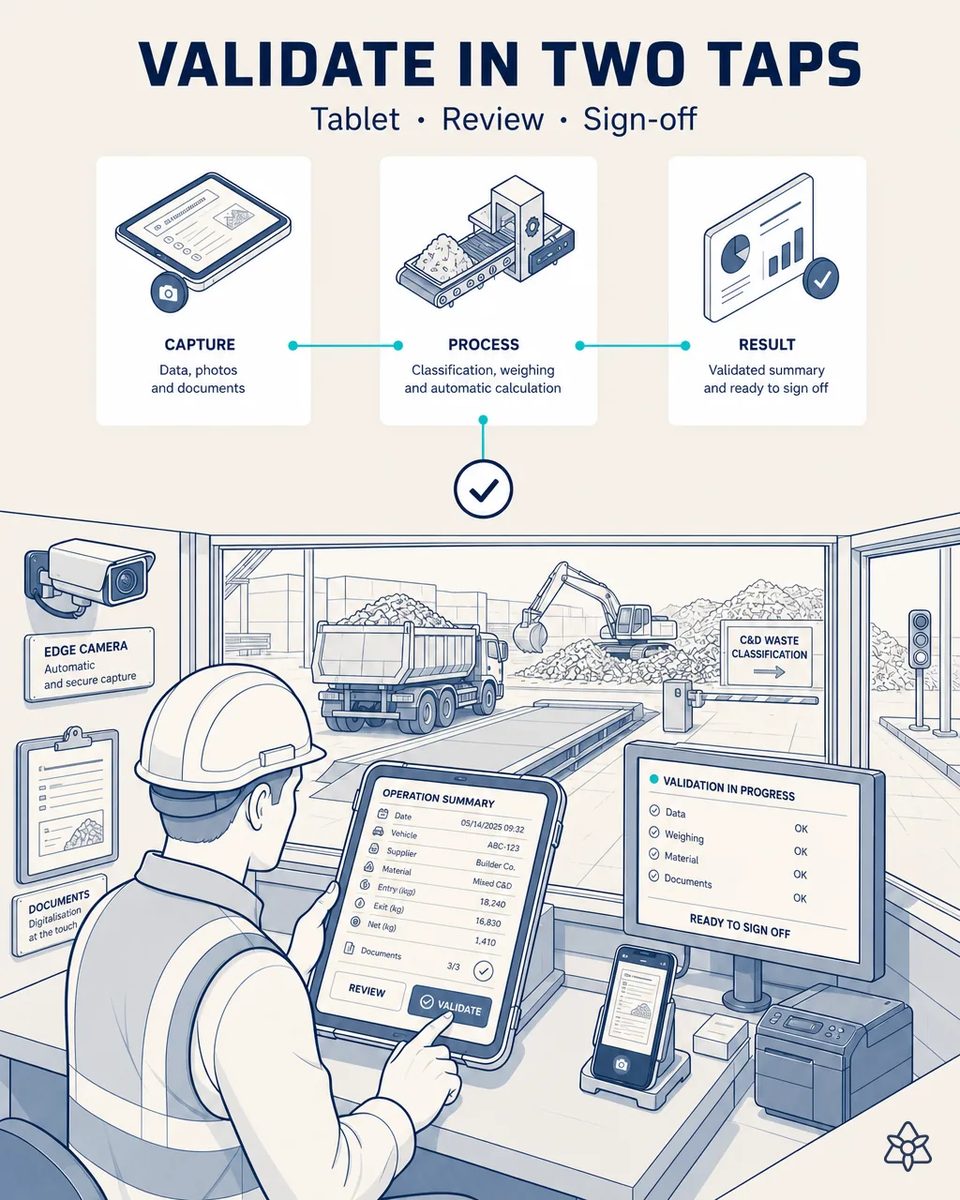
Nothing iLEAN captures enters the central system before a human has seen it. In the scale booth, a tablet shows a visual summary of every capture and the operator confirms with two taps.
The fear is reasonable, and so is the queue.
The fear that AI will 'classify the waste on its own and someone will have to fix the record during an inspection' is the main cultural brake on digitizing the scale. But the operator doesn't want to type while weighing a queue of trucks either.
- The main brake on digitizing the scale is cultural: the fear that the AI classifies the waste on its own and someone has to fix the record in front of an inspector.
- That fear is well founded. A wrong waste code in the record is not a typo; it is a traceability gap with the authorization at stake, and the operator knows it better than anyone.
- At the same time, the operator cannot type while weighing a queue of trucks, so data either goes in unchecked or does not go in at all.
- At the end of a long shift, neither option is a real choice. Both outcomes contaminate the record: unvalidated data, or data never captured out of distrust. Either way, the inspector ends up looking at a record nobody can vouch for.
Connect with early human verification — two taps in the scale booth.
Connect's early human-verification mode: every capture (form photo, scale panel, voice, parsed email) arrives on the tablet as a two-second visual summary. The operator confirms with two taps (✓ enters the record / ✏️ correct before it enters).
It is the piece that makes the other eleven approvable: no waste manager signs off on an AI writing alone into the record the authorization depends on. Here, every datum enters with the name of the person who saw the truck. That is what turns the AI from a risk to the authorization into evidence for it.
Data entering the waste record, unchecked versus confirmed
| Aspect | Today | With iLEAN Connect |
|---|---|---|
| What reaches the record | Whatever was typed, or nothing | Only what the operator confirmed |
| Time per capture | Minutes at the keyboard | Two seconds, two taps |
| A wrong waste code | Found at inspection | Corrected before it enters |
| Author of each entry | Whoever typed it later | Whoever saw the truck |
| Captures it covers | — | Form photo, scale panel, voice and alerts |
| What happens to a correction | Lost | Stored and fed back to extraction |
Unvalidated data contaminating the record, or data not captured due to distrust → captured and verified data with seconds of latency, clean record.
Impact estimate — the enabling piece of the whole matrix.
The block below is an estimate to be validated against your plant's actual data. We put it forward so the committee has an order of magnitude; we refine it during the assessment.
- No standalone payback: this is an enabling piece. Its value is strategic and not directly monetizable, so we do not put a number on it.
- Without it, the other cases do not get signed off by the plant manager or by whoever answers to the authority: it is what guarantees the waste record is not contaminated by an unchecked extraction.
- The record goes from unvalidated or missing data to captured and verified data with seconds of latency, instead of hours or never.
- And every correction made by the operator stays as a trail, which is exactly what an inspector asks to see when a record is questioned months later.
Enabling piece for the whole iLEAN matrix — without it, the other pieces don't get signed off. *Strategic value, not directly monetizable*.
And the fair question from the production manager
“If the operator confirms everything anyway, what does the AI save?” — the assembling, not the deciding. Reading an intake form or a weighbridge display is an anchored task where the best models drop below 1.5% error [1], so the summary arrives already built and the operator only confirms or corrects it. Without the tablet, that same person would be typing every field while the queue grows. And every correction is stored, so the system learns exactly where its extraction fails.
[1] OpenAI paper "Why Language Models Hallucinate", 2025 — on the reliability of AI in anchored tasks.
What people ask about two-tap validation at the scale
How long does it take per truck?
About two seconds per capture, even with gloves on: the summary arrives with plate, waste code and weight already filled in, and the operator taps confirm or correct. The queue at the barrier does not notice it.
Can the AI classify a load on its own?
No, and it is not a setting that can be switched on: it is the architecture. Nothing enters the record before a person confirms it, whatever the capture channel.
What does the tablet show for a weighing?
Plate, gross, tare and net, matched to the intake form. If the declared waste code and the weighing do not belong to the same truck, it says so. That mismatch is exactly the gap an inspector would find months later.
Does the plant manager have to validate everything?
No. The operator confirms routine captures; only loads flagged as outside the authorization escalate to the plant manager. That keeps the manager's attention on the few decisions that need it.
What is recorded when someone corrects a field?
The original extraction, the correction, who made it and when. It is a trail for the inspection and feedback so extraction improves on that form model. Over the weeks, the same correction stops being needed.
More cases from this series
- Site or carrier alert in secondsA contractor's WhatsApp message or a carrier's email warning of a critical change reaches one person who…
- The delivery note that self-loadsThe weighbridge operator photographs the carrier's delivery note and the waste identification form…
- Foreman's hands-free headsetThe plant supervisor spends the whole day walking between sorting, mobile plants and the landfill with…
- Photo of the weighbridge intake formEvery truck entering a C&D waste plant carries a hand-filled waste identification form. That paper…
- The aggregate quality Excel flies to ERPThe quality manager fills in a spreadsheet every batch with grading, contaminant and moisture data for…
- Weighbridge stitched to ERP, no typingThe weighbridge software already exports data but stays isolated from the ERP. With iLEAN, it gets…
Tell us who types the intake data into your system today, and when.
We work on your plant's real data, not ours. Assessment with no commitment.
Request estimated ROI within 48h ‹ See all cases of C&D waste recycling See waste and recycling