The aggregate quality Excel flies to ERP
The quality manager fills in a spreadsheet every batch with grading, contaminant and moisture data for the recycled aggregate. With iLEAN Connect, that spreadsheet uploads to the ERP automatically after sign-off, freeing up licenses.
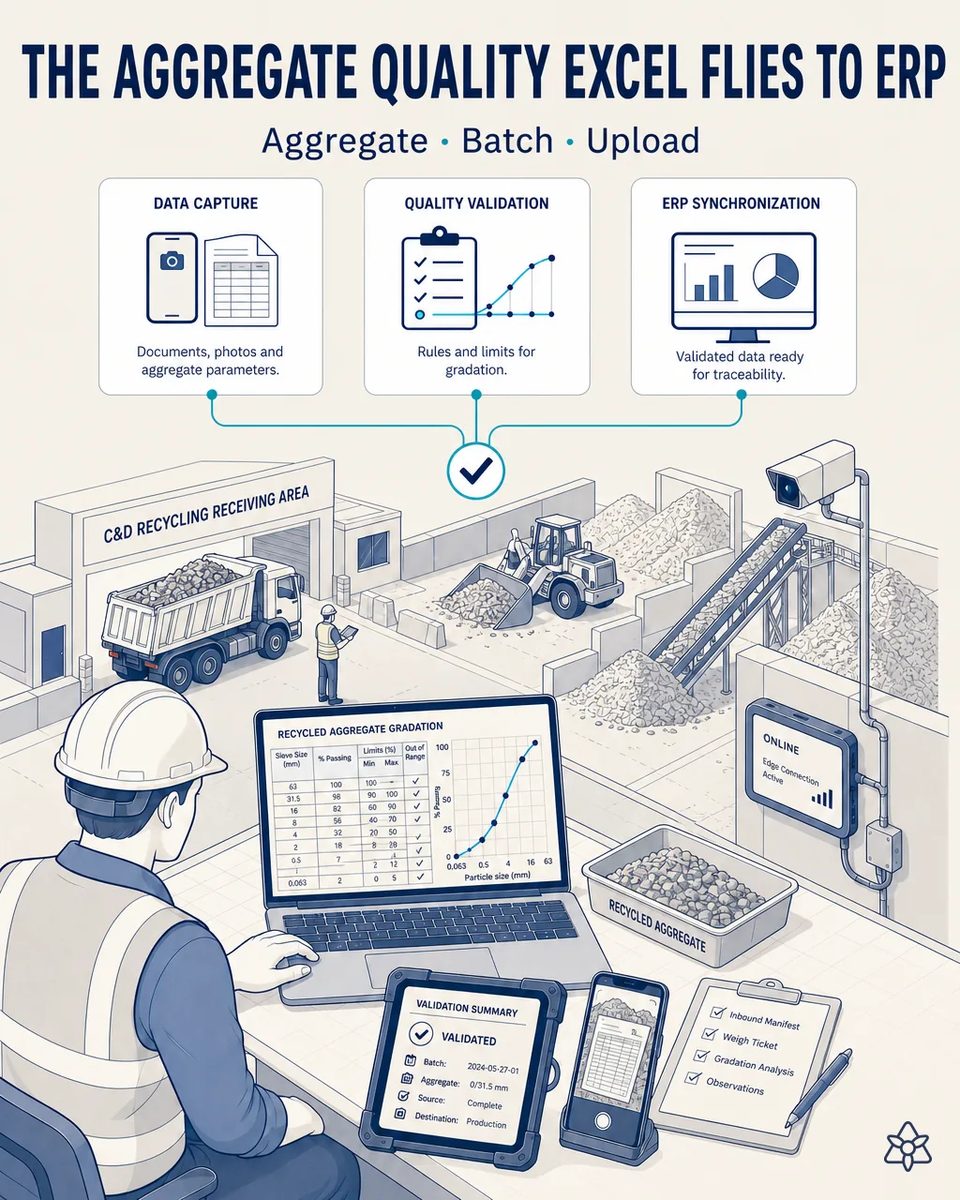
The real batch data and the official batch data live in different places.
Two parallel worlds: the real spreadsheet where every batch's live data lives, and the official ERP, with data transcribed weeks late by someone who spends hours a month copy-pasting and making mistakes.
- The quality manager logs every recycled aggregate batch in a spreadsheet: sieve-by-sieve gradation, contaminant percentage, moisture. It is the document the whole plant trusts.
- That spreadsheet is the truth. The ERP, the official system, receives the same data weeks later, typed by someone who spends hours a month copy-pasting from one window to another.
- Nobody checks the copy against the original. Copying errors go in silently, and the management certificate is issued against quality data nobody has cross-checked batch to batch.
- Meanwhile several people hold ERP licenses only to enter quality data — a cost the CFO pays every month for a typing job. Nobody budgets it as such, but it is there in the license renewal.
Connect in listen-inward mode — it watches the shared folder, not the person.
Connect's 'listen inward' mode: it watches the shared folder, not the person, reads the delta when the file is saved, parses it with an anchored LLM, validates it on screen, and uploads it to the ERP via API.
The quality manager keeps the spreadsheet that works for them. Connect reads only what changed when the file is saved, shows it on screen for sign-off and pushes it to the ERP by API, tagged with the batch and the person who signed. The spreadsheet stops being a parallel world and becomes the front door of the ERP for quality data.
The gradation sheet off to one side versus wired to the ERP
| Aspect | Today | With iLEAN Connect |
|---|---|---|
| Lag to the ERP | Weeks | Zero after sign-off |
| Monthly hours copy-pasting | Several | None |
| A batch out of gradation limits | Seen when someone looks | Flagged on save |
| Certificate vs quality data | Not cross-checked | Batch-to-batch cross-check |
| Who needs a lab-module license | Everyone who types | Only the validating supervisor |
| The spreadsheet itself at a C&D recycling plant | — | Same file, same columns |
Weeks of lag → zero latency. Hours a month transcribing → zero. A management certificate with uncross-checked quality data → automatic batch-to-batch cross-check.
Impact estimate — to be validated against your license count.
The block below is an estimate to be validated against your plant's actual data. We put it forward so the committee has an order of magnitude; we refine it during the assessment.
- Estimated payback 4-9 months, depending on batches per week and on how many people hold a quality-module seat today.
- CFO angle: typically a 50-80% cut in quality and lab-module ERP licenses, because only the validating supervisor still needs one.
- Weeks of lag and hours a month of transcription go to zero, and so do the copying errors that came with them.
- And the management certificate is issued against quality data automatically cross-checked batch to batch, so the client receives a document backed by the lab and not by a retyped number.
CFO angle — direct ERP license savings: if several people log in just to enter quality data, with Connect only the validating supervisor needs a license. Typically a 50-80% cut in quality/lab-module licenses. Estimated payback 4-9 months. *Estimate to validate*.
And the fair question from the production manager
“What if it reads the wrong sieve column?” — parsing a spreadsheet whose structure you defined is an anchored task, where the best models drop below 1.5% error [1]. Each value is also checked against the physical logic of a grading curve — the percentage passing cannot grow as the sieve gets smaller — and nothing is pushed to the ERP until the supervisor signs it off on screen. A batch that breaks the curve is shown in red, not posted.
[1] OpenAI paper "Why Language Models Hallucinate", 2025 — on the reliability of AI in anchored tasks.
What people ask about moving aggregate quality data to the ERP
Does the quality manager have to change their spreadsheet?
No. Connect learns the columns you already use. If you add a sieve or a test next month, it is mapped once and carries on. The quality manager does not notice anything has changed.
What about moisture and the contaminant percentage?
They travel with the batch in the same upload. They are often what decides which use a recycled aggregate batch can be sold for. Sending gradation without them would give the ERP only half the batch.
How many ERP licenses can really be dropped?
Typically 50-80% of the quality and lab-module ones: the people who logged in only to type results stop needing a seat, and the supervisor who validates keeps theirs. The figure is checked against your own license list before committing.
How does the data reach the ERP?
Through the ERP's API when it has one, otherwise through its standard import. There is no screen automation clicking through menus. In both cases the upload carries the batch reference and who signed it off. That trail is what an auditor asks for when a certificate is questioned.
Does it cope with a file that is saved many times a day?
Yes. It reads only the change since the last save, so a sheet that grows all day is never uploaded twice. Rows already confirmed are not offered for sign-off again.
More cases from this series
- Site or carrier alert in secondsA contractor's WhatsApp message or a carrier's email warning of a critical change reaches one person who…
- The delivery note that self-loadsThe weighbridge operator photographs the carrier's delivery note and the waste identification form…
- Foreman's hands-free headsetThe plant supervisor spends the whole day walking between sorting, mobile plants and the landfill with…
- Photo of the weighbridge intake formEvery truck entering a C&D waste plant carries a hand-filled waste identification form. That paper…
- Validate in two taps at the scaleNothing iLEAN captures enters the central system before a human has seen it. In the scale booth, a…
- Weighbridge stitched to ERP, no typingThe weighbridge software already exports data but stays isolated from the ERP. With iLEAN, it gets…
Tell us how many people log into your ERP only to type aggregate quality data.
We work on your plant's real data, not ours. Assessment with no commitment.
Request estimated ROI within 48h ‹ See all cases of C&D waste recycling See waste and recycling