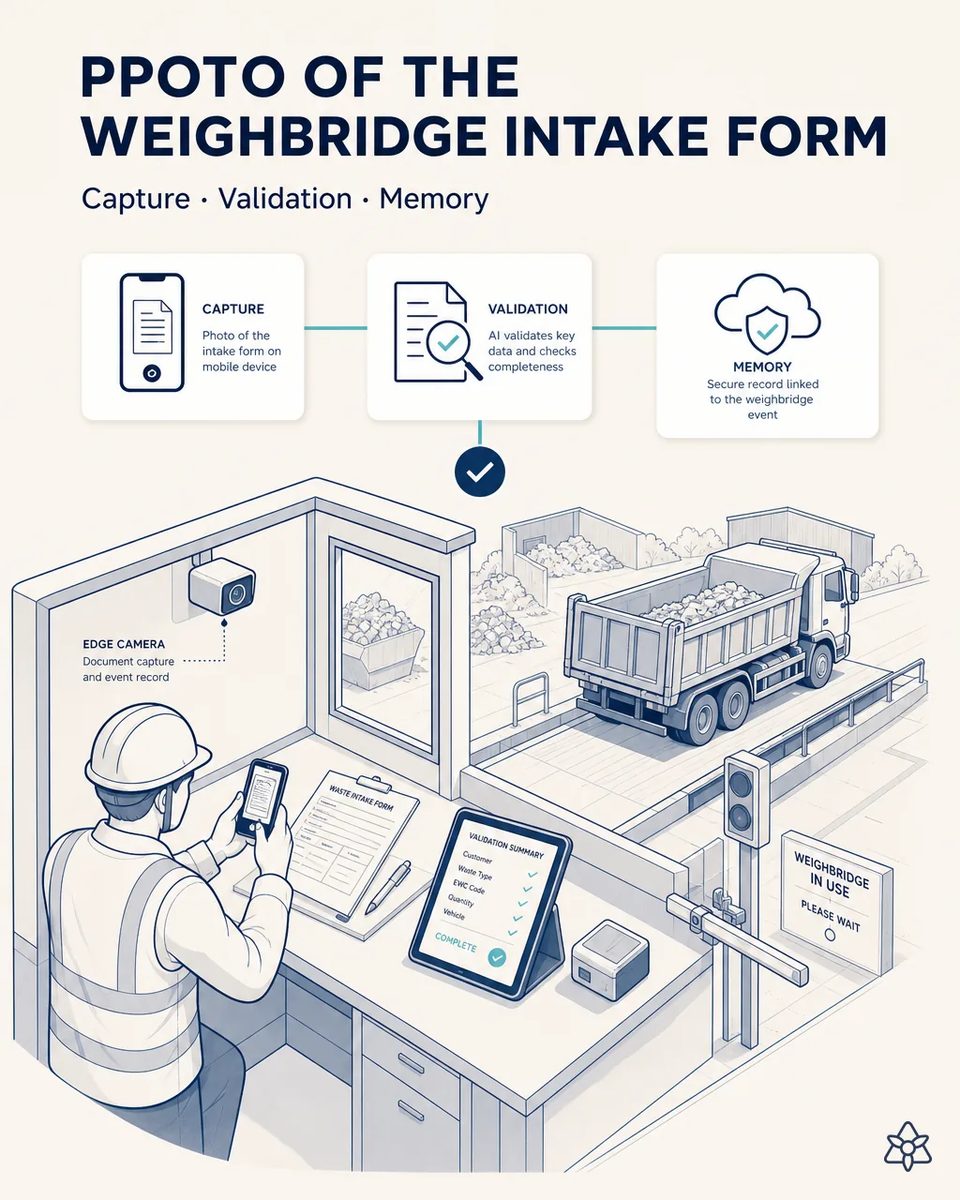
Photo of the weighbridge intake form
Every truck entering a C&D waste plant carries a hand-filled waste identification form. That paper defines the waste record, but today it takes hours to digitize. With iLEAN Connect, the weighbridge operator takes a photo on arrival and the record already exists in the central system instantly, with no change to their routine.
The first link of the traceability chain sits in a booth tray for hours.
The waste identification form (or intake delivery note) is the first link in all downstream traceability: where the truck comes from, what waste type is declared, what plate number. Today that paper sits in the scale booth until someone transcribes it at shift's end, 4-8 hours later. Any same-day issue (misdeclared waste, suspicious mix) has already been processed before anyone reviews it, because the data only lives on paper.
- The waste identification form is the first link of everything downstream: which site the truck comes from, which waste code is declared, which plate and which carrier.
- It is filled in by hand by the driver or the operator, often in a hurry, and stays clipped in the scale booth until someone transcribes it at shift's end — four to eight hours later.
- During that gap the load has already been tipped, sorted and sometimes fed to the crusher, so a misdeclared code or a suspicious mix is found after it has been processed.
- When a contractor calls asking what was delivered from their site on Tuesday, the answer is a box of paper forms sorted by date, not a lookup. And the contractor needs that answer for their own waste plan.
Connect in photo mode — the operator takes the same photo they already took.
Connect's photo mode: the weighbridge operator photographs the form with a phone or the booth's tablet. An anchored LLM extracts structured fields (origin, waste type, plate number, gross weight, carrier) and stores them centrally. Zero habit change: the operator takes the same photo they already took for internal control, only now the data flows straight into the system.
It asks the weighbridge for nothing new: the photo already existed for internal control, and now it carries the data. That is why it is usually the first case a waste manager approves, and the one the rest of the chain hangs from. Without a clean intake record, no later control can say where a ton came from.
The intake form in a tray versus the intake form captured
| Aspect | In the booth today | With iLEAN Connect |
|---|---|---|
| When the load exists in the system | At shift's end, 4-8 h later | On arrival at the scale |
| Declared waste code | Read when someone types it | Extracted and tied to the truck |
| Misdeclared load | Found after tipping | Flagged before sorting |
| Lookup by plate or site | Leafing through paper | Web search by truck and date |
| Driver's handwriting | Retyped by guesswork | Read, low confidence flagged |
| Weighbridge routine | — | Unchanged: one photo |
4-8 hours of latency until transcription → zero latency. Scattered paper records → instant web lookup by truck and date.
Impact estimate — to be validated with your daily truck count.
The block below is an estimate to be validated against your plant's actual data. We put it forward so the committee has an order of magnitude; we refine it during the assessment.
- Estimated payback 4-9 months, depending on daily truck volume at the weighbridge.
- Admin transcription time recovered: the forms stop being typed at shift's end by someone who never saw the truck.
- From 4-8 hours of latency down to zero: the record exists while the truck is still on the scale.
- And scattered paper becomes an instant web lookup by truck, plate, date or contractor site, from the office or from the yard.
Estimated payback 4-9 months depending on daily truck volume, recovering admin transcription time. *Estimate to validate*.
And the fair question from the production manager
“What if it misreads the waste code a driver scribbled?” — reading fields from a form with a known layout is an anchored task, where the best models drop below 1.5% error [1]. The code is also checked against the list of codes your environmental authorization accepts, and the summary reaches the booth tablet so the operator confirms or corrects it before it enters the record. A wrong code caught at the booth costs a tap; caught at inspection, it costs a finding.
[1] OpenAI paper "Why Language Models Hallucinate", 2025 — on the reliability of AI in anchored tasks.
What people ask about photographing the intake form
Does the contractor or the carrier have to change their form?
No. Each site brings its own model and that is normal; vision reads the layout as it comes, including handwritten fields and stamps. A new form model only has to be seen a few times before it is read reliably.
Which fields does it extract at a C&D recycling plant?
Origin site, declared waste code, plate number, gross weight, carrier and producer. Any extra field your authorization requires is added at commissioning. Each field arrives with a confidence level, so the operator knows where to look.
What happens with a code outside our authorization?
It is flagged on the tablet before the truck tips, which is the only moment a redirect is still cheap. The operator decides whether the load enters or is turned away, and that decision is stored with the truck for the next inspection.
Does it work in a booth with poor signal?
The photo is queued on the device and sent when the connection returns, with its original timestamp. Nothing is lost if the network drops for a few minutes. The operator sees on screen which captures are still waiting to be sent.
Can it be linked to the weighing of the same truck?
Yes, by plate and time window. That is the natural next step and it connects directly with the camera on the weighbridge panel. Together they give, per truck, what was declared and what it actually weighed.
More cases from this series
- Site or carrier alert in secondsA contractor's WhatsApp message or a carrier's email warning of a critical change reaches one person who…
- The delivery note that self-loadsThe weighbridge operator photographs the carrier's delivery note and the waste identification form…
- Foreman's hands-free headsetThe plant supervisor spends the whole day walking between sorting, mobile plants and the landfill with…
- The aggregate quality Excel flies to ERPThe quality manager fills in a spreadsheet every batch with grading, contaminant and moisture data for…
- Validate in two taps at the scaleNothing iLEAN captures enters the central system before a human has seen it. In the scale booth, a…
- Weighbridge stitched to ERP, no typingThe weighbridge software already exports data but stays isolated from the ERP. With iLEAN, it gets…
Tell us how many trucks cross your weighbridge on a normal day.
We work on your plant's real data, not ours. Assessment with no commitment.
Request estimated ROI within 48h ‹ See all cases of C&D waste recycling See waste and recycling