Site or carrier alert in seconds
A contractor's WhatsApp message or a carrier's email warning of a critical change reaches one person who reads it late. With iLEAN Connect, the system reads the alert instantly, cross-checks the intake schedule, and returns the concrete action before the truck reaches the scale.
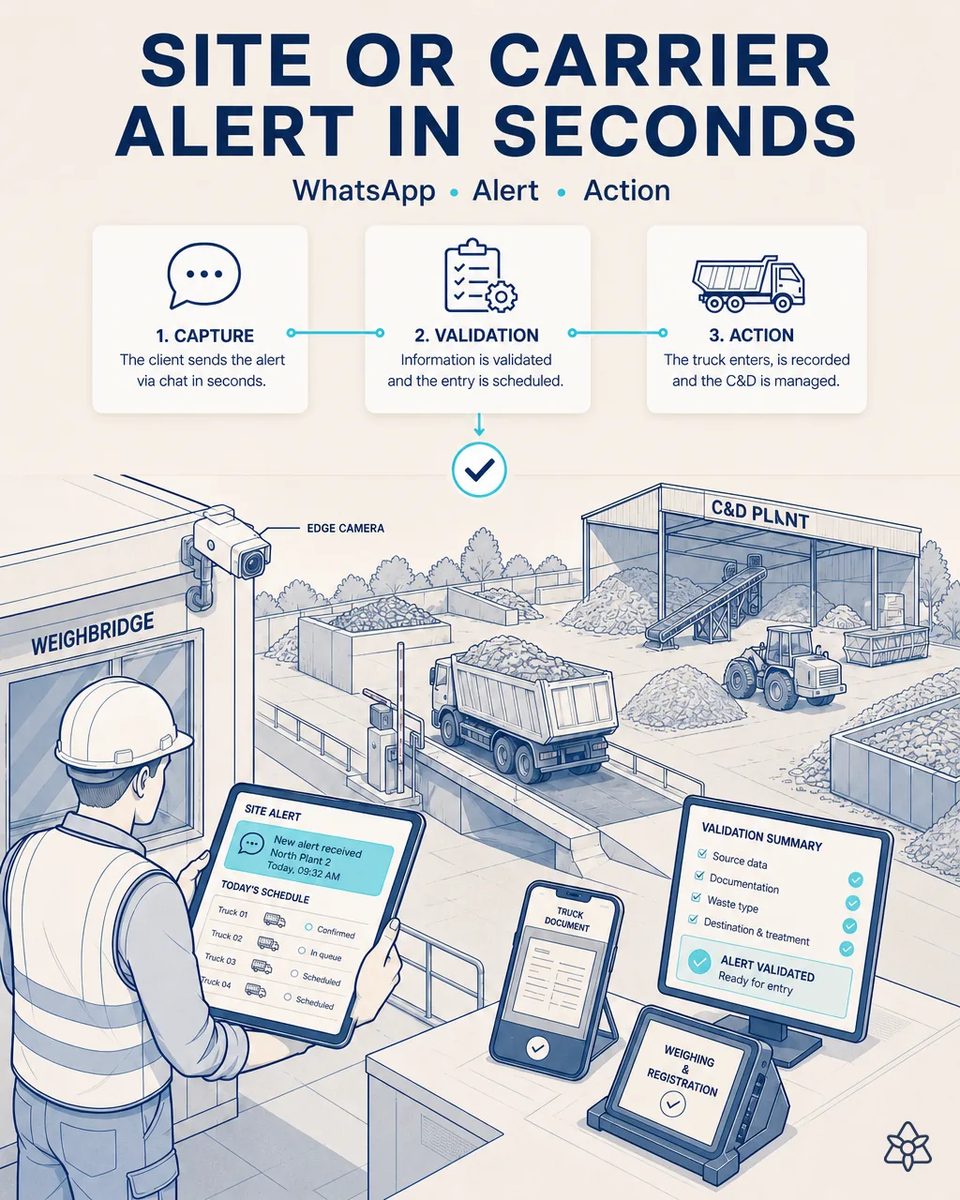
What is really arriving travels through a channel nobody watches.
Critical alerts about what's really arriving (not what the delivery note says) come through informal channels — email or WhatsApp — to specific people who can't watch the inbox in real time. By the time they're read, the truck is already queued at the scale and the redirect decision comes too late.
- The delivery note says clean concrete. The contractor's WhatsApp to the plant manager says the load now carries gypsum board and wood from an interior strip-out.
- Carriers warn of delays, double loads or a changed source site by email, to whichever personal address they happen to have, competing with everything else in the inbox. Nobody designed that channel; it simply became the one that works.
- Those people cannot watch their phone in real time, so the alert is read two to three hours later — with the truck already queued at the scale, or already tipped.
- Once a mixed load has been processed together with clean material, the redirect decision has no value left: the batch is already compromised. All that is left is to explain it at the next inspection.
Connect in chaotic-sources mode — a silent copy on the operational channels, around the clock.
Connect's chaotic-sources mode: a dedicated mailbox or WhatsApp Business number stays silently copied in 24/7. An LLM extracts intent (waste composition change, transport delay), entities (site, carrier, date) and cross-checks the active intake schedule. It returns the manager a concrete action, not just the alert.
Reading the alert sooner is not the value; cross-checking it is. Knowing that a site's load changed matters only if you also know which truck it is, when it arrives and whether your authorization accepts the new mix. That is what comes back, to the plant manager and to the weighbridge, before the truck turns into the gate.
The contractor's warning, unread versus cross-checked
| Aspect | Today, on someone's phone | With iLEAN Connect |
|---|---|---|
| When the alert is read | When its recipient checks the phone | Seconds after it is sent |
| Change in waste composition | Discovered at tipping | Matched to the scheduled truck |
| Decision to redirect | After the bad mix is processed | Before the truck reaches the scale |
| Load outside the authorization | Accepted by mistake | Flagged for refusal |
| Carrier delay | A hole in the intake plan | Schedule re-sequenced |
| Final call | Whoever happened to read it | The plant manager, with the action ready |
2-3 hours of human latency → seconds. Redirect decision made before the truck arrives, not after a bad mix is processed.
Impact estimate — to be validated with your alert history.
The block below is an estimate to be validated against your plant's actual data. We put it forward so the committee has an order of magnitude; we refine it during the assessment.
- Estimated payback 3-7 months, depending on how often contractors and carriers send alerts and how many of them change what the truck carries.
- Unauthorized waste stops being processed by mistake, with everything that means for the environmental authorization.
- From 2-3 hours of human latency down to seconds, nights and weekends included.
- And the decision to redirect or refuse a load is made before the truck arrives, not after a bad mix has reached the crusher.
Avoids incorrect processing of unauthorized waste, estimated payback 3-7 months depending on alert frequency. *Estimate to validate*.
And the fair question from the production manager
“Are you going to read my staff's WhatsApp?” — no. iLEAN sits on a dedicated mailbox and a WhatsApp Business number that contractors and carriers are given for operational alerts; personal chats are never seen. Classifying the intent of an alert and extracting site, carrier and date is an anchored task where the best models drop below 1.5% error [1], and the decision to redirect is always taken by a person. iLEAN proposes the action; the plant manager decides it.
[1] OpenAI paper "Why Language Models Hallucinate", 2025 — on the reliability of AI in anchored tasks.
What people ask about reading contractor and carrier alerts
Does it tell a composition change from a simple delay?
Yes. A change in the declared waste is top priority because it can put a load outside the authorization; a 30-minute delay just re-sequences the schedule. Priority decides who receives it and how insistently.
Which schedule does it cross the alert with?
The day's intake plan, whether it lives in the ERP, in the weighbridge software or in a shared spreadsheet. It identifies the affected truck by site, carrier and plate. If no truck matches, it says so instead of guessing.
What if the contractor sends a voice note?
Voice notes are transcribed and processed like text. Photos of the load sent with the message are attached to the alert for the plant manager. A photo of the load is often more useful than the message itself.
Do contractors have to use a template?
No. They write as they always have; the point of this case is precisely that no format is imposed on a site foreman. All they are given is a number and an address to copy.
Does the alert stay on record?
Yes, linked to the truck and its intake record. If an inspection asks why a load was refused, the warning and the decision are both there, with the time each was received and taken.
More cases from this series
- The delivery note that self-loadsThe weighbridge operator photographs the carrier's delivery note and the waste identification form…
- Foreman's hands-free headsetThe plant supervisor spends the whole day walking between sorting, mobile plants and the landfill with…
- Photo of the weighbridge intake formEvery truck entering a C&D waste plant carries a hand-filled waste identification form. That paper…
- The aggregate quality Excel flies to ERPThe quality manager fills in a spreadsheet every batch with grading, contaminant and moisture data for…
- Validate in two taps at the scaleNothing iLEAN captures enters the central system before a human has seen it. In the scale booth, a…
- Weighbridge stitched to ERP, no typingThe weighbridge software already exports data but stays isolated from the ERP. With iLEAN, it gets…
Tell us the last time a mixed load was processed before anyone read the warning.
We work on your plant's real data, not ours. Assessment with no commitment.
Request estimated ROI within 48h ‹ See all cases of C&D waste recycling See waste and recycling