Foreman's hands-free headset
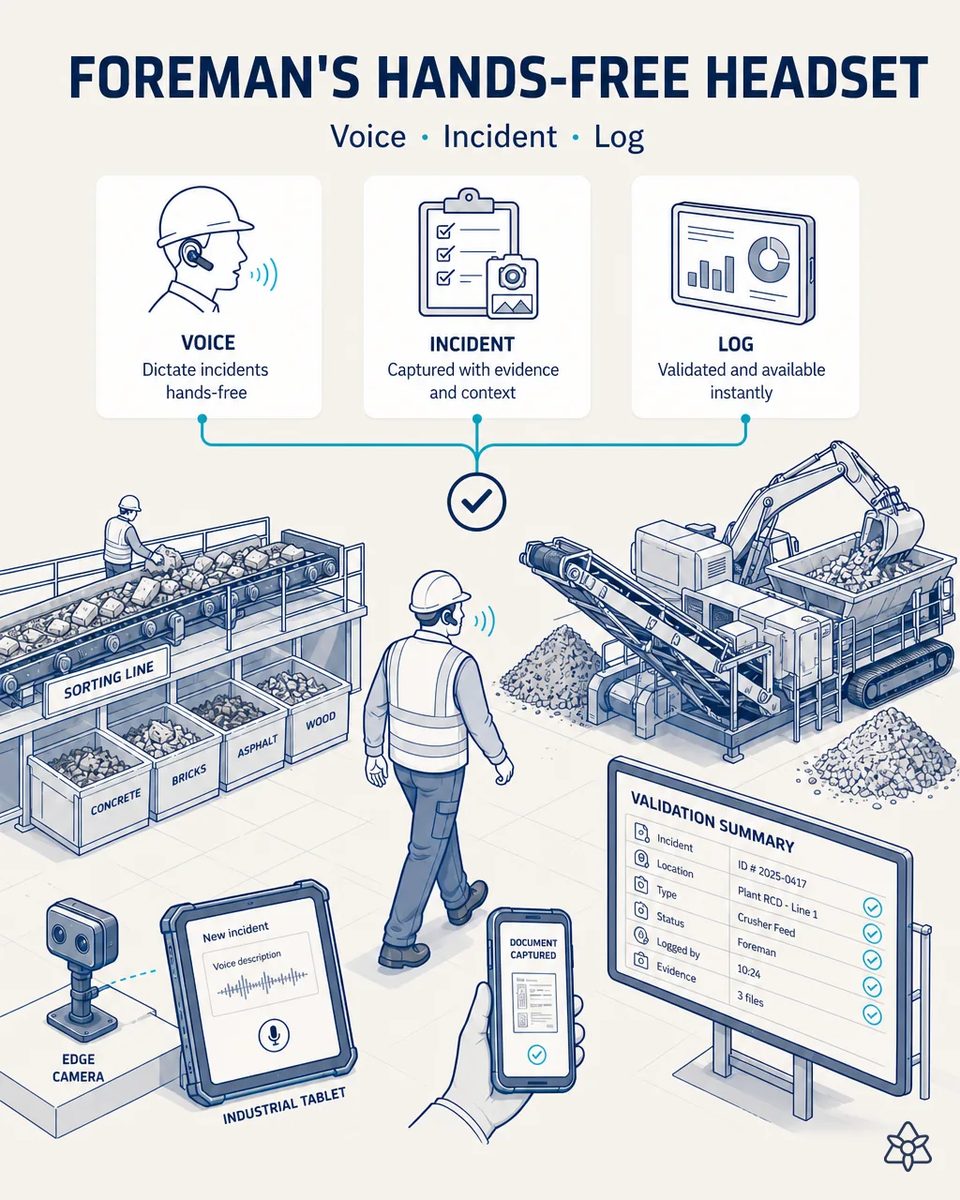
The plant supervisor spends the whole day walking between sorting, mobile plants and the landfill with their hands full. With iLEAN Connect's headset mode, they dictate incidents on the move and the AI structures and stores them without touching any device.
What explains a bad aggregate batch is in one person's head.
Critical operational knowledge (a hopper carrying more contaminants, a need to reinforce manual sorting) lives in the supervisor's head and never enters the system because they can't type while walking and managing the plant.
- The supervisor knows that this morning's hopper is carrying more plaster than usual, that the cabin needs a second picker on mixed loads, that the screen deck is blinding again.
- They spend the day walking between the picking cabin, the mobile plants and the landfill cell with gloves on and a radio in hand. Typing is not an option.
- So that knowledge never enters the system: it survives in a verbal handover and, with luck, a line in a notebook.
- When a recycled aggregate batch fails its grading or its contaminant count, nobody can link it to what the supervisor saw at nine in the morning.
Connect in voice mode — the supervisor speaks, iLEAN structures and links.
Connect's voice mode with a Bluetooth headset and a custom wake word ('iLEAN, note this'). An LLM structures the dictation as an incident linked to the active hopper, batch or shift, and returns support by voice or tablet push within seconds.
It records what the supervisor chooses to tell it, when they choose to, after the wake word. That is what keeps the case alive months later: it is a tool for the supervisor, not a microphone pointed at the crew. And the incident lands where it matters: on the hopper, the batch or the shift it belongs to.
The supervisor's round, lost versus captured
| Aspect | Today | With iLEAN Connect |
|---|---|---|
| An incident at the hopper | Told on the radio and forgotten | Logged against the active hopper and batch |
| Recording it | Walk back to the office | Say “iLEAN, note this” |
| Reinforcing manual sorting | Decided and not recorded | Decision with time and reason |
| Link to scale and sorting data | None | Cross-checked live |
| Asking for a figure on the yard | A call to the office | Answered by voice or tablet push |
| Next shift's starting point | A five-minute chat | The shift's incidents, in order |
Knowledge that used to die at shift's end → enters the system in real time and cross-checks live scale and sorting data.
Impact estimate — an enabling piece, with no number of its own.
The block below is an estimate to be validated against your plant's actual data. We put it forward so the committee has an order of magnitude; we refine it during the assessment.
- No standalone payback: this is an enabling piece. We do not fix a range, because its value depends on how many incidents die at shift's end today, and that is only measured once they start being recorded.
- Recycled aggregate quality depends on it: the plaster or wood the supervisor spots at the hopper explains the batch that later fails its contaminant count.
- Clean per-batch records depend on it too: incidents enter the system in real time instead of being reconstructed for an inspection.
- The figure is validated with the plant supervisor after the first weeks, counting how many incidents were captured that previously left no record.
Strategic value, hard to monetize upfront, but recycled aggregate quality and clean per-batch records depend on it. *Estimate to validate* with the plant supervisor.
And the fair question from the production manager
“Will it understand me next to a crusher running at full load?” — the headset filters the plant's noise at source, and turning a short dictation into an incident with hopper, batch and shift is an anchored task, where the best models drop below 1.5% error [1]. When a field is ambiguous, iLEAN asks back by voice instead of guessing, and the incident is confirmed on the tablet before it enters the batch record.
[1] OpenAI paper "Why Language Models Hallucinate", 2025 — on the reliability of AI in anchored tasks.
What people ask about the supervisor's headset at a C&D recycling plant
Does it record everything said on the yard?
No. It only listens after the wake word and only to the supervisor's headset. The crew is never recorded. Without the wake word, nothing leaves the headset.
Can the supervisor ask questions as well as dictate?
Yes: how many tons the scale has logged today, which batch is in the hopper, what the last grading result was. The answer comes by voice or as a tablet push. Long answers, such as a batch history, go to the tablet rather than to the ear.
How does it know which batch an incident belongs to?
It links the dictation to the hopper, batch and shift active at that moment, using the scale and sorting data already in the system. If the supervisor names a different batch, that one wins.
What if the supervisor dictates in a hurry and leaves something out?
iLEAN asks for the missing piece by voice — which hopper, which fraction — before structuring the incident. One short question is better than an incident linked to the wrong batch.
Why is this case not measured with a payback?
Because its value shows up in other cases: fewer degraded batches, cleaner records, faster root cause. We prefer to say so rather than invent a number. What we do measure, from the first weeks, is how many incidents now reach the record.
More cases from this series
- Site or carrier alert in secondsA contractor's WhatsApp message or a carrier's email warning of a critical change reaches one person who…
- The delivery note that self-loadsThe weighbridge operator photographs the carrier's delivery note and the waste identification form…
- Photo of the weighbridge intake formEvery truck entering a C&D waste plant carries a hand-filled waste identification form. That paper…
- The aggregate quality Excel flies to ERPThe quality manager fills in a spreadsheet every batch with grading, contaminant and moisture data for…
- Validate in two taps at the scaleNothing iLEAN captures enters the central system before a human has seen it. In the scale booth, a…
- Weighbridge stitched to ERP, no typingThe weighbridge software already exports data but stays isolated from the ERP. With iLEAN, it gets…
Tell us what your plant supervisor knows today that never reaches the system.
We work on your plant's real data, not ours. Assessment with no commitment.
Request estimated ROI within 48h ‹ See all cases of C&D waste recycling See waste and recycling