Weighbridge stitched to ERP, no typing
The weighbridge software already exports data but stays isolated from the ERP. With iLEAN, it gets stitched both ways: weight, plate number and waste code travel automatically, with no manual entry.
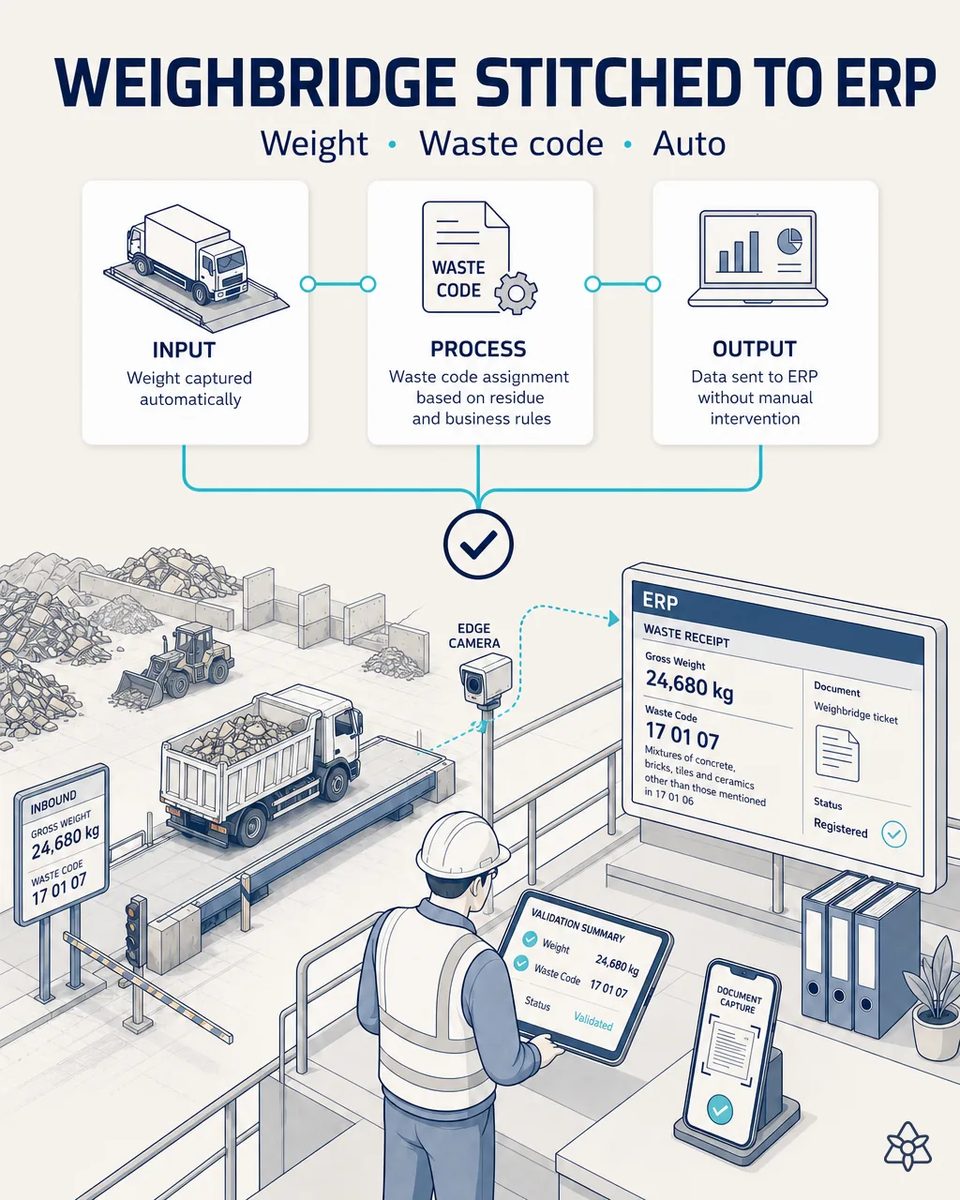
Two systems that already speak, separated by a keyboard.
When a weighing closes, someone types the weight and waste code by hand into the ERP to generate the outbound note. One typo turns into incorrect billing or a traceability record with the wrong data.
- The weighbridge software already exports data. The ERP already accepts it. Between them, a person retypes weight and waste code to generate the outbound note, weighing after weighing.
- It is repetitive work done hundreds of times a month, and exactly the kind of work where a digit gets transposed. Nobody is careless; it is simply volume.
- One typo becomes an incorrect invoice or a traceability record with the wrong data, and sometimes a management certificate issued on top of it and already in the client's hands.
- Nobody notices until month-end reconciliation, or until a client asks why their certificate shows a tonnage that does not match their own records. At that point, the correction involves the client, billing and the certificate.
Connect stitches scale and ERP together via API — both ways, replacing neither.
Connect stitches two modern systems together via API: when a weighing closes at the scale, weight, plate number and waste code are automatically published to the ERP. Closing a weighing becomes automatic, not a typing task in the management system.
This is the most classic case in the matrix, and often the quickest to deploy: two modern systems, nothing for an AI to read, only a reliable stitch. When the weighing closes, plate, weight and waste code are already in the ERP and the note is ready. It is often the quickest win to show the finance team in the first month, because the errors it removes are already visible in their reconciliation.
Weights retyped versus weights published
| Aspect | Today | With iLEAN Connect |
|---|---|---|
| Moment the ERP gets the weight | When someone types it | When the weighing closes |
| Human-origin typing errors | Recurring every month | Zero |
| Waste code on the outbound note | Copied by hand | Carried from the scale |
| Certificate with the wrong tonnage | Possible | Removed at source |
| Master data (clients, codes) | Kept twice | Synced from the ERP |
| Scale and ERP software | — | Both untouched |
Recurring monthly typing errors (some affecting billing or certificates) → zero human-origin errors in weighing uploads.
Impact estimate — fast, and measured against certificate risk.
The block below is an estimate to be validated against your plant's actual data. We put it forward so the committee has an order of magnitude; we refine it during the assessment.
- Estimated payback 3-6 months, one of the fastest in the matrix, because both systems already exist and nothing has to be read.
- Recurring monthly typing errors — some of them affecting billing or certificates — go to zero, together with the month-end hunt to find them.
- The risk of issuing a management certificate with incorrect data drops drastically, and so does the time spent correcting certificates already sent to clients.
- And the person who retyped weights all day goes back to work that actually needs a person: checking the exceptions, not retyping the rule.
Fast payback (3-6 months), drastically reducing the risk of a management certificate with incorrect data. *Estimate to validate*.
And the fair question from the production manager
“And if the link breaks on a busy morning?” — weighings are queued on the scale side and published in order when the link returns, so nothing is lost or duplicated. Where a field has to be interpreted — a free-text remark the operator adds to a weighing — the mapping is an anchored task where the best models drop below 1.5% error [1], and a mismatch with the ERP master data is held for review rather than posted. Nothing reaches an invoice that the ERP itself does not recognize.
[1] OpenAI paper "Why Language Models Hallucinate", 2025 — on the reliability of AI in anchored tasks.
What people ask about stitching the scale to the ERP
Does it work with our current scale software?
If it exports or has an API, yes; most weighbridge packages of the last ten years do. For those that do not, the camera on the panel covers the gap. Both routes end in the same record.
Which direction does the data travel?
Both. The weighing goes to the ERP; clients, sites, authorized waste codes and prices come back to the scale, so the operator picks instead of typing. Master data is kept in one place only.
What if the waste code does not exist in the ERP?
The weighing is held and flagged instead of posted. Nothing half-correct gets through. That is the moment to fix the master data, not after the invoice has gone out. Fixing it there takes minutes; fixing it on a certificate takes weeks.
Does it change how billing is done?
No. The ERP keeps its billing logic, its prices and its approval flow; it simply receives the closed weighing without anyone retyping it. Invoices and outbound notes come out exactly as they do today.
Is there a new piece of software for our team to run?
No middleware on your side: the connector is part of iLEAN and is monitored from the same place as the other cases. If the link drops, we are alerted before your team notices.
More cases from this series
- Site or carrier alert in secondsA contractor's WhatsApp message or a carrier's email warning of a critical change reaches one person who…
- The delivery note that self-loadsThe weighbridge operator photographs the carrier's delivery note and the waste identification form…
- Foreman's hands-free headsetThe plant supervisor spends the whole day walking between sorting, mobile plants and the landfill with…
- Photo of the weighbridge intake formEvery truck entering a C&D waste plant carries a hand-filled waste identification form. That paper…
- The aggregate quality Excel flies to ERPThe quality manager fills in a spreadsheet every batch with grading, contaminant and moisture data for…
- Validate in two taps at the scaleNothing iLEAN captures enters the central system before a human has seen it. In the scale booth, a…
Tell us how many weighings a month someone retypes into your ERP.
We work on your plant's real data, not ours. Assessment with no commitment.
Request estimated ROI within 48h ‹ See all cases of C&D waste recycling See waste and recycling