Camera on the weighbridge control panel
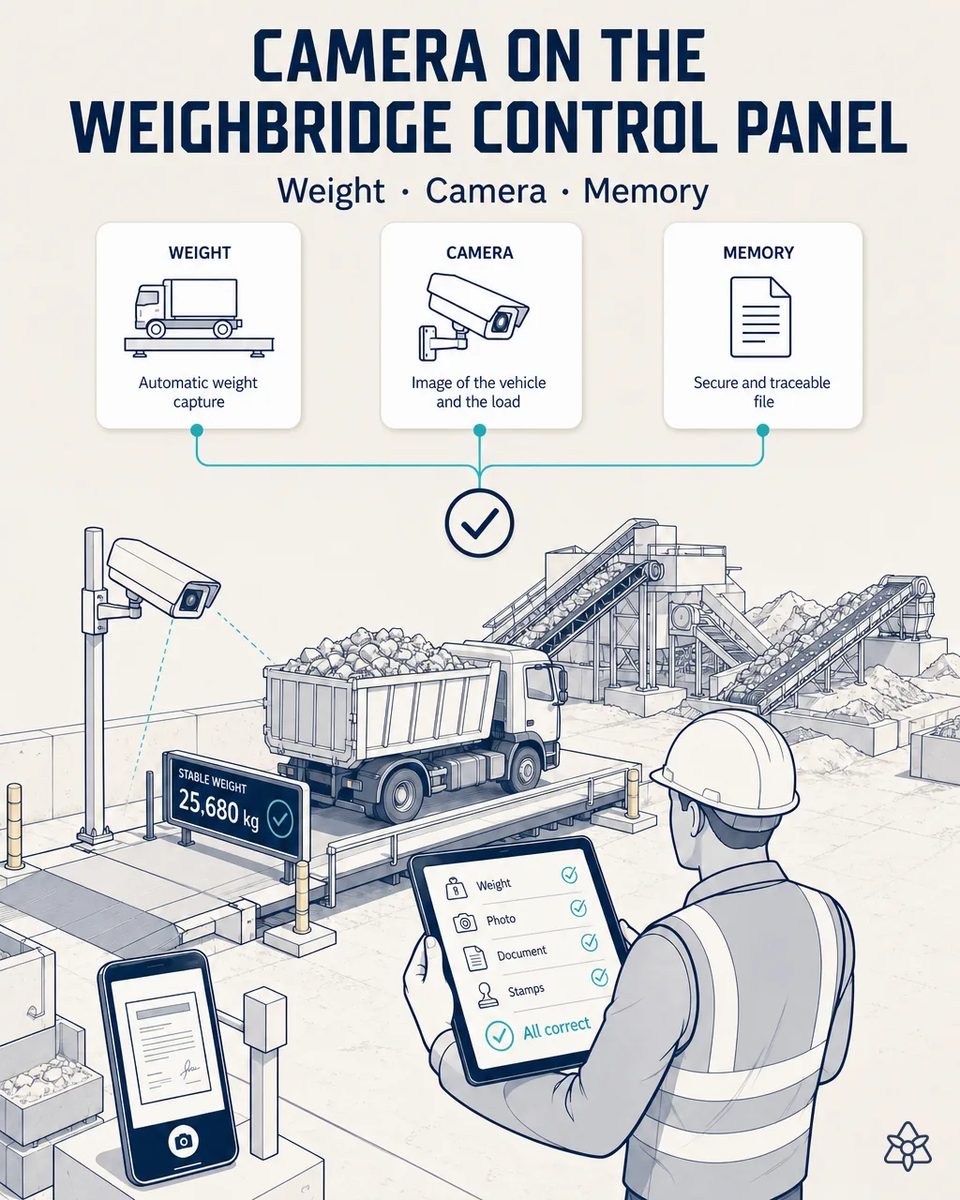
The weighbridge and the fixed sorting plant's control panel are often over a decade old and run isolated from the network. With iLEAN Connect, an external camera aimed at the panel digitizes every weighing without touching the original hardware.
The instrument behind billing and traceability writes on paper.
The scale is the instrument behind billing and traceability for everything entering and leaving the plant. Today its data only survives on a paper ticket or a local log nobody cross-checks against the rest of the process. Replacing it with a connected unit costs downtime and significant investment.
- The weighbridge decides what is billed and what enters the traceability record for everything that comes in and goes out of the plant.
- Many units, and the fixed sorting plant's control panel next to them, are over ten years old and run isolated from the network, by design or by age. Their manufacturers often no longer support an upgrade path.
- The weighing survives on a printed ticket or a local log nobody cross-checks against the intake form, the sorting or the outbound note. When a client disputes a tonnage, someone digs through ticket rolls to find it.
- Replacing the scale with a connected unit means days of downtime, recalibration and a significant investment — so the project never leaves the budget drawer, year after year, while the scale keeps weighing correctly.
Connect in panel photo mode — the scale stays exactly as it is.
Connect's panel photo mode: a fixed industrial camera captures the weighbridge screen, OCR plus an anchored LLM reads every weighing and automatically matches it to the same truck's intake record (see the intake form example). The scale stays exactly the same; it just stops being a data island.
Nothing is installed in the weighing terminal and no cable is touched, so the scale's calibration and legal verification are untouched. It simply stops being a data island and starts feeding the same truck's record. The day the plant decides to replace it, the history captured so far stays in the system.
The isolated scale versus the scale being read
| Aspect | Today | With iLEAN Connect |
|---|---|---|
| Where a weighing lives | Ticket or local log | Searchable history by truck, client, date |
| Match with the intake form | By hand, if ever | Automatic by plate and time |
| Ticket vs billing note | Discrepancies found at month-end | Cross-checked per weighing |
| Gross, tare and net | Typed from the ticket | Read off the display |
| Scale calibration | — | Untouched, no rewiring |
| Replacement project | In the capex plan | Deferrable |
Loose paper or local-log weighings → an instant searchable history by truck, client or date.
Impact estimate — to be validated against your billing discrepancies.
The block below is an estimate to be validated against your plant's actual data. We put it forward so the committee has an order of magnitude; we refine it during the assessment.
- Estimated payback 5-10 months, depending on daily weighings and on how often tickets and billing notes disagree today.
- Discrepancies between the scale ticket and the billing note eliminated, which is where margin leaks quietly every month and where client disputes usually start.
- Every weighing becomes an instant, searchable history by truck, client or date, matched to its intake form.
- And replacing a scale that still weighs correctly stops being an urgent investment. The capex can wait until the scale actually needs replacing.
Estimated payback 5-10 months, eliminating discrepancies between the scale ticket and the billing note. *Estimate to validate*.
And the fair question from the production manager
“Can a camera reading a display be trusted for a weighing that gets billed?” — fair question, because that number ends up on an invoice and on a certificate. The task is anchored: a fixed display, digits in a known position and physically bounded values, where the best models drop below 1.5% error [1]. A reading above the scale's capacity or inconsistent with the tare is discarded, and every weighing still goes past the operator's tablet before it enters the record. The camera reads; a person still confirms what is billed.
[1] OpenAI paper "Why Language Models Hallucinate", 2025 — on the reliability of AI in anchored tasks.
What people ask about reading the weighbridge display
Does the scale need recalibrating or reverifying?
No. The camera reads the display from outside; it does not connect to the weighing terminal, so the scale's metrological verification is unaffected. That is usually the argument that gets the case past the plant manager in the first meeting.
Does it read the sorting plant's control panel as well?
Yes, with the same pattern: a fixed camera on the panel captures running hours, feed rate and alarms that today only live on that screen. It is the same installation, one more camera, and the same reading logic.
How does it know which truck a weighing belongs to?
By matching plate and time window against the intake form captured on arrival. When two trucks overlap, the operator resolves it with one tap. On a normal day, the overlap is the exception rather than the rule.
What about glare, rain or dust on the display?
The camera is housed and positioned for that. A frame with an unreadable digit is discarded and the next stable reading is used instead. A stable weighing stays on the display long enough for several clean frames.
Does it capture inbound and outbound weighings?
Both. The pair gives the net per truck and is what later lets the system tie incoming waste to outgoing recycled aggregate. Without the outbound weighing, the mass balance of the plant cannot be closed.
More cases from this series
- Site or carrier alert in secondsA contractor's WhatsApp message or a carrier's email warning of a critical change reaches one person who…
- The delivery note that self-loadsThe weighbridge operator photographs the carrier's delivery note and the waste identification form…
- Foreman's hands-free headsetThe plant supervisor spends the whole day walking between sorting, mobile plants and the landfill with…
- Photo of the weighbridge intake formEvery truck entering a C&D waste plant carries a hand-filled waste identification form. That paper…
- The aggregate quality Excel flies to ERPThe quality manager fills in a spreadsheet every batch with grading, contaminant and moisture data for…
- Validate in two taps at the scaleNothing iLEAN captures enters the central system before a human has seen it. In the scale booth, a…
Tell us how old your weighbridge is and how its weighings reach billing today.
We work on your plant's real data, not ours. Assessment with no commitment.
Request estimated ROI within 48h ‹ See all cases of C&D waste recycling See waste and recycling