Scale and WMS, stitched to the ERP with no integration project
The cutting scale and warehouse WMS have their own APIs, but nobody's had time to properly integrate them with the commercial ERP. Connect stitches the systems together via the API that already exists, without replacing the scale, WMS or ERP.
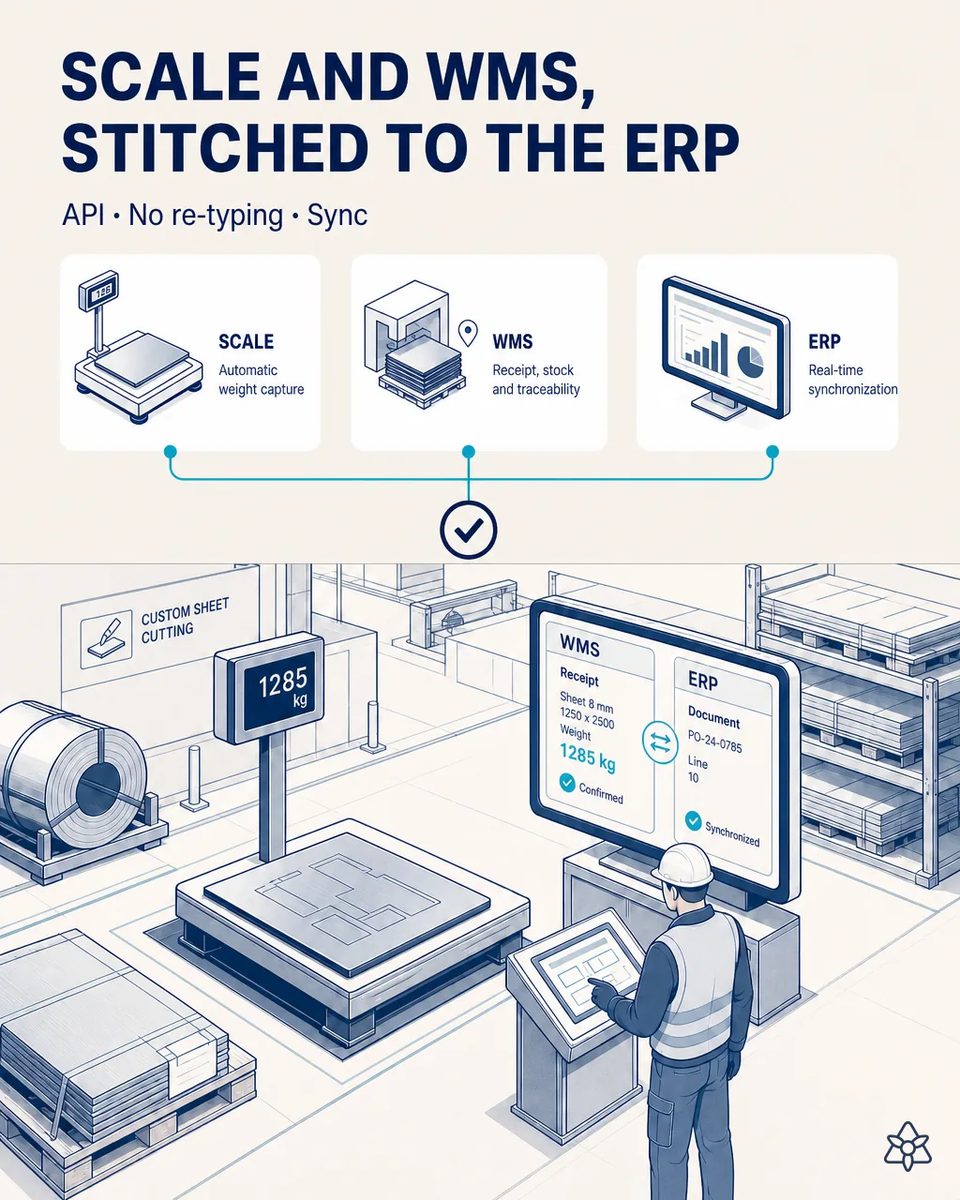
Three systems that could talk to each other, and a person in the middle retyping.
The cutting scale and warehouse WMS have their own APIs, but nobody's had time to properly integrate them with the commercial ERP. Every weighing or location move gets keyed into the ERP by hand again.
- The scale weighs, the WMS knows where every pallet of formats is, and the ERP is what invoices the customer. All three are modern enough to have an API of their own, and none of them has ever been introduced to the others.
- Nobody has ever had the two or three weeks it would take to integrate them properly, and that project has sat at the bottom of the list for years.
- So every weighing and every location move gets keyed into the ERP by hand, a second time, and in a business that invoices by the kilo a mistyped weight is money.
- The result is the recurring argument between what was invoiced and what was delivered, which always ends up being settled by weighing it again.
Connect stitches what already exists — no scale, WMS or ERP is replaced.
Connect stitches the systems together via the API that already exists, without replacing the scale, WMS or ERP. Weight, size and location reach the ERP in the background.
This is not an integration project, and that is the whole point: it does not compete for the same weeks, it opens nothing and it swaps nothing out. The weight the scale gives is the weight the ERP invoices, and it gets there on its own.
The isolated scale versus the stitched scale
| Aspect | Today | With iLEAN Connect |
|---|---|---|
| Weight of a cut order | Typed into the ERP by hand | Arrives on its own, from the scale |
| Location moves | Keyed in a second time | Synced in the background |
| Invoiced versus delivered | A recurring argument | The same number in both |
| A remnant back on the rack | Often never recorded | Reweighed and back in stock |
| Integration project | Years at the bottom of the list | Not needed |
| Scale, WMS and ERP | — | None of them replaced |
Double data entry on every movement → automatic sync with no manual step.
Impact estimate — to be validated with your numbers.
The block below is an estimate to be validated against your plant's actual data. We put it forward so the committee has an order of magnitude; we refine it during the assessment.
- Administrative time recovered on every movement, which in a warehouse that weighs all day is the bulk of the office's workload.
- Fewer invoiced-versus-delivered mismatches, which today are settled by reweighing and by issuing a credit note.
- The remnant that goes back on the rack gets recorded with its real weight instead of quietly disappearing from stock.
- And the integration project pending for years stops being a prerequisite for anything else.
Administrative time recovered and fewer invoiced-vs-delivered mismatches. Estimate to be validated.
And the fair question from the production manager
“If we are going to connect systems, isn't a proper integration cleaner?” — it is, on the day it reaches the top of the list, and that is exactly the problem: in years it never has. This stitching leans on the interfaces that are already documented, replaces nothing and asks for no shutdown window, so it does not join that queue. Matching a weighing to the right order line is an anchored task where the best models drop below 1.5% error [1], and any mismatch is raised for a person rather than written.
[1] OpenAI paper "Why Language Models Hallucinate", 2025 — on the reliability of AI in anchored tasks.
What people ask about stitching the scale and the WMS
Do we have to replace the scale or the WMS?
Neither. Connect uses the interfaces they already publish. If a piece of equipment turns out to have none, it is read from its display with a camera, the same way the shear panel is.
What if the ERP is old?
Most of them expose something, even if it is only an import file. Where there is genuinely nothing, the ERP side is handled by a validated entry instead of by hand, which still removes the double typing.
Does it cover the weighbridge as well as the cutting scale?
Yes. It is the same pattern: the weight is captured where it is produced and lands on the order line it belongs to, whether that is a whole truck across the weighbridge or a single pallet of cut pieces on the floor scale.
What about the remnant that goes back into stock?
It is weighed and returned to stock as a piece with its own dimensions and its own heat, which is the only way the remnant rack stops being a black hole. Until that happens, yield per order is an opinion and the offcuts are sold as scrap because nobody can find them.
How long does it take to deploy?
Days rather than months, because nothing is being built from scratch. What takes the time is agreeing which fields travel in which direction and who validates the exceptions, and that is a meeting rather than a project.
More cases from this series
- Heat traceability, ready in secondsEvery critical cut automatically generates its traceability dossier, organized by order.
- A paperless cutting order, at zero latencyDigitize the cutting order and its corrections without changing the shear operator's routine.
- Validate before the data reaches the ERPA tablet at the cutting station summarizes what iLEAN captured; the operator confirms with 2 taps.
- Delivery note and heat certificate, one tap into the ERPPhotograph the delivery note and the supplier's heat certificate; after validation, it all goes to the…
- The heat-control spreadsheet, synced to the ERPiLEAN reads the heat-control spreadsheet on save and syncs it, validated, to the ERP.
- The mill alert that arrives on timeiLEAN reads a delayed-heat or measurement-change alert instantly and suggests the action to take.
Tell us how many times a day a weight gets typed into your ERP by hand.
We work on your plant's real data, not ours. Assessment with no commitment.
Request estimated ROI within 48h ‹ See all cases of steel sheet distribution See steel