The heat-control spreadsheet, synced to the ERP
The shared warehouse folder holds heat control data: supplier, grade, thickness, heat number, certificate. Connect listen-inward mode: reads the file on save, parses it with an anchored LLM, and after a single human validation, syncs it to the ERP via API.
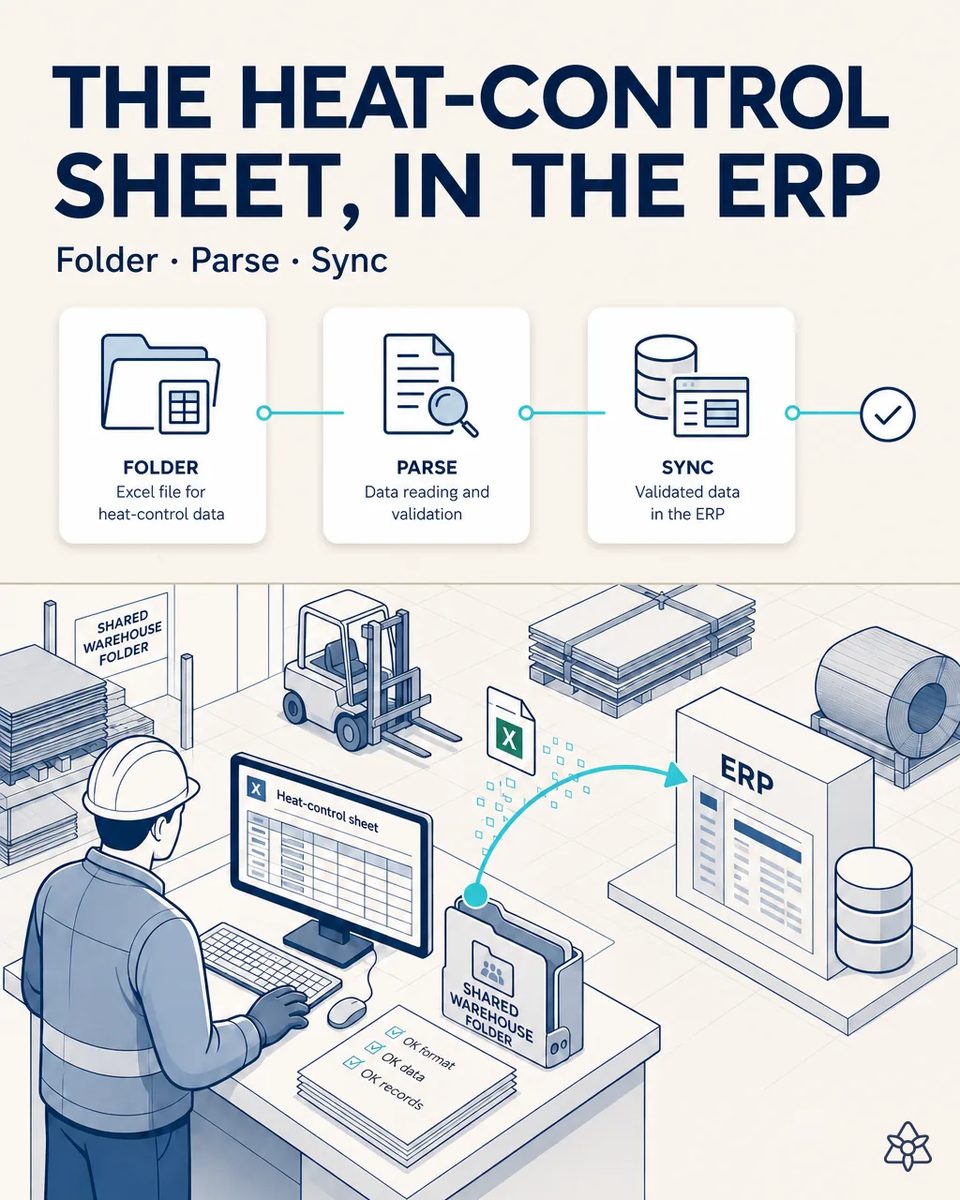
The real heat control is a file in a shared folder, and the ERP is a late copy of it.
The shared warehouse folder holds heat control data: supplier, grade, thickness, heat number, certificate. But the ERP demands manual line-by-line transcription, costing half a day a month and weeks of drift from reality.
- The shared warehouse folder holds the heat control the business actually runs on: supplier, grade, thickness, heat number and the certificate that goes with each one.
- The ERP wants exactly the same thing typed in line by line, by hand, by somebody holding a named license that gets paid for every year whether it is used for five minutes or five hours.
- Half a day a month goes into that transcription, and between one transcription and the next the ERP runs weeks behind reality.
- Which means the copy people quote from, and the copy a customer's paperwork is built on, is not the copy that is true.
Connect in listen-inward mode — it reads the file when it is saved, not the person.
Connect listen-inward mode: reads the file on save, parses it with an anchored LLM, and after a single human validation, syncs it to the ERP via API.
Nobody is asked to standardize the sheet, and that is deliberate: asking the warehouse to change the file it has used for years is the fastest way to end up with two files, one of which is a lie. iLEAN reads the one that exists — columns, merged cells, notes in the margin and all — and the only new step in anyone's day is a single sign-off.
Today's spreadsheet versus the connected spreadsheet
| Aspect | Today | With iLEAN Connect |
|---|---|---|
| Where the truth lives | In the shared folder only | In both, and they agree |
| Getting it into the ERP | Line by line, by hand | Automatic after one sign-off |
| Time spent | Half a day a month | Minutes of review |
| Gap with reality | Weeks | Zero latency |
| The sheet's format | Has to be respected | Read as it is, even as it changes |
| ERP licenses on the module | 4 people typing | 1 person validating |
Monthly manual transcription and weeks of drift → automatic sync after a single sign-off.
Impact estimate — to be validated against your own invoice.
The block below is an estimate to be validated against your plant's actual data. We put it forward so the committee has an order of magnitude; we refine it during the assessment.
- 💰 CFO angle: the ERP bills per named user. If four people hold a quality and stock license purely to type heat data, that is a 50-80% reduction on the module, recurring every year.
- Half a day a month of somebody's time recovered, month after month.
- From weeks of drift between the sheet and the ERP to a sync after a single sign-off.
- And quoting stops being done from a copy that is out of date, which is where the expensive mistakes start.
Direct ERP license savings: from 4 licensed users down to 1 validator, -50 to -80% on the quality/stock module. Estimate to be validated.
And the fair question from the production manager
“That sheet has been passed around and edited for years — will it cope?” — that is the expected case, not the exception. Parsing does not depend on fixed cell positions: it interprets columns, units, merged cells and notes in the margin without anyone standardizing anything first. It is an anchored task, where the best models drop below 1.5% error [1], and the sync only happens after one person signs off on what was read.
[1] OpenAI paper "Why Language Models Hallucinate", 2025 — on the reliability of AI in anchored tasks.
What people ask about connecting the heat-control sheet
Do we have to change the spreadsheet?
No, and it is better not to. The file keeps being used exactly as it is today, including the columns somebody added two years ago and never told anyone about, and the tab at the end that only one person understands.
Does it pick up the certificate as well?
The link to it, yes: each row ends up tied to the mill certificate filed for that heat, so finding a certificate stops meaning opening folders one by one. That link is what every other case in this matrix leans on later.
What if two people edit it at the same time?
The file is read when it is saved, and each save is treated as a version with its own timestamp. What reaches the ERP is what a person validated, not every intermediate save, so a half-finished row never becomes an official record.
Can we really reduce ERP licenses?
It depends on your contract, which is why it is framed as an estimate to validate against last year's invoice. The logic is simple: whoever logs in only to type stops needing to log in, and read-only access is usually far cheaper or free.
Is it looking at the folder or at the people?
At the file. It is read when it is saved; there is no record of who opens what or how long they spend on it, and no interest in producing one.
More cases from this series
- Heat traceability, ready in secondsEvery critical cut automatically generates its traceability dossier, organized by order.
- A paperless cutting order, at zero latencyDigitize the cutting order and its corrections without changing the shear operator's routine.
- Validate before the data reaches the ERPA tablet at the cutting station summarizes what iLEAN captured; the operator confirms with 2 taps.
- Delivery note and heat certificate, one tap into the ERPPhotograph the delivery note and the supplier's heat certificate; after validation, it all goes to the…
- The mill alert that arrives on timeiLEAN reads a delayed-heat or measurement-change alert instantly and suggests the action to take.
- The vintage shear starts talkingRead the parameters of a network-isolated shear with an external camera, without touching the machine.
Tell us how many people hold an ERP license just to type heat data.
We work on your plant's real data, not ours. Assessment with no commitment.
Request estimated ROI within 48h ‹ See all cases of steel sheet distribution See steel