The vintage shear starts talking
The cutting shear is over 15 years old and runs a proprietary controller with no data output to any system. A fixed external camera points at the panel.
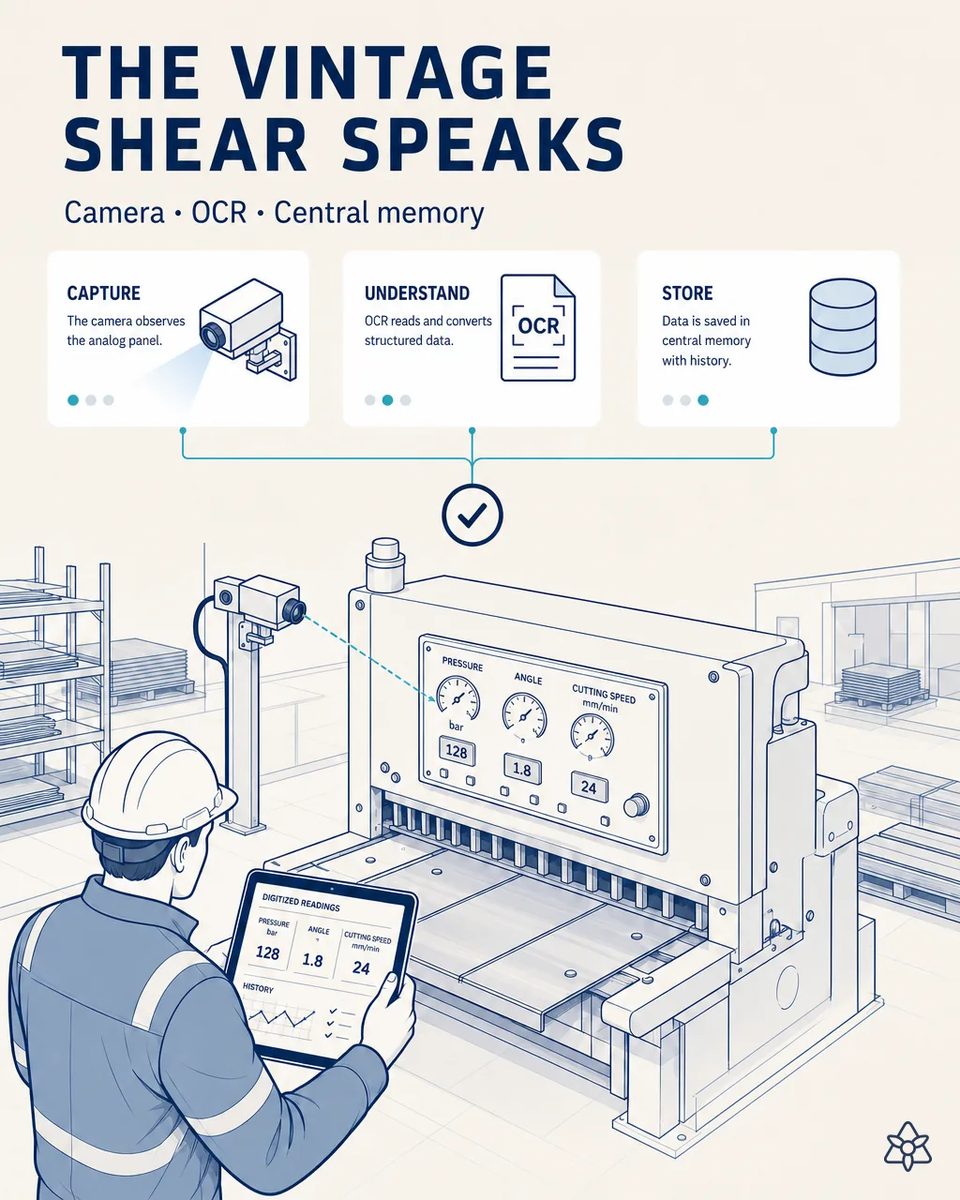
The machine that decides cut quality leaves no record of how it cut.
The cutting shear is over 15 years old and runs a proprietary controller with no data output to any system. Its panel shows pressure, blade angle and feed speed, but that data dies on screen as soon as the next cut starts. Replacing it costs hundreds of thousands of euros and weeks of downtime.
- The shear is over fifteen years old and runs a proprietary controller with no data output to any system. It cuts perfectly well, which is exactly why nobody is going to replace it.
- Its panel shows hydraulic pressure, blade angle and feed speed. Those values die on the screen the moment the next cut starts, and the next order is already on the table.
- When a workshop sends a batch back for burr or for a cut that is out of square, there is nothing to correlate the complaint with: no pressure, no angle, no clearance recorded for that batch.
- Replacing the machine costs hundreds of thousands of euros and weeks with the cutting service stopped, which for a stockholder means sending its own customers to the competitor down the road.
Connect in photo mode on the panel — read from outside, with nothing wired in.
A fixed external camera points at the panel. OCR with an anchored LLM reads each value every few seconds and structures it by batch, cross-referencing it with the order being cut at that moment. The machine stays the same, but now it talks.
Nothing is connected to the controller, no cabinet is opened and no port is enabled. What changes is that the panel's readings now exist outside the screen, stamped with the order, the grade and the heat that were on the table at that moment. Keeping an old shear stops meaning going blind about it, and the decision to replace it can finally be taken on tonnage and condition rather than on the absence of data.
The silent panel versus the panel being read
| Aspect | Today | With iLEAN Connect |
|---|---|---|
| Pressure, blade angle and speed | Visible, volatile, unrecorded | A reading every few seconds, per batch |
| A burr or out-of-square claim | Nothing to correlate it with | Root cause per order in minutes |
| Which order was on the table | Reconstructed from paper | Stamped on every reading |
| The machine's controller | — | Untouched, nothing installed |
| Replacing the shear | The only way to get data | Deferrable: capex avoided |
| Blade clearance drifting | Noticed when pieces come back | Visible as a trend |
Zero correlation between cutting parameters and measurement claims → root-cause analysis per order in minutes.
Impact estimate — to be validated with your numbers.
The block below is an estimate to be validated against your plant's actual data. We put it forward so the committee has an order of magnitude; we refine it during the assessment.
- Estimated payback 5-10 months, counting the replacement capex you do not spend.
- Hundreds of thousands of euros of machine capex deferred, plus the weeks of stopped cutting service that would come with it.
- Root-cause analysis per order in minutes when a batch comes back for burr or squareness, instead of a conversation nobody can win.
- And blade wear stops being discovered through returns: a clearance drifting batch after batch shows as a trend before a customer finds it.
Estimated payback of 5 to 10 months, avoiding machine replacement CAPEX. Estimate to be validated.
And the fair question from the production manager
“Does a camera reading a panel hold up in front of a customer?” — the task here is anchored: a fixed screen, fields in known positions and physically expected ranges, where the best models drop below 1.5% error [1]. On top of that, any frame with a value outside what that shear can physically do — zero pressure mid-cut, a speed the machine does not reach — is discarded rather than stored, which is precisely what would otherwise ruin the series in a claim.
[1] OpenAI paper "Why Language Models Hallucinate", 2025 — on the reliability of AI in anchored tasks.
What people ask about reading the shear panel
Does it work on a panel with analog gauges?
Yes. Needle gauges, a monochrome display or a touchscreen are all handled the same way: the camera reads what the operator reads, and each value is structured with its units. A machine old enough to have a painted dial is exactly the machine this case was designed around.
Does it affect the machine's warranty or its maintenance contract?
No, because nothing is touched. No cable enters the cabinet, no software is installed on the controller and no port is enabled, so there is nothing for a service technician to object to and nothing to renegotiate with a manufacturer that may no longer exist.
How does it know which order was being cut?
Because the batch is open in central memory, either from the photographed cutting order or from the ERP. Every reading carries the order, the grade and the heat of that moment, so a claim can be laid over the exact conditions of that cut instead of over an average.
How often does it read the panel?
Every few seconds, which is ample resolution for a shear: what matters is the setting that held for a batch, not a millisecond signal. The readings become a short series per batch, which is what a root-cause conversation actually needs.
Can the same camera cover the profile cutting table?
Yes, the pattern is identical for any machine with a panel and no network connection: the oxy or plasma table, the press brake, the band saw. You start with the shear because that is where most of the cut-to-size volume goes through.
More cases from this series
- Heat traceability, ready in secondsEvery critical cut automatically generates its traceability dossier, organized by order.
- A paperless cutting order, at zero latencyDigitize the cutting order and its corrections without changing the shear operator's routine.
- Validate before the data reaches the ERPA tablet at the cutting station summarizes what iLEAN captured; the operator confirms with 2 taps.
- Delivery note and heat certificate, one tap into the ERPPhotograph the delivery note and the supplier's heat certificate; after validation, it all goes to the…
- The heat-control spreadsheet, synced to the ERPiLEAN reads the heat-control spreadsheet on save and syncs it, validated, to the ERP.
- The mill alert that arrives on timeiLEAN reads a delayed-heat or measurement-change alert instantly and suggests the action to take.
Tell us what your shear's panel shows and what happens to it afterwards.
We work on your plant's real data, not ours. Assessment with no commitment.
Request estimated ROI within 48h ‹ See all cases of steel sheet distribution See steel