Delivery note and heat certificate, one tap into the ERP
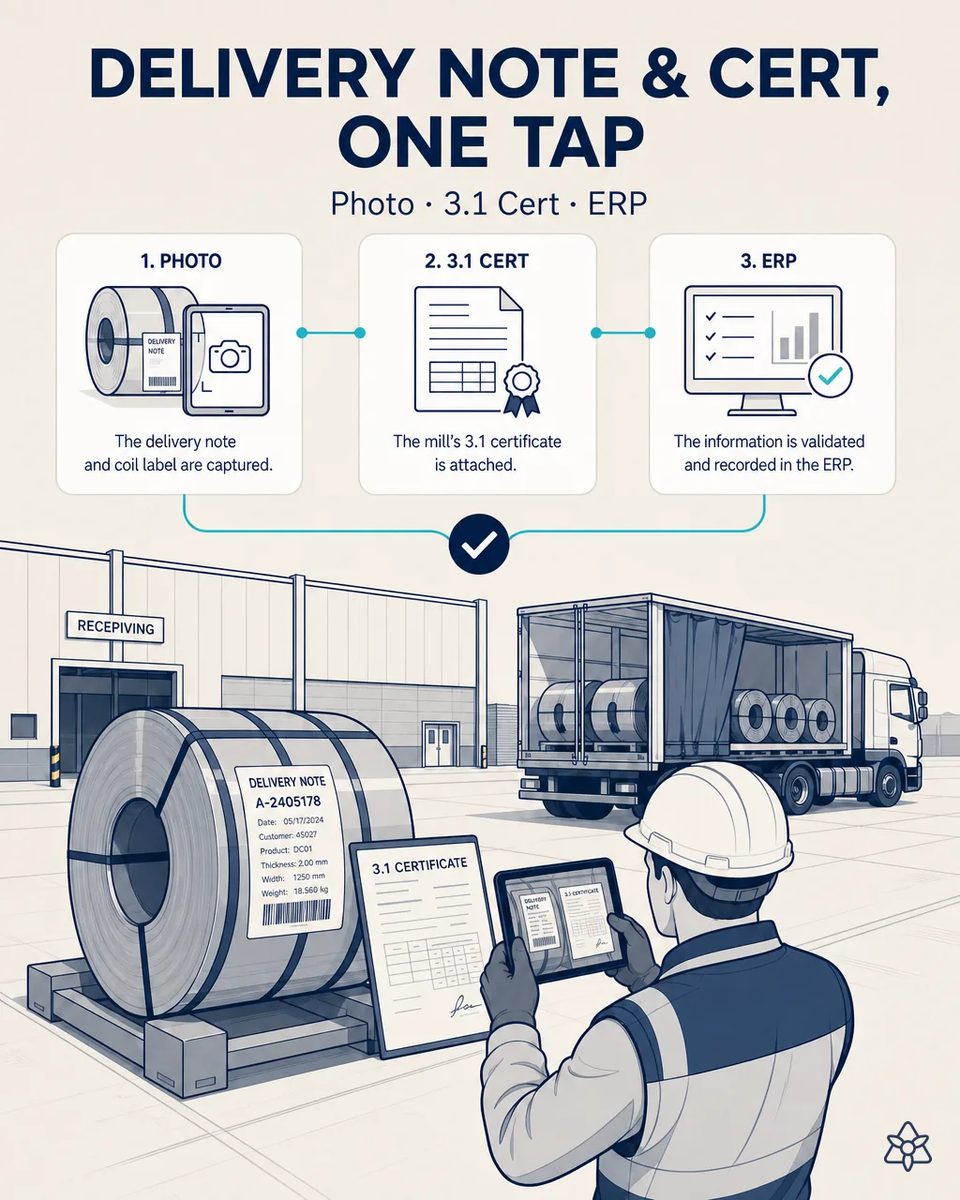
The truck arrives with the coil; the delivery note and heat certificate tie down (or lose) future traceability. Connect photographs the delivery note and heat certificate in a single capture, reading the composition table, heat number and plain OCR.
Traceability is won or lost at the yard, in the ten minutes the truck is waiting.
The truck arrives with the coil; the delivery note and heat certificate tie down (or lose) future traceability. Sign fast to avoid carrier demurrage, or key it into the ERP slowly line by line: both options fail.
- The truck arrives with the material that will become every cut sheet you sell this month. The delivery note and the mill's inspection certificate are what tie each of those pieces to a heat.
- There are two ways of handling it and both are bad. Sign fast so the carrier does not charge demurrage, and the certificate ends up in a folder linked to nothing.
- Or type it into the ERP line by line with the driver waiting, which is how a heat number gets a digit wrong and nobody notices for months.
- And the certificate is not a formality: it is the document a customer, or their auditor, will one day ask you to produce for one specific piece.
Connect in photo mode — delivery note, label and certificate in a single capture.
Connect photographs the delivery note and heat certificate in a single capture, reading the composition table, heat number and plain OCR. The manager confirms the summary with one tap and Connect syncs it all to the ERP via API.
The certificate stops being a sheet of paper in a filing cabinet and becomes linked to the material from minute one. That is what turns the question every demanding customer eventually asks — which heat did this piece come from — into a query instead of an afternoon's work for whoever knows the filing cabinet best.
Today's receiving versus captured receiving
| Aspect | Today | With iLEAN Connect |
|---|---|---|
| Truck at the yard | Long enough to earn demurrage | Seconds, and validated |
| The mill certificate | Filed loose, linked to nothing | Attached to the material from minute one |
| Composition table and heat number | Typed by hand, if at all | Read and cross-checked with the order |
| A heat number with a wrong digit | Found months later | Flagged before it enters |
| Tracing a piece back to its heat | An afternoon in the filing cabinet | A query |
| ERP licenses on receiving | Two or three | One, the person who validates |
Carrier demurrage or broken traceability → validated receiving in seconds with no demurrage.
Impact estimate — to be validated against your own invoice.
The block below is an estimate to be validated against your plant's actual data. We put it forward so the committee has an order of magnitude; we refine it during the assessment.
- 💰 CFO angle: the receiving module usually needs two or three named licenses; with Connect only the person who validates needs one — a 50-70% reduction, recurring.
- Carrier demurrage at the yard, eliminated: receiving stops being a choice between signing blind and holding the driver.
- The certificate linked to the material from the first minute, which is the difference between answering a customer in seconds and rebuilding a paper trail.
- And the heat numbers that today go in with a digit wrong and surface months later as a non-conformance.
Direct ERP license savings on the receiving module: -50 to -70%. Estimate to be validated.
And the fair question from the production manager
“Does it recognize every mill's delivery note and certificate?” — yes, and without asking a single supplier to change theirs: the model reads the table structure with no per-supplier template, and the same applies to the composition table on the certificate. It is an anchored task where the best models drop below 1.5% error [1], and the receiving supervisor validates the summary before anything is booked in.
[1] OpenAI paper "Why Language Models Hallucinate", 2025 — on the reliability of AI in anchored tasks.
What people ask about digitizing receiving
Does it read the composition table on the certificate?
Yes, and that is the part that adds most: the chemical analysis and the mechanical values end up attached to the material, so a customer's technical question does not start with a search through folders.
What if the delivery note and the label on the material disagree?
The discrepancy is shown in the summary before anything is validated. Today nobody makes that comparison with a driver waiting, which is exactly why it goes unnoticed.
Do we need a barcode scanner?
Not necessarily. A photo from a phone or an industrial tablet is enough, which matters in a yard where the tags come stapled, printed or handwritten depending on the mill. If you already have scanners that work well, they are used the same way.
What if the certificate arrives later by email?
The receipt is booked with what came on the truck and the certificate is attached when it arrives, matched by heat number without anyone hunting for it. A certificate that never turns up is chased as an open item rather than forgotten until a customer asks.
Can we start with receiving alone?
Yes, and it is a good place to start: the result is visible from the first truck and it does not depend on any other piece being deployed. It is also the case that puts the foundation under all the traceability the rest of the matrix promises.
More cases from this series
- Heat traceability, ready in secondsEvery critical cut automatically generates its traceability dossier, organized by order.
- A paperless cutting order, at zero latencyDigitize the cutting order and its corrections without changing the shear operator's routine.
- Validate before the data reaches the ERPA tablet at the cutting station summarizes what iLEAN captured; the operator confirms with 2 taps.
- The heat-control spreadsheet, synced to the ERPiLEAN reads the heat-control spreadsheet on save and syncs it, validated, to the ERP.
- The mill alert that arrives on timeiLEAN reads a delayed-heat or measurement-change alert instantly and suggests the action to take.
- The vintage shear starts talkingRead the parameters of a network-isolated shear with an external camera, without touching the machine.
Tell us how long a truck waits at your yard while the delivery note gets typed.
We work on your plant's real data, not ours. Assessment with no commitment.
Request estimated ROI within 48h ‹ See all cases of steel sheet distribution See steel