The mill alert that arrives on time
The mill emails or messages about a delayed heat, or a customer asks to change a measurement already scheduled. Connect chaotic-sources mode: mailbox or WhatsApp Business in silent copy 24/7.
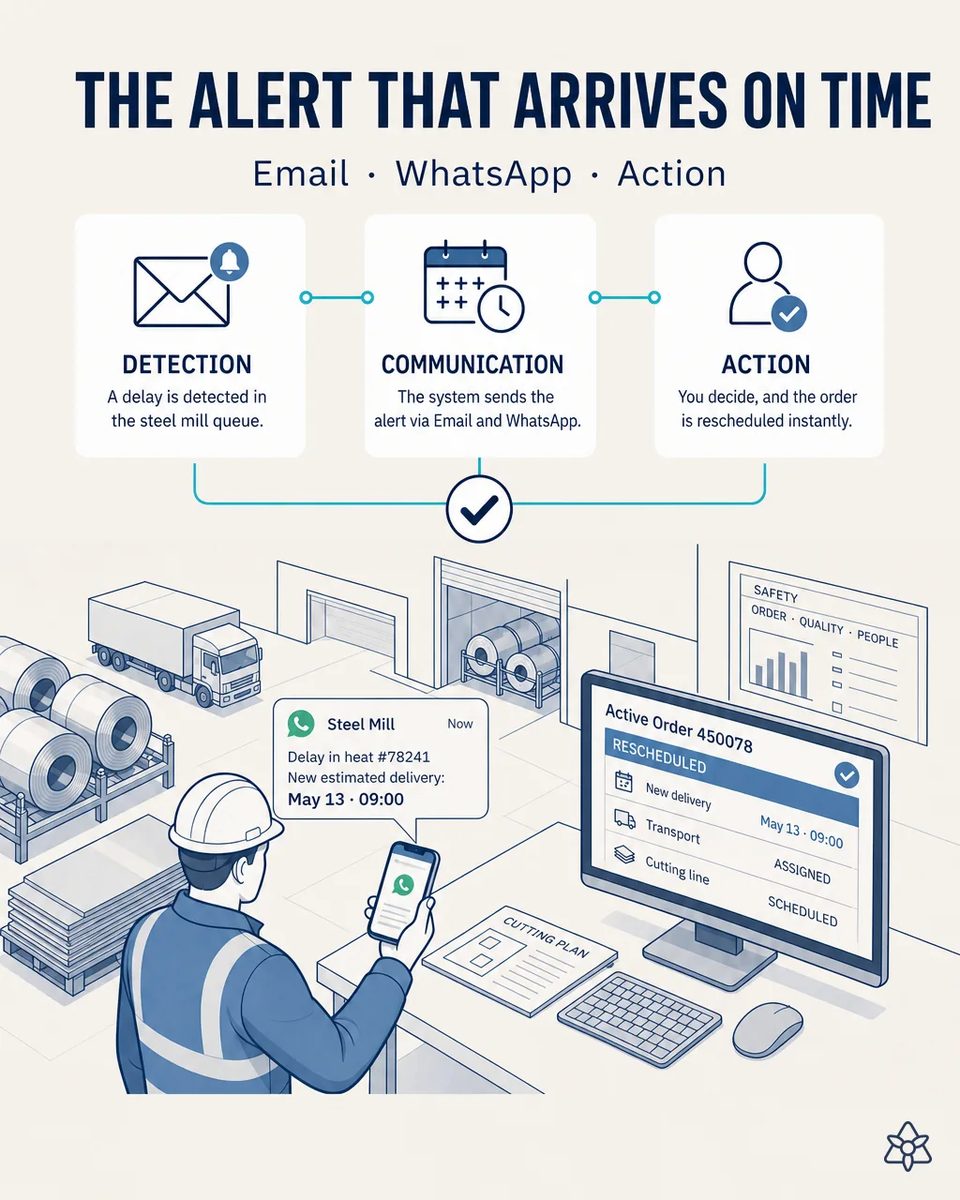
The message that breaks the week lands in a mailbox nobody is looking at.
The mill emails or messages about a delayed heat, or a customer asks to change a measurement already scheduled. The message sits in an inbox nobody checks in real time while handling the counter or the phone, and by the time it's read, decisions already made fall apart.
- The mill writes to say a heat is running late. A customer messages to change a size already scheduled for tomorrow's cutting list. Both arrive in plain language, at a personal address, at the worst possible hour.
- Whoever they were sent to is on the counter or on the phone selling. The message sits unread for two or three hours, competing with a hundred others that matter far less.
- By the time it is read, the promise has already been made: material committed at the counter, a date given to a workshop, a cutting list sequenced around a heat that is not coming.
- It is not solved by asking people to check their inbox more often, because the counter does not stop.
Connect in chaotic-sources mode — mailbox and business number, in silent copy around the clock.
Connect chaotic-sources mode: mailbox or WhatsApp Business in silent copy 24/7. The LLM extracts intent and entities, cross-checks active ERP orders, and returns the specific action to the manager.
Reading the alert sooner is only half of it. What comes back is the cross-check: which open orders depend on that heat, whether another format in stock covers the same grade and thickness, and which customer has to be called before they send a truck for material that is not there.
Today's alert versus the cross-checked alert
| Aspect | Today, in the inbox | With iLEAN Connect |
|---|---|---|
| When it is read | 2-3 hours later | Seconds |
| A delayed heat from the mill | Found out with the order already promised | An alternative from stock proposed |
| A size change from a customer | Found out after the cut | Caught before the batch starts |
| Rescheduling against | This morning's picture | Live orders and live stock |
| What arrives | One more email | Which order to move and whom to call |
| Who decides | Whoever opens the mailbox | The manager — iLEAN proposes |
2-3 hours of human latency → seconds, with rescheduling based on real-time data.
Impact estimate — to be validated with your numbers.
The block below is an estimate to be validated against your plant's actual data. We put it forward so the committee has an order of magnitude; we refine it during the assessment.
- Estimated payback 3-7 months, depending on how often a critical alert actually lands.
- Measured in promises kept: material committed at the counter against a heat that was never going to arrive is the expensive kind of mistake.
- From 2-3 hours of human latency to seconds, with the cutting list resequenced on live data rather than on this morning's picture.
- And a size change caught before the batch starts instead of after the sheet is cut, which is the difference between a correction and a scrapped piece.
Estimated payback of 3 to 7 months depending on critical alert frequency. Estimate to be validated.
And the fair question from the production manager
“Are you going to read my team's email?” — no. iLEAN sits in copy on a dedicated mailbox and a business messaging number: it sees only what mills and customers send to those commercial channels. On the extraction side, classifying intent — a delay, a size change, a claim, a routine acknowledgment — and pulling out order, heat, grade and thickness is an anchored task where the best models drop below 1.5% error [1], and the action itself is always taken by a person.
[1] OpenAI paper "Why Language Models Hallucinate", 2025 — on the reliability of AI in anchored tasks.
What people ask about reading mill and customer alerts
Does it tell a real delay from a routine acknowledgment?
Yes, and that is the point. A delayed heat affecting material already committed is flagged as urgent, while an order confirmation interrupts nobody. The priorities are set with your manager at commissioning, mill by mill and customer by customer.
What does it do with a delayed heat?
It looks up which orders depended on it and whether another heat already in the warehouse covers the same grade, thickness and format. If there is one, it proposes the swap with its own certificate; if not, it tells you which customer to call and how much margin is left.
Does it work with messaging as well as email?
Yes, through a business messaging number in silent copy, which is how a large part of this trade actually communicates. The mill's logistics desk and the customer's workshop foreman are read the same way, and neither of them has to change how they write to you.
Does it replace the ERP's order entry?
No. The formal order keeps arriving through its own channel and remains the reference. This case covers what gets communicated by hand and breaks the day — the message at seven in the morning, the call-back changing a width — which is what no system reads today.
What if the alert comes in another language?
Buying from mills abroad means notices in more than one language, and intent extraction does not depend on the language the message is written in. The action that comes back to your manager is in yours.
More cases from this series
- Heat traceability, ready in secondsEvery critical cut automatically generates its traceability dossier, organized by order.
- A paperless cutting order, at zero latencyDigitize the cutting order and its corrections without changing the shear operator's routine.
- Validate before the data reaches the ERPA tablet at the cutting station summarizes what iLEAN captured; the operator confirms with 2 taps.
- Delivery note and heat certificate, one tap into the ERPPhotograph the delivery note and the supplier's heat certificate; after validation, it all goes to the…
- The heat-control spreadsheet, synced to the ERPiLEAN reads the heat-control spreadsheet on save and syncs it, validated, to the ERP.
- The vintage shear starts talkingRead the parameters of a network-isolated shear with an external camera, without touching the machine.
Tell us what the last delayed heat you found out about too late cost you.
We work on your plant's real data, not ours. Assessment with no commitment.
Request estimated ROI within 48h ‹ See all cases of steel sheet distribution See steel