A paperless cutting order, at zero latency
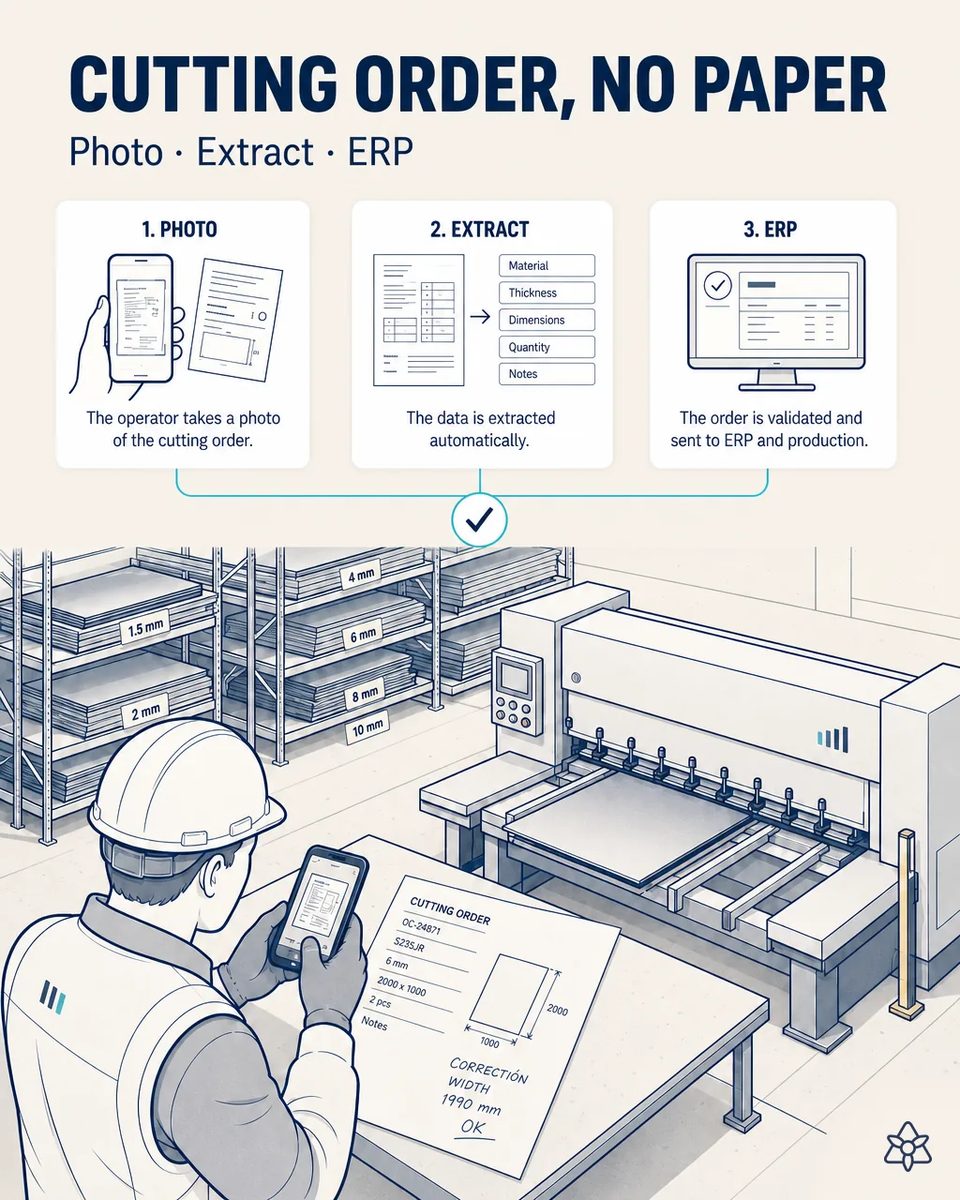
In a steel service center, every cutting batch starts with a paper order listing customer, grade, thickness and dimensions. Connect photo mode: the operator photographs the order when starting the batch.
The order that reaches the shear is not always the order the customer asked for.
In a steel service center, every cutting batch starts with a paper order listing customer, grade, thickness and dimensions. Any last-minute correction phoned in gets scribbled in the margin and rarely makes it back into any system. When a customer disputes a measurement, nobody can reconstruct which exact order reached the shear.
- Every cutting batch starts with a paper order: customer, grade, thickness, the format it comes out of and the sizes to cut. It is written at the counter and it walks to the shear in somebody's hand.
- A correction phoned in at the last minute — a width down from 2000 to 1990, one more piece, a grade swapped for whatever is actually on the rack — gets written in the margin and rarely makes it back into any system.
- Between the margin correction and the system, four to eight hours pass, and part of it never gets typed at all.
- So when a metal fabricator disputes a measurement three weeks later, nobody can reconstruct which exact order reached the shear, and the discussion is settled by whoever remembers harder. In a trade where the same customer orders three times a week, that conversation is expensive twice over.
Connect in photo mode — one photo when the batch starts, and the order exists.
Connect photo mode: the operator photographs the order when starting the batch. An anchored LLM extracts customer, grade, thickness, dimensions and the handwritten note, cross-checking it against the ERP order. The data lands in central memory before cutting starts, with no change to the operator's routine.
The operator's routine does not change: they keep working from the same paper order and simply photograph it before the first cut. That is why this is usually the first case a steel warehouse approves, and why the order stops depending on a sheet of paper surviving the shift.
Today's cutting order versus the captured order
| Aspect | Today, on paper | With iLEAN Connect |
|---|---|---|
| When the order exists in a system | 4-8 h later, or never | Zero latency |
| A correction phoned in | Written in the margin | Extracted and tied to the batch |
| A measurement dispute | Word against word | The exact order that reached the shear |
| Grade, thickness and format | Retyped from paper | Cross-checked against the ERP order |
| Sizes cut out of the format | Only on the paper | Recorded with the offcut left over |
| Operator's routine | — | Unchanged: one photo |
4-8 hours of latency between the paper correction and its reflection in the system → zero latency.
Impact estimate — to be validated with your numbers.
The block below is an estimate to be validated against your plant's actual data. We put it forward so the committee has an order of magnitude; we refine it during the assessment.
- Estimated payback 4-9 months, depending on how many cutting orders you put through per day.
- Counter and administrative transcription time recovered, order after order.
- From 4-8 hours of latency — and orders that never got typed at all — to zero latency on every one.
- And a dispute over a measurement stops being word against word: the exact order that reached the shear, corrections included, becomes a query.
Estimated payback of 4 to 9 months depending on daily order volume. Estimate to be validated.
And the fair question from the production manager
“What if it misreads a size in a handwritten correction?” — reading fields off a document with a known structure is an anchored task, where the best models drop below 1.5% error [1]. And there are two nets behind it: the summary goes to the tablet at the cutting station for the operator to confirm or correct, and grade, thickness and format are cross-checked against the ERP order and against what the warehouse actually holds, so a combination that does not exist is flagged instead of accepted.
[1] OpenAI paper "Why Language Models Hallucinate", 2025 — on the reliability of AI in anchored tasks.
What people ask about photographing the cutting order
Do we have to change how the counter writes the order?
No. The order keeps being printed or written exactly as it is today, and the model reads its structure as it stands. Changing the counter's paperwork is the fastest way to end up with a system nobody uses, and in a stockholder the counter is the busiest desk in the building.
Does it pick up the correction written in the margin?
That is the part that adds most, because the margin is where the order that actually got cut lives. Handwritten notes are extracted like any printed field, and a low-confidence value is flagged for a person to confirm rather than being quietly guessed at.
What about an order taken over the phone at the counter?
Same thing: the counter fills in its slip as always and the slip is photographed. What matters is not how the order arrived but that the version the shear worked from exists somewhere other than on a piece of paper. Small urgent orders from a workshop are precisely the ones that never reach a system today, and they are also the ones that generate most of the arguments.
Does it record the offcut left over?
Yes, as part of the batch: which format went in, which sizes came out and what remnant goes back to the rack with its grade and heat. That is the figure nobody has today, and the one that decides whether a small urgent order actually made money or quietly ate a whole sheet.
Do we need ERP integration from day one?
No. It works from the first batch against iLEAN's central memory, and the push into the ERP is connected afterwards, once the warehouse has seen the data for itself. Starting without integration is what lets the case go live in weeks rather than waiting on a software vendor's roadmap.
More cases from this series
- Heat traceability, ready in secondsEvery critical cut automatically generates its traceability dossier, organized by order.
- Validate before the data reaches the ERPA tablet at the cutting station summarizes what iLEAN captured; the operator confirms with 2 taps.
- Delivery note and heat certificate, one tap into the ERPPhotograph the delivery note and the supplier's heat certificate; after validation, it all goes to the…
- The heat-control spreadsheet, synced to the ERPiLEAN reads the heat-control spreadsheet on save and syncs it, validated, to the ERP.
- The mill alert that arrives on timeiLEAN reads a delayed-heat or measurement-change alert instantly and suggests the action to take.
- The vintage shear starts talkingRead the parameters of a network-isolated shear with an external camera, without touching the machine.
Tell us how many cutting orders reach your shear on paper each day.
We work on your plant's real data, not ours. Assessment with no commitment.
Request estimated ROI within 48h ‹ See all cases of steel sheet distribution See steel