Heat traceability, ready in seconds
An automotive, construction or heavy-industry customer asks for the heat certificate of a specific cut. Every critical cut automatically triggers the dossier: heat certificate, pre/post cutting photos, measurement and decision log, organized by Agents per order and customer.
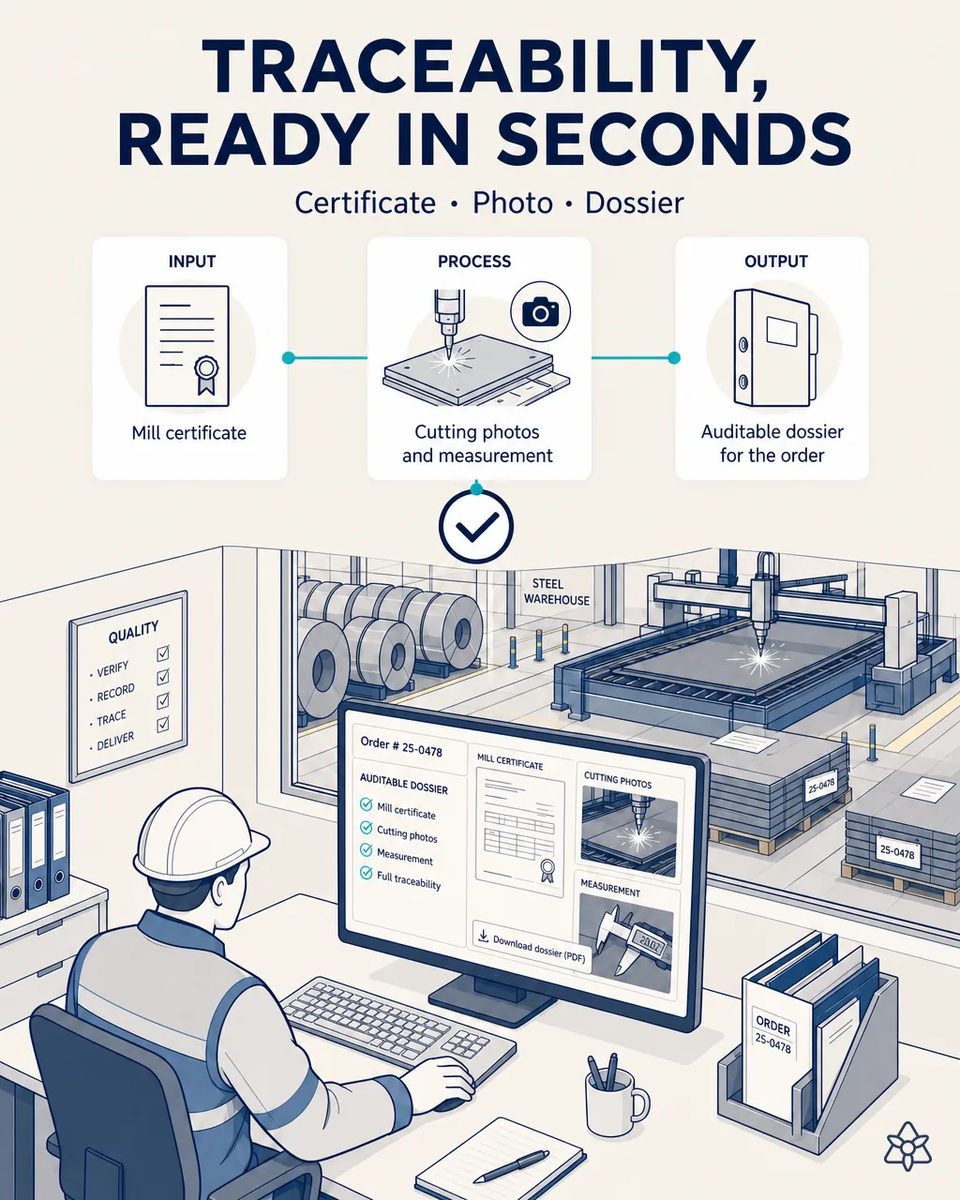
The evidence exists. It is just scattered across four places and one person's memory.
An automotive, construction or heavy-industry customer asks for the heat certificate of a specific cut. Today someone spends hours gathering paperwork, loose photos and ERP data to respond, and any gap becomes a non-conformance if there's also a qualification audit.
- An automotive, construction or heavy-industry customer asks for the mill certificate covering one specific cut, delivered weeks ago.
- The certificate is in a folder, the order is in the ERP, the photos are on somebody's phone and the measurement is on a paper record in a drawer. Somebody spends hours putting it together, and that somebody is usually the person you can least afford to take off the floor.
- Two to three days to rebuild the traceability of a single claim, and that is when the paperwork happens to be complete.
- When there is a qualification audit on top, any gap stops being an inconvenience and becomes a non-conformance with a corrective action attached to it.
Agents assembles nothing new — it organizes what the other pieces already capture.
Every critical cut automatically triggers the dossier: heat certificate, pre/post cutting photos, measurement and decision log, organized by Agents per order and customer.
Every critical cut closes its own dossier at the moment it happens, out of evidence that was captured anyway. Anything rebuilt afterwards inherits the gaps of whatever nobody wrote down at the time, and it is precisely in that assembly, weeks later, that the non-conformances appear.
Today's paper chase versus the permanent dossier
| Aspect | Today | With iLEAN Agents |
|---|---|---|
| Answering a certificate request | 2-3 days | Seconds |
| Where the evidence is | Four places and a memory | One dossier per order |
| Cutting photos | On somebody's phone | Attached to the order |
| A gap in the paperwork | Found by the auditor | Flagged when it happens |
| A qualification audit | Days of preparation | A filtered view to download |
| Who the dossier is for | — | The customer, and their auditor |
2-3 days to rebuild traceability for a claim → dossier available in seconds.
Impact estimate — to be validated with your numbers.
The block below is an estimate to be validated against your plant's actual data. We put it forward so the committee has an order of magnitude; we refine it during the assessment.
- From 2-3 days to seconds to answer a claim with the full traceability of a cut, as an estimate to validate against your own last claim.
- Qualification audits stop being preceded by days of hunting for paper across four systems and two filing cabinets.
- The dossier also works commercially: being able to send it the same day is an argument in front of a demanding customer, and it is the kind of argument a competitor selling the same steel at the same price per kilo cannot make.
- And a gap is detected when the evidence should have been generated, not on the auditor's day.
Drastic reduction in response time for claims and qualification audits. Estimate to be validated.
And the fair question from the production manager
“Isn't this just another document manager?” — the difference is direction. A document manager stores what somebody decides to upload, afterwards, and inherits exactly the same gaps. Here the dossier closes the instant the cut happens, out of what Connect and Edge already captured, and Agents reorganizes it for whoever is asking. Classifying each piece of evidence is an anchored task where the best models drop below 1.5% error [1], and a missing document is reported rather than invented.
[1] OpenAI paper "Why Language Models Hallucinate", 2025 — on the reliability of AI in anchored tasks.
What people ask about the traceability dossier
What goes into the dossier?
The mill certificate for the heat, the pre and post cutting photos, the measurement, the validated order and the log of decisions taken, including who confirmed what and when. In practice it is everything a customer or an auditor has ever asked you for, gathered before they ask.
Which cuts trigger one?
The ones you define as critical: a customer, a grade, a thickness or a destination sector. Generating a dossier for every counter sale would just be noise, and noise is how a system stops being read; the point is that the ones that matter are never the ones missing.
Does the customer get into our systems?
No. They receive the dossier for their own order, or an auditor gets a view limited to the period and the scope that were agreed beforehand. Nothing else is exposed, and nothing has to be prepared by hand for them either.
What about orders from before this is deployed?
They stay exactly where they are. The dossier builds from day one forward, and bringing the history in is an optional exercise rather than a prerequisite, which is what keeps the case from turning into a digitization project.
Does it help with a qualification audit?
That is where it saves most time, because an audit asks for the same evidence a claim does, only for a whole period instead of for one cut. What used to be days of preparation becomes a filtered view somebody reviews before the auditor arrives.
More cases from this series
- A paperless cutting order, at zero latencyDigitize the cutting order and its corrections without changing the shear operator's routine.
- Validate before the data reaches the ERPA tablet at the cutting station summarizes what iLEAN captured; the operator confirms with 2 taps.
- Delivery note and heat certificate, one tap into the ERPPhotograph the delivery note and the supplier's heat certificate; after validation, it all goes to the…
- The heat-control spreadsheet, synced to the ERPiLEAN reads the heat-control spreadsheet on save and syncs it, validated, to the ERP.
- The mill alert that arrives on timeiLEAN reads a delayed-heat or measurement-change alert instantly and suggests the action to take.
- The vintage shear starts talkingRead the parameters of a network-isolated shear with an external camera, without touching the machine.
Tell us how long it took to answer the last certificate request you received.
We work on your plant's real data, not ours. Assessment with no commitment.
Request estimated ROI within 48h ‹ See all cases of steel sheet distribution See steel