Validate before the data reaches the ERP
Without a human gate, any recognition error — a misread size or heat number — would flow straight into the ERP and from there to the invoice and delivery note, the worst place to discover it. An industrial tablet at the cutting station or supervisor's post shows a clear visual summary of what was captured by photo, voice or email.
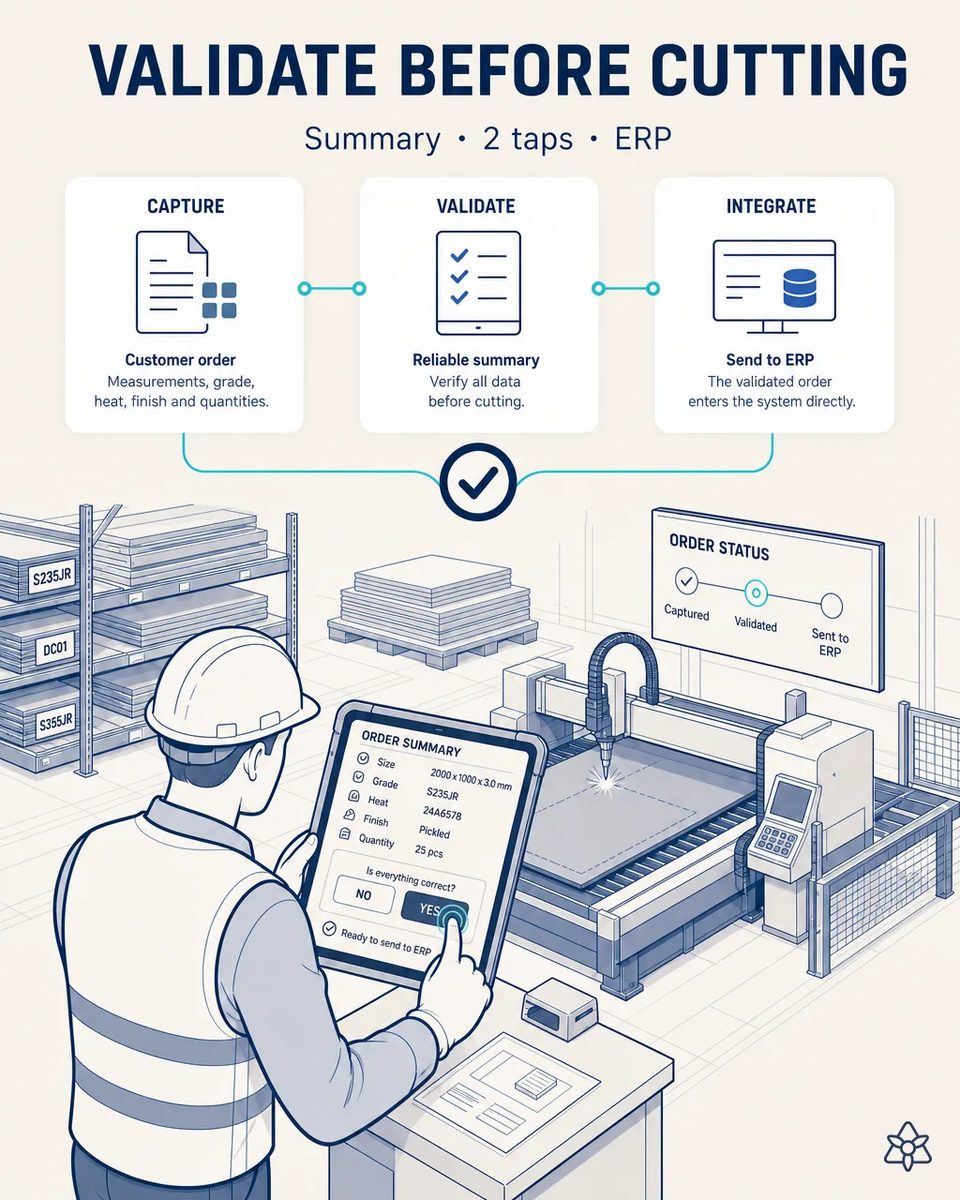
A misread heat number does not stop at the ERP: it ends up on the delivery note.
Without a human gate, any recognition error — a misread size or heat number — would flow straight into the ERP and from there to the invoice and delivery note, the worst place to discover it.
- Without a human gate, any recognition error — a size read as 1990 instead of 1900, a heat number with one character wrong — would flow straight into the ERP.
- And the ERP is not the end of the line. From there it travels to the delivery note and to the invoice, which in this trade is priced by the kilo, and onto the label that goes with the pallet.
- That is the worst possible place to discover it: in front of the customer, with the material already loaded and the paperwork signed.
- It is also the fear that stops the whole project at management level, and it is a reasonable fear: bad data that looks official is worse than no data at all.
Connect with early human verification — an industrial tablet and two taps.
An industrial tablet at the cutting station or supervisor's post shows a clear visual summary of what was captured by photo, voice or email. The operator confirms with 2 taps (✓ / correct) and only then does the data cross into the central system.
Humans in command written into the architecture rather than promised in a slide: whatever was captured by photo, by voice or by email appears as a short summary, and it does not exist in the ERP until somebody has confirmed it. This is the piece that gets the other eleven approved.
Today's data entry versus the validated entry
| Aspect | Today | With iLEAN |
|---|---|---|
| Who writes to the ERP | A person, typing later | A person, confirming now |
| Time per order | Minutes at a terminal | Two taps at the cutting station |
| A misread size or heat number | Found on the invoice | Corrected before it enters |
| Where the summary comes from | — | The order photo, a dictation or an email |
| Who appears as the author | Whoever typed it | Whoever looked at the order |
| Can the AI write on its own | The fear that blocks everything | No, by architecture |
Silent capture error reaching the invoice → error caught and corrected before invoicing or cutting.
Impact estimate — to be validated with your numbers.
The block below is an estimate to be validated against your plant's actual data. We put it forward so the committee has an order of magnitude; we refine it during the assessment.
- No standalone payback — this is an enabling piece and it is honest to say so: it is not monetized on its own.
- What it buys is the reduction in returns and claims for a wrong size or a wrong heat, which the brief flags as the expected benefit and which your own returns log will price better than we can.
- And the approval of everything else: no sensible management team lets a system write the heat number that travels to an invoice with nobody in front of it.
- Plus a record of who confirmed what and when, which is exactly what gets asked for the day a claim lands.
Expected reduction in returns and claims from incorrect size or heat. Estimate to be validated.
And the fair question from the production manager
“If a person confirms in the end, what is the AI actually saving?” — the work is not in deciding, it is in assembling. Today somebody walks to a terminal, finds the order and types grade, thickness, format, quantity and heat. With the gate, the extraction — an anchored task where the best models drop below 1.5% error [1] — arrives already assembled and the operator only confirms or corrects. Every correction is stored, so the system learns where it fails on your own documents.
[1] OpenAI paper "Why Language Models Hallucinate", 2025 — on the reliability of AI in anchored tasks.
What people ask about the validation tablet
Can the AI send anything to the ERP without a tap?
No, and it is not a setting: it is the architecture. Data crosses into the ERP only after a human confirmation, whichever source it came from.
What does the operator see on the tablet?
A short summary: size, grade, thickness, finish, heat number and quantity, with two buttons. It is designed to be read from a meter away and tapped with gloves on, not to be filled in. Nobody is being asked to become a data entry clerk at the cutting station.
Does it hold up the cutting station?
No. Two taps take less time than walking to a terminal, and if the operator is busy the summary waits its turn. Nothing enters until somebody gets to it, and nothing is lost in the meantime.
What exactly is recorded?
What summary was shown, who confirmed it, when, and what they corrected if anything. That is the trail that answers a customer asking who checked their order, and it is also the feedback that makes the reading better on your own paperwork.
Can it sit with the supervisor instead of at the shear?
Yes. In a small warehouse the tablet usually lives at the supervisor's desk; in a busier one it sits at the cutting station. What matters is that the person tapping is the person who saw the order.
More cases from this series
- Heat traceability, ready in secondsEvery critical cut automatically generates its traceability dossier, organized by order.
- A paperless cutting order, at zero latencyDigitize the cutting order and its corrections without changing the shear operator's routine.
- Delivery note and heat certificate, one tap into the ERPPhotograph the delivery note and the supplier's heat certificate; after validation, it all goes to the…
- The heat-control spreadsheet, synced to the ERPiLEAN reads the heat-control spreadsheet on save and syncs it, validated, to the ERP.
- The mill alert that arrives on timeiLEAN reads a delayed-heat or measurement-change alert instantly and suggests the action to take.
- The vintage shear starts talkingRead the parameters of a network-isolated shear with an external camera, without touching the machine.
Come and see the two-tap validation screen on a real order.
We work on your plant's real data, not ours. Assessment with no commitment.
Request estimated ROI within 48h ‹ See all cases of steel sheet distribution See steel