The cut that doesn't pass inspection
At a steel service center's cutting pace, a defect — burr, dent, rust — can slip past the human eye. An Edge camera above the cutting line, with a CNN trained on correct and defective pieces of that specific material, inspects every piece in milliseconds and ejects it before packaging.
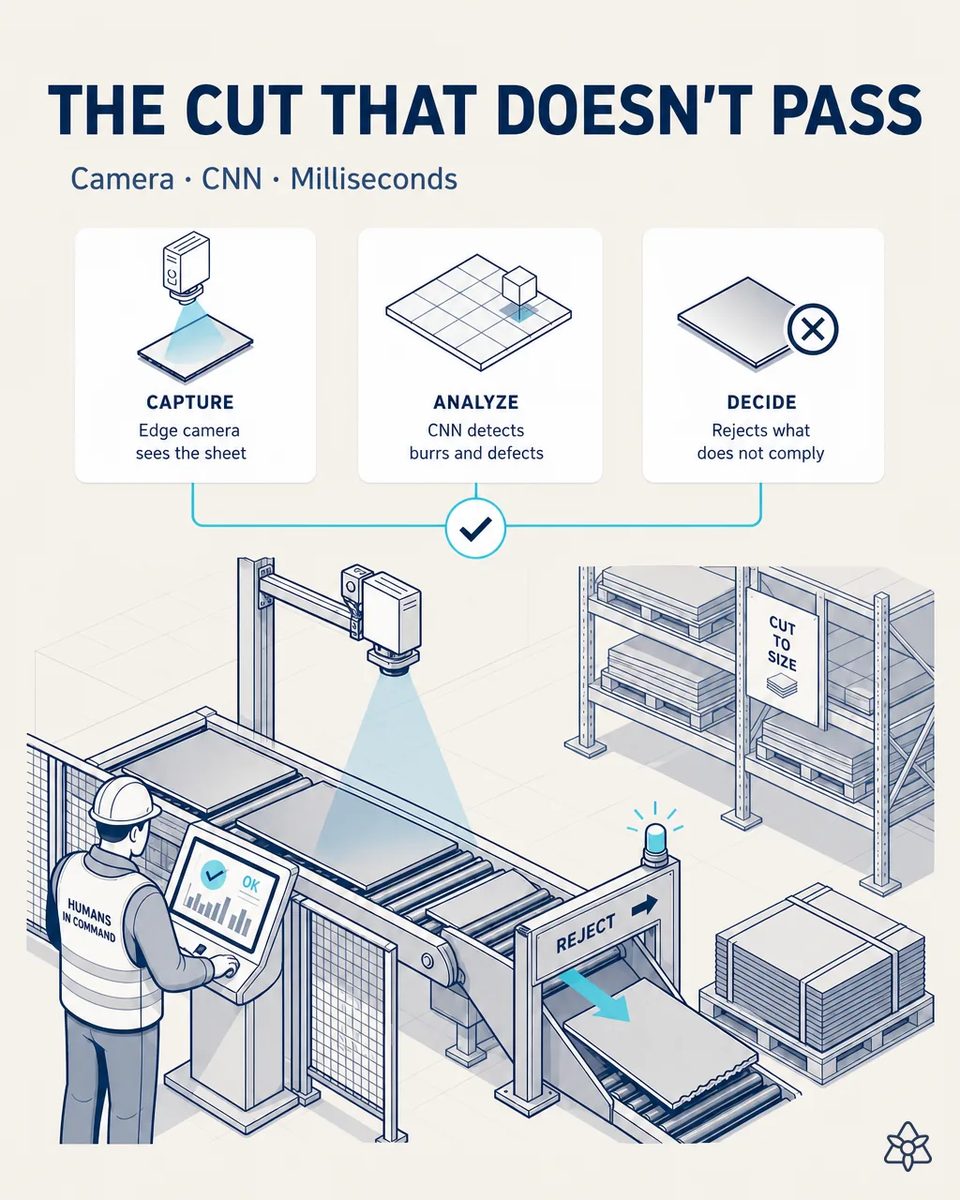
At cutting pace, the defect that gets through is the one the eye cannot catch.
At a steel service center's cutting pace, a defect — burr, dent, rust — can slip past the human eye. The piece reaches the customer's facility, and that's where the out-of-tolerance cut or surface damage gets found.
- A steel warehouse cuts to size all day, in short batches, changing grade and thickness constantly. A burr along one edge, a dent from handling, a patch of rust on a sheet that sat too long: any of them can pass.
- The eye that is supposed to catch them belongs to somebody who is also loading, strapping and moving on to the next order, with a customer waiting at the counter for a job promised within the hour.
- The piece reaches the workshop, and that is where the defect is found — on the customer's bench, with their own job already late.
- And the cost is never just the piece: it is the return, the replacement cut, the transport paid twice and a metal fabricator who starts phoning somebody else.
Edge — a camera over the cutting line and a model trained on your own material.
An Edge camera above the cutting line, with a CNN trained on correct and defective pieces of that specific material, inspects every piece in milliseconds and ejects it before packaging.
Inference runs locally, in milliseconds, on the machine itself: it does not depend on the warehouse network or on the cloud, and it keeps up with the pace of the line. The piece is ejected before it is packed, which is the only moment when fixing it is still cheap.
Today's inspection versus Edge inspection
| Aspect | Visual inspection | With iLEAN Edge |
|---|---|---|
| Coverage | Whatever the eye catches while loading | Every piece, at cutting pace |
| Burr along the cut edge | Found by the customer | Ejected before packing |
| Handling dents and rust | Argued about after delivery | Classified piece by piece |
| Point of detection | The workshop's bench | The cutting line |
| Cost of a miss | Return, recut and double transport | One piece recut on the spot |
| Borderline pieces | Pass, because nobody is sure | Escalated to a person |
Defect discovered at the customer's facility → defect ejected before leaving the warehouse.
Impact estimate — to be validated with your numbers.
The block below is an estimate to be validated against your plant's actual data. We put it forward so the committee has an order of magnitude; we refine it during the assessment.
- At least a 30% reduction in incidents of this type, as an estimate to validate against your own returns log.
- The cost avoided is never the piece: it is the return, the replacement cut and the transport paid twice.
- And the customer relationship, which is what a stockholder actually competes on once the price per kilo is the same everywhere.
- Plus a defect history by grade, thickness and supplier that tells you whether the problem is your shear or the material you bought.
Estimated reduction of at least 30% in this type of incident. Estimate to be validated.
And the fair question from the production manager
“What if it rejects good pieces?” — the false positive is the real risk of any vision system, which is why the model is trained on good and bad pieces of your own grades and thicknesses, under your own lighting, rather than on a generic model. Borderline pieces are not simply thrown out: they are escalated for a person to decide, and every decision feeds back into training. On the classification itself the task is anchored, where the best models drop below 1.5% error [1].
[1] OpenAI paper "Why Language Models Hallucinate", 2025 — on the reliability of AI in anchored tasks.
What people ask about inspecting the cut piece
Does it keep up with our pace?
Yes: inference is local and resolves in milliseconds per piece. Nothing is sent to the cloud and nothing depends on the warehouse network being up.
How many pieces does it need to learn?
Fewer than people expect, because the defect catalog in cut sheet is short and repetitive: burr, dent, scratch, rust, out of square. What matters is that they are real pieces of your own material, cut on your own machine, under the lighting you actually have.
Does it work across grades and thicknesses?
Yes, switching model with the active order. In a warehouse that changes grade several times a day and cuts everything from thin cold-rolled sheet to ten millimeter plate, that is the normal condition rather than the exception.
Does it measure the piece as well as look at it?
It checks the piece against the dimensions on the order within the camera's resolution, which catches gross errors. A caliper check stays wherever your standard puts it; what changes is that it stops being the only check.
What happens to a rejected piece?
It is diverted and recorded with its photo and its order, so it can be recut from the same heat rather than from whatever is nearest on the rack, and so the reason gets counted instead of forgotten. Over a few weeks that count is what tells you where the defects are really coming from.
More cases from this series
- Heat traceability, ready in secondsEvery critical cut automatically generates its traceability dossier, organized by order.
- A paperless cutting order, at zero latencyDigitize the cutting order and its corrections without changing the shear operator's routine.
- Validate before the data reaches the ERPA tablet at the cutting station summarizes what iLEAN captured; the operator confirms with 2 taps.
- Delivery note and heat certificate, one tap into the ERPPhotograph the delivery note and the supplier's heat certificate; after validation, it all goes to the…
- The heat-control spreadsheet, synced to the ERPiLEAN reads the heat-control spreadsheet on save and syncs it, validated, to the ERP.
- The mill alert that arrives on timeiLEAN reads a delayed-heat or measurement-change alert instantly and suggests the action to take.
Tell us how many pieces came back last year for burr or a dent.
We work on your plant's real data, not ours. Assessment with no commitment.
Request estimated ROI within 48h ‹ See all cases of steel sheet distribution See steel