Transdermal patch control with AI — one micron of thickness out is one dose released out.
Controlling a transdermal patch means cross-checking three realities in real time — drug-in-adhesive laminate thickness, API content in the matrix and die-cutting plus pouch sealing. iLEAN automates that cross-check with in-line vision, capture from the thickness gauge however old it is, and an agent that holds the roll or the pouch before cartoning. The person signs.
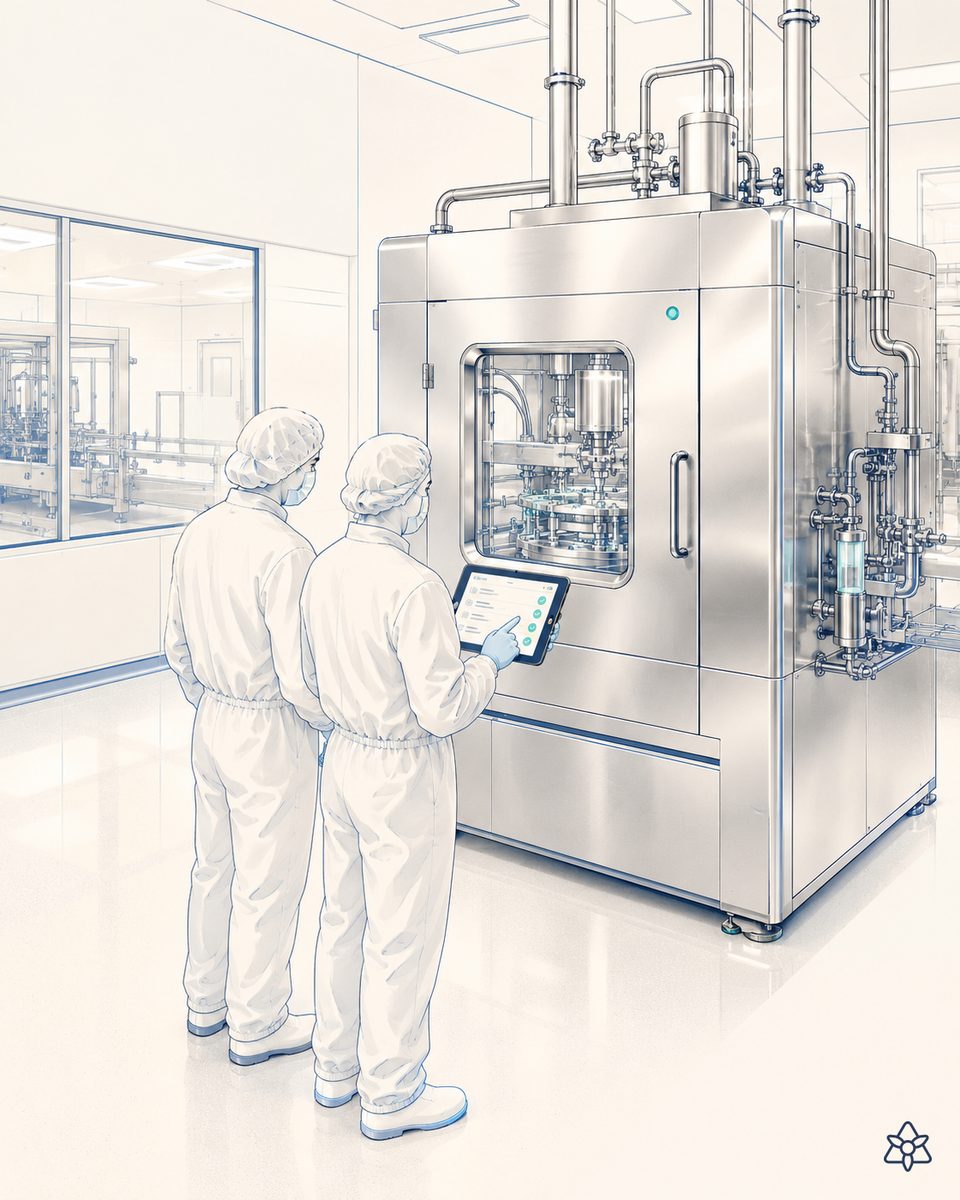
Three plant-floor realities that almost never get cross-checked in time.
On a transdermal patch line — drug-in-adhesive matrix or reservoir, coating onto the liner, rotary die-cutting, foil pouching — the guarantee of the delivered dose rests on three pieces of data that, in most plants, each live on their own island:
- Laminate thickness — microns of API-loaded coating on the liner. It shifts with web speed, oven temperature and blend viscosity. Verified by a beta or laser gauge, but rarely correlated live with visual data and with die-cutting.
- API content in the matrix — the percentage of active ingredient in the blend and the uniformity of the coating. Verified by sampling + IVRT (in vitro release test) at release, not in line.
- Die-cutting and pouch sealing — the dimensions of the cut patch and the integrity of the foil seal. What the operator checks by sampling at the start and end of the batch.
The quality manager knows everything lines up for 99% of the roll. That 1% is what triggers the OOS investigation off the back of an IVRT result — and the suspicion that falls on the whole batch. Caught late it is a deviation; caught in line, it is nothing.
iLEAN does not add a fourth system — it seals the cracks between the three you already have.
The transdermal patch problem is not a lack of information: it is information living on islands that, at the critical moment (thickness gauge drift, a change of adhesive batch, a die-cutting head wearing out), does not reach the person deciding in time. iLEAN acts as the putty that fills those gaps, without asking you to change the coating line or the die-cutter.
Edge sees the matrix, the die-cutting and the pouch seal. Connect reads the thickness gauge wherever it lives — modern PLC, old panel, a forgotten spreadsheet. The agent cross-checks against the recipe and the IVRT specification and, if something does not add up, holds the roll. The person signs — never the other way round.
The three iLEAN pieces applied to transdermal patches:
- Edge — terminals with machine vision (CNN) over the coating line (matrix appearance: bubbles, craters, particles), the die-cutter (cut dimensions and cleanliness) and the pouch packer (foil seal line). It fires actuators (roll marker, pouch rejector, stack light) before cartoning. It works with no network. If the plant loses its internet connection, Edge keeps verifying.
- Connect — captures the thickness gauge whether it comes from the PLC over OPC-UA, from an old terminal via OCR, or from the formulation lead's setpoint spreadsheet. It also captures web speed, oven temperature, blend viscosity and whatever arrives from outside (an email from the R&D lead with a formulation change, a WhatsApp message from the supplier flagging a deviation in an adhesive batch).
- Agent — cross-checks thickness, appearance, die-cutting, sealing, the MES recipe and the IVRT/GMP specification. If there is a deviation it does not send an email at 10pm: it holds the affected stretch of roll and alerts the quality manager through whatever channel they use. The person validates and signs; the line does not restart on its own. And it assembles the batch record with every reading, ready for the auditor.
Transdermal patches controlled by manual IPC vs. cross-checked with iLEAN
| Aspect | Manual control + sampling-based IPC | With iLEAN Edge + Connect + Agent |
|---|---|---|
| Laminate thickness | In-line gauge, not correlated live | Gauge + vision + die-cutting correlated |
| Visual matrix defects | Eyeball sampling at start/end | Continuous CNN vision across the whole web |
| Die-cutting | Calipers every N pieces, the rest assumed | Dimensions and cleanliness verified piece by piece |
| Pouch sealing | Peel test by sampling | Seal line verified pouch by pouch |
| Operation with no network | n/a | Edge keeps running on the panel's own power |
| File for the FDA/EMA auditor | Rebuild it from paper, days of work | Automatic batch dossier with images and traces |
Impact estimate for your plant — to be validated with your numbers.
The block below is an estimate to be validated with the specific data of your plant. We put it forward so the committee has an order of magnitude; we refine it during the diagnostic.
- Pharma plant with a coating line + rotary die-cutter + foil pouch packer for transdermal patches (drug-in-adhesive matrix or reservoir), typical sector web speed, multi-SKU with die changeovers.
- Edge pilot on the line (cameras over the coater, die-cutter and pouch packer + actuators + integration with the thickness gauge and the MES). First value expected within a few weeks.
- Reduction of roll stretches with thickness deviations or visual defects of ≥ 30% in the first pilot batch, depending on the initial severity and the spread of the coater.
- Indicative payback between 4 and 9 months, depending on the documented frequency of IVRT-driven OOS results and the scrap cost of API-loaded adhesive matrix (expensive).
- The hard lever is a single OOS deviation avoided: investigation, rework of the affected roll, risk of a scrapped batch, auditor attention.
And the quality manager's reasonable doubt
“What if the AI gets it wrong and lets through a stretch of roll with thickness out of range?” — hallucination is a problem of free generation, not of anchored tasks. In tasks where the AI simply recontextualizes a piece of data from one system into another (reading the gauge and comparing it with the specification), the best models brought error below 1.5% [1]. And even so, what is critical is never decided alone: iLEAN holds the stretch and the person signs. The three safety rings exist precisely for this.
[1] OpenAI paper “Why Language Models Hallucinate”, 2025 — on the reliability of AI in anchored tasks.
What people ask about transdermal patch control with AI
What transdermal patch defects can AI detect in line?
Three critical families: laminate thickness out of range (the API-loaded adhesive coating varies if web speed or oven temperature drifts, which changes the active ingredient content per unit of surface area), visual defects in the matrix (bubbles, craters, particles or missing adhesive that affect the releasing area) and faulty die-cutting or pouch sealing (out-of-dimension cuts, foil seals made with insufficient pressure or temperature, which breaks barrier integrity). iLEAN Edge sees all three; the agent cross-checks them against in-line gauge thickness and the oven curve.
How is laminate thickness cross-checked against API content per patch?
Active ingredient content per unit of surface area comes out of the drug-in-adhesive blend (API percentage + coating thickness). If laminate thickness drifts, the dose of the die-cut patch drifts with it even when the percentage is correct. Connect reads the in-line beta or laser thickness gauge, web speed, drying oven temperature and the composition of the lamination blend. Edge sees the visual pattern of the laminate. The agent correlates them and, if variance climbs, holds the roll before die-cutting, not after.
Does it work for matrix (drug-in-adhesive) and reservoir patches?
Yes. In matrix patches (drug-in-adhesive), control covers thickness + coating uniformity + die-cutting + pouch sealing. In reservoir patches (with a rate-controlling membrane), you add control of reservoir filling before the backing is closed, which is very close to fill control in single-dose formats: iLEAN Edge verifies level and appearance, Connect reads the filler, the agent correlates and holds if there is a deviation. The die-cutting and pouch sealing part is common to both formats.
How does it fit GMP, USP <724> in vitro release and matrix traceability?
iLEAN is documented as a computerized system under Annex 11: functional specifications, validation plan, IQ/OQ/PQ, complete audit trail. The agent does not decide on release — it proposes, holds and assembles the batch record with the thickness, visual and die-cutting/sealing data the QC lab needs to correlate with USP <724> (in vitro release test) at release. The person signs. In GMP language: documented continuous in-process control, high criticality with human-in-the-loop, a file ready for FDA/EMA.
Do we have to replace the coating line, die-cutter or pouch packer?
No. iLEAN sits on top of the existing line — Coatema/Polytype/Erichsen coater, rotary die-cutter, horizontal foil pouch packer. Edge is fitted as a camera and actuator over each station (it does not touch the coating mechanics or the die-cutter). Connect connects to the machines even when they are old: PLC over OPC-UA or Modbus if they have one; OCR of the local panel if they do not; the formulation lead's setpoint spreadsheet if that is all there is. The integration is real work, not a magic button — but it does not require replacing a seven-figure line.
← MDI inhaler control with AI · Nasal spray control with AI → · Pharma blister control with AI →
More cases in pharma
- Syrup filling control with AI — one milliliter out of range is not an incident, it is an OOS deviation.How iLEAN cross-checks volumetric dosing, viscosity and bottle closure to secure correct pharmaceutical…
- Tablet coating with AI — the defect is not visible in the lab: it is visible in the pan.iLEAN cross-references the coating pan image, process parameters and batch recipe to catch picking,…
- Pharmaceutical topical cream manufacturing with AI — the emulsion does not break during packing, it breaks on the previous shift.How iLEAN cross-checks viscosity, emulsion homogeneity and GMP specs to guarantee consistent…
- AI cold chain for vaccines and biologics — one hour short of −70 °C does not show up on the label.iLEAN traces the temperature of every vaccine and biologic vial from manufacturing to administration. No…
- AI for veterinary pharma — multi-species, multi-dose, a single safety net.How iLEAN cross-checks multi-species recipes, batch data, EMA-CVMP rules and traceability to release…
- AI control of pharma WFI water — the invisible utility that decides the batch.How iLEAN cross-references TOC, conductivity and endotoxins from the WFI loop with the batch in progress…
Tell us your case and in 48h we'll send you the estimated ROI of this AI project for your transdermal patch line.
We work on your plant's real data, not ours. Diagnostic with no commitment.
Request estimated ROI in 48h See pharma