Pharmaceutical topical cream manufacturing with AI — the emulsion does not break during packing, it breaks on the previous shift.
A pharmaceutical topical cream lives or dies by emulsion consistency, the right viscosity and the GMP traceability of the batch. iLEAN Edge sees the filling, Connect captures the mixer and recipe parameters, and the agent cross-checks them against the history of conforming batches. If something drifts, it holds the batch before packing. The person signs.
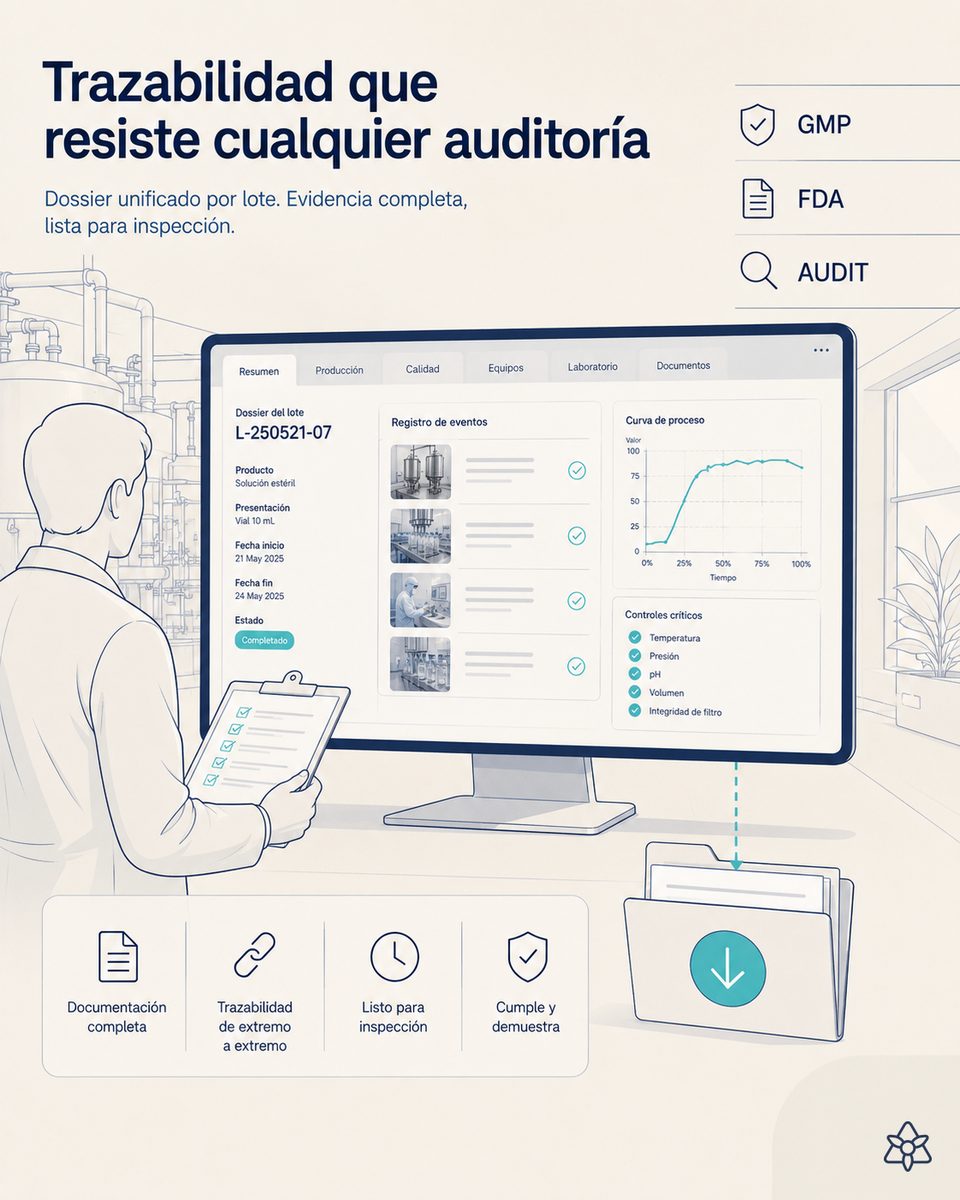
An emulsion that drifts upstream shows up at packing — when it is already batch scrap.
A pharmaceutical topical cream is an emulsion: water phase, oil phase, emulsifiers, active ingredient. It works if three things line up properly:
- The recipe and its parameters — melting temperature of the oil phase, RPM and homogenization time, final viscosity window. It usually lives in the MES or in a process sheet that R&D updates and that does not always reach production in time.
- The raw material batch — the supplier certificate (CoA) carries the profile of the thickener or the emulsifier. It arrives by email, gets filed, and is almost never cross-checked in real time against the batch being manufactured.
- What the mixer actually did — the torque curve, the measured temperature, the total time. It lives in the equipment PLC, sometimes with no record beyond a local log.
The lab takes a sample at the mixer outlet and measures viscosity by rheology; if the result comes back bad, the batch is already packed or going into packing. The QP signs the deviation, opens the CAPA and the cost is absorbed. The problem is not a missing viscometer: it is that the three data sets live on islands and nobody cross-checks them at second zero.
iLEAN does not replace your GMP system — it seals the cracks between the systems you already have.
The problem with process control in topical cream is not a lack of information: it is information living on islands. iLEAN acts as the putty that fills the gaps between the MES, the ERP, the mixer PLC and the supplier CoA — without asking you to change anything.
Connect reads the mixer and the CoAs. Edge sees the tube filler. The agent cross-checks against the recipe and the history and, if something drifts, holds the batch before packing. The person signs — never the other way round.
The three iLEAN pieces applied to topical cream manufacturing:
- Connect — captures the mixer parameters (temperature, RPM, torque, time) by whatever route is available: direct integration with a modern PLC, reading the local computer of an old machine, or a camera that reads the analog panel. And it captures the supplier CoA at second zero (email, PDF, scan) and turns it into data you can cross-check against the batch.
- Edge — a terminal with machine vision (CNN) over the tube or jar filler. It sees visual homogeneity, absence of trapped bubbles, correct fill level. It works with no network. If the plant loses WiFi, Edge keeps reading and holding units that are out of spec.
- Agent — cross-checks the MES recipe, the mixer's real parameters, the CoA of the thickener batch, the history of conforming batches and the outgoing image. If the trend drifts out of the corridor, it does not send an email at 10 pm: it holds the batch before packing and assembles the dossier for the QP. The person validates, signs, and the line runs on.
Manual viscosity control vs. cross-checked control with iLEAN
| Aspect | Manual control + lab | With iLEAN Edge + Connect + Agent |
|---|---|---|
| Viscosity measurement | Spot sample sent to the lab | Continuous mixer curve + cross-checked final reading |
| Cross-check with supplier CoA | Filed in a folder, never cross-checked in production | Cross-checked at second zero against the batch in progress |
| Detection of the drift | Post-packing analysis, OOS opened | Before packing, batch held |
| Cleaning between batches | Paper checklist, manual signature | Traced with real parameters and cross-checked against the next recipe |
| File for the QP | Rebuilt by hand, days | Per-batch dossier, automatic, ready for review |
| Operation with no network | n/a | Edge keeps running on the panel's own power |
Impact estimate for your plant — to be validated with your numbers.
The block below is an estimate to be validated with the specific data of your plant. We put it forward so the QP and the committee have an order of magnitude; we refine it during the diagnostic.
- Pharmaceutical topical cream plant, one line with rotor-stator mixer + homogenizer + tube filler, multi-SKU (with and without active ingredient).
- iLEAN Connect pilot (mixer capture + CoA reading) + Edge (packing). First value expected within a few weeks.
- Reduction of OOS batches caused by viscosity/homogeneity of ≥ 30% over the documented history, depending on incident frequency.
- Indicative payback between 4 and 9 months. The hard lever is the avoided cost of a full GMP deviation: batch held, rework or destruction, CAPA, QP review, management time.
And the quality manager's reasonable doubt
“What if the AI gets it wrong and lets an OOS batch through?” — hallucination is a problem of free generation, not of anchored tasks. In tasks where the AI simply reads a PLC parameter and compares it with a spec from the MES, the best models brought error below 1.5% [1]. And even so, what is critical is never decided alone: iLEAN holds the batch and the QP signs. The three safety rings exist precisely for this.
[1] OpenAI paper “Why Language Models Hallucinate”, 2025 — on the reliability of AI in anchored tasks.
What people ask about pharmaceutical topical cream with AI
What makes a batch of pharmaceutical topical cream fail?
Three patterns keep coming back: an emulsion that separates during filling because the temperature dropped at shift change; viscosity out of spec because the thickener batch came in with a different profile and nobody cross-checked the certificate; cross-contamination between creams with and without active ingredient because the mixer cleaning was not fully documented. It all shows up in outgoing quality control — when it is already scrap for the whole batch or a GMP deviation.
How do you control emulsion viscosity in line?
In most plants, with a lab viscometer on a spot sample — the data arrives after packing. iLEAN Connect reads the mixer parameters (temperature, RPM, torque) every few seconds, cross-checks them against the MES recipe and the raw material batch certificate, and the agent compares the curve with the history of conforming batches. If the trend drifts, it warns before packing — not after.
Does iLEAN integrate with old rotor-stator mixers?
Yes. iLEAN Connect has three graduated capture modes: if the machine has a modern interface, direct integration; if it has a local computer, however old and isolated, Connect hooks up and pulls the data; if the panel is analog, a camera reads it. It does not force you to replace equipment. The same principle applies to homogenizers, tube fillers and any machine upstream of packing.
What does GMP say about process control in topical creams?
EU GMP Part I, chapter 5 requires control of critical process points (CCP) with documented evidence and QP review. ICH Q9 requires you to assess risk and mitigate deviations in a traceable way. A topical cream is not sterile — but its bioavailability depends on the homogeneity of the emulsion, and a non-homogeneous batch is an OOS. iLEAN does not replace your quality system: it supplies the continuous evidence so the QP signs off on data, not on good faith.
How long does an AI pilot on a topical cream line take?
First value in a few weeks with an Edge + Connect pilot on one line — capture of mixer parameters, reading of the packing step and cross-check against the MES recipe. Indicative payback between 4 and 9 months depending on how often viscosity/homogeneity incidents show up in your history and on the average cost of a batch. A single GMP deviation avoided (with its CAPA and its QP review) covers a good part of the pilot. This is an estimate to be validated with your numbers.
Other related topics: Suppositories with AI · Transdermal patch with AI · Nasal spray with AI.
More cases in pharma
- AI suppository manufacturing control — one degree less in the mass is a run of weights out of spec.How iLEAN cross-checks mass temperature, cavity dosing and strip sealing to guarantee the right…
- Syrup filling control with AI — one milliliter out of range is not an incident, it is an OOS deviation.How iLEAN cross-checks volumetric dosing, viscosity and bottle closure to secure correct pharmaceutical…
- Tablet coating with AI — the defect is not visible in the lab: it is visible in the pan.iLEAN cross-references the coating pan image, process parameters and batch recipe to catch picking,…
- Transdermal patch control with AI — one micron of thickness out is one dose released out.How iLEAN cross-checks laminate thickness, API content in the matrix and pouch die-cutting to secure the…
- AI cold chain for vaccines and biologics — one hour short of −70 °C does not show up on the label.iLEAN traces the temperature of every vaccine and biologic vial from manufacturing to administration. No…
- AI for veterinary pharma — multi-species, multi-dose, a single safety net.How iLEAN cross-checks multi-species recipes, batch data, EMA-CVMP rules and traceability to release…
Tell us your case and in 48h we'll send you the estimated ROI of this AI project for your topical cream line.
We work on your plant's real data, not ours. Diagnostic with no commitment.
Request estimated ROI in 48h See pharma