Tablet coating with AI — the defect is not visible in the lab: it is visible in the pan.
Picking, sticking and poor film uniformity appear inside the coating pan within minutes, and are discovered in the lab hours later — when a whole batch is at stake. iLEAN Edge sees what is happening in the pan in real time, Connect captures the process parameters, and an agent cross-references them with the recipe and the actual viscosity of the polymer. If something does not add up, the batch is held before discharge. The person signs.
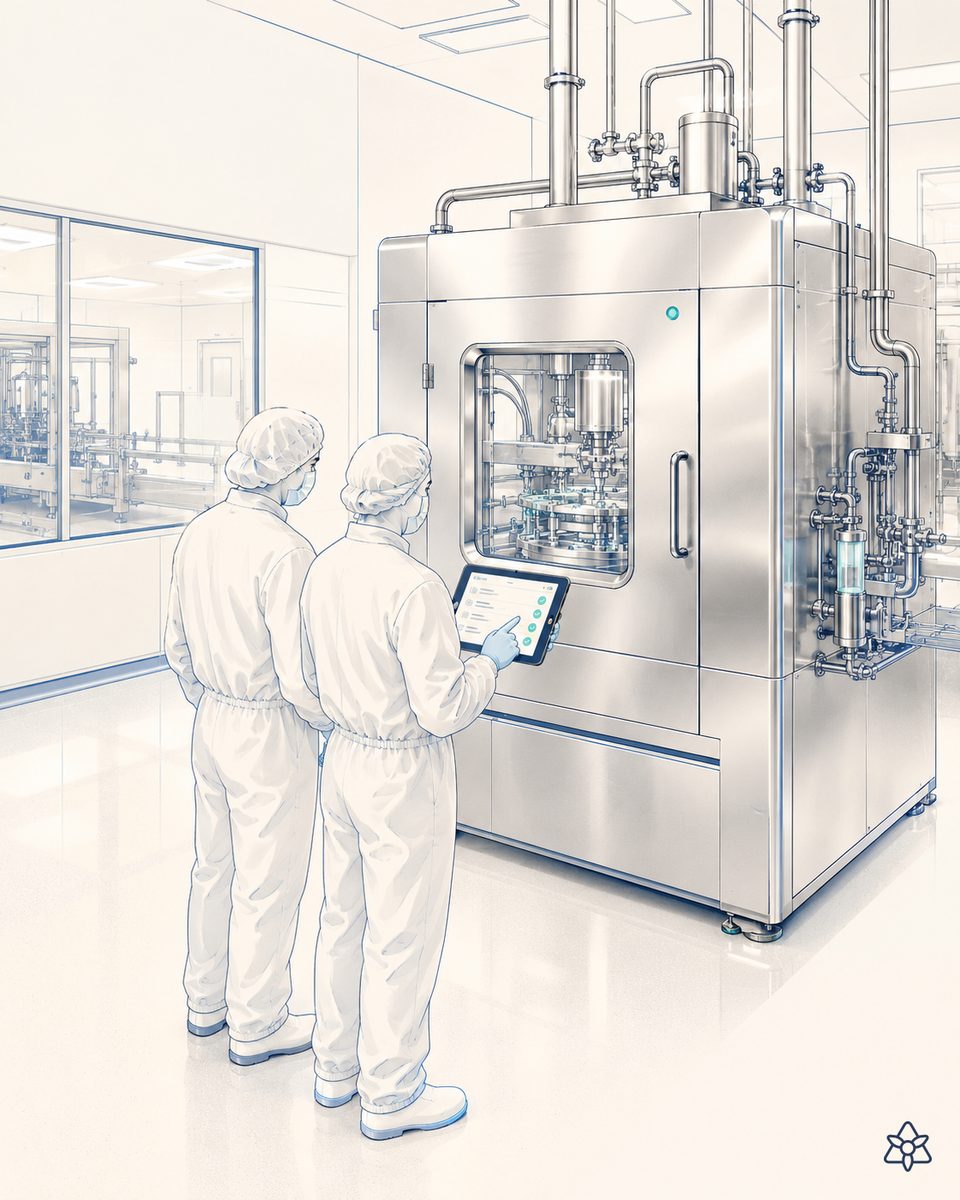
The defect is born in the pan and discovered in the lab.
Tablet coating works 98% of the time. The remaining 2% is what wrecks the whole week's planning — an entire batch rejected, reworked, or worse: released to the market and returned.
The coating operator knows something is wrong before the system does. They can tell from how the spray falls, they feel it in how the pan turns, they see the tablets coming out "dull". But between the moment they notice it and the moment lab sampling confirms it — 120 minutes of process have gone by. And by then the pan has three batches behind it.
The three pieces of data you would need to cross-reference to anticipate the problem live in three different places:
- The batch recipe — theoretical polymer viscosity, suspension %TS, nominal spray rate. In the MES, or in an R&D sheet the scale-up lead updated last week.
- What is happening in the pan right now — product temperature, peristaltic pump speed, inlet air flow, atomization pressure. In the equipment's SCADA, with no cross-reference to the recipe.
- What can be seen inside the pan — color, surface appearance, presence of agglomerates, segregation. The operator sees it through the sight glass every 20 minutes, when they can.
Three islands, each doing its own job well, none of them talking to the others. The defect lives in the joint between the three — and nobody was there listening in time.
iLEAN does not replace your PAT — it puts a brain on top of what it already measures.
Coating control is not a problem of missing sensors. A modern plant already has NIR, Raman, thermocouples and SCADA. The problem is that nobody cross-references those signals with the batch recipe, with the R&D scale-up note and with the image inside the pan in the same second. iLEAN is the putty that seals that crack, without asking you to change your coating equipment or your PAT.
Edge sees inside the pan. Connect captures the recipe, the SCADA parameters and the scale-up note that was sitting in a spreadsheet. The agent cross-references them, anticipates the drift and holds the batch before discharge. The person signs — never the other way round.
The three iLEAN pieces applied to tablet coating:
- Edge — a terminal with machine vision (CNN) over the pan's sight glass or at the sampling point. It reads color uniformity, surface appearance, presence of agglomerates and picking in real time. If something drifts away from the learned pattern of a good batch, it triggers the hold before discharge. It works with no network.
- Connect — captures the recipe whether it comes from the vertical MES, from modern PAT or from the R&D scale-up spreadsheet. And it also captures what arrives from outside: the email from the polymer supplier warning of a viscosity change in the new batch, the internal note on the last deviation. All of it at second zero.
- Agent — cross-references the recipe, the SCADA parameters, the PAT signals and the pan image. If the real curve separates from the pattern of a correct batch, it does not write an email at 10 pm: it notifies the coating lead through their own channel, proposes the adjustment and waits for the signature. The person validates; the line does not restart on its own.
Coating with after-the-fact sampling vs. cross-referenced coating with iLEAN
| Aspect | Classic coating + isolated PAT | With iLEAN Edge + Connect + Agent |
|---|---|---|
| Defect detection | Lab sampling hours later | Inside the pan, in real time |
| Recipe change / scale-up | An R&D note that reaches the MES late | Connect captures the note; the agent applies it |
| Actual polymer viscosity | Assumed from the datasheet | Cross-referenced with the supplier's email for that batch |
| Picking / sticking | Seen in the lab after the batch | Edge detects it and holds before discharge |
| File for an FDA/EMA inspection | Rebuilt from 4 different systems | Automatic per-batch dossier, with images |
| Operation with no network | n/a | Edge keeps inspecting on the cabinet's own light |
Impact estimate for your plant — to be validated with your numbers.
The block below is an estimate to be validated with the specific data of your plant. We put it forward so the committee has an order of magnitude; we refine it during the diagnostic.
- Oral solids plant with 2-4 coating pans, a multi-SKU mix (enteric coating + cosmetic coating), a vertical MES living alongside scale-up notes in spreadsheets.
- Edge pilot on one pan (camera over the sight glass + integration with SCADA and MES). First value expected within a few weeks: the rate of batches rejected for film defects down by ≥ 30%.
- Indicative payback between 4 and 9 months, depending on the average cost of a rejected coating batch and the frequency of incidents documented over the last few years.
- The hard lever is a single batch avoided: product rescued, a pan cycle not repeated, a packaging slot freed. One batch pays for the pilot.
And the quality assurance manager's reasonable doubt
“What if the AI fails and releases a batch with picking?” — hallucination is a problem of free generation, not of anchored tasks. In tasks where the model merely recontextualizes (reading the pan image and comparing it against the learned pattern of a good batch), the best models brought error below 1.5% [1]. And even so, what is critical is never decided alone: iLEAN holds the batch and the person signs with their GMP credential. The three safety rings exist precisely for this. And the pharma quality standard that really matters — the order of 25 PPM demanded in automotive [2] — is only reached with complete capture of reality, not with an audit after the fact.
[1] OpenAI paper “Why Language Models Hallucinate”, 2025 — on the reliability of AI in anchored tasks. [2] Symestic — automotive quality standard on the order of 25 PPM, a cross-industry benchmark for industrial quality.
What people ask about AI in tablet coating
What defects typically appear in tablet coating?
The classic defects are picking (the film is torn away and leaves a crater), sticking (tablets stuck to each other or to the pan), twinning (two tablets joined by the film), orange peel (roughness caused by evaporation that is too fast), erosion, non-uniform color and film weight deviations outside specification. They all share the same pattern: they appear within minutes inside the pan and are only detected when the lab sampling result arrives — too late.
Why doesn't a classic PAT system solve this on its own?
PAT (NIR, Raman, torque and product temperature sensors) does its part very well — it measures. What it does not do on its own is cross-reference what it measures with the batch recipe, with the spray rate that changed 8 minutes ago and with the actual viscosity of the polymer that arrived in this order. That cross-reading is what is missing. iLEAN does not replace your PAT: it puts a brain on top that pulls its signals together with everything else and raises the alert sooner.
How do you validate an AI system under GMP / Annex 11 / 21 CFR Part 11?
The piece that sees and decides at the pan (Edge) logs every inference with a timestamp, a model version and image traceability. The agent that cross-references against the recipe generates signed evidence in ring 2 (validation). What is critical never runs on auto: the system proposes, the person signs with their credential — and it lands in the electronic batch record. It meets the principle of Annex 11 (meaningful human oversight of computerized systems) by design, not as a patch.
Can iLEAN Edge see inside the coating pan without interrupting the process?
Yes. Edge is installed over the pan's sight glass or at the automatic sampling point, with CNN vision trained for that phase of the coating. It reads surface appearance, color, uniformity and the presence of agglomerates at whatever cadence the process defines. It works with no network: if the plant loses WiFi or the link to the MES, Edge keeps inspecting and holding, because in a GMP coating suite what is critical cannot depend on connectivity.
What is the typical ROI of applying AI to tablet coating control?
An Edge pilot on one coating pan, integrated with the recipe and the batch management system, is usually set up with a modest initial investment and a reasonable annual license. Payback lands in a range of several months, depending on the cost of a fully rejected batch and on how often the classic defects show up in your product mix. The hard lever is a single batch saved per shift in the first few weeks. Ask us for the ROI with your numbers — we send it in 48h.
More cases in pharma
- Spray drying with AI — process drift shows up half an hour early, not after the batch.iLEAN cross-checks temperatures, flow rates, residual moisture and the recipe to anticipate spray drying…
- AI suppository manufacturing control — one degree less in the mass is a run of weights out of spec.How iLEAN cross-checks mass temperature, cavity dosing and strip sealing to guarantee the right…
- Syrup filling control with AI — one milliliter out of range is not an incident, it is an OOS deviation.How iLEAN cross-checks volumetric dosing, viscosity and bottle closure to secure correct pharmaceutical…
- Pharmaceutical topical cream manufacturing with AI — the emulsion does not break during packing, it breaks on the previous shift.How iLEAN cross-checks viscosity, emulsion homogeneity and GMP specs to guarantee consistent…
- Transdermal patch control with AI — one micron of thickness out is one dose released out.How iLEAN cross-checks laminate thickness, API content in the matrix and pouch die-cutting to secure the…
- AI cold chain for vaccines and biologics — one hour short of −70 °C does not show up on the label.iLEAN traces the temperature of every vaccine and biologic vial from manufacturing to administration. No…
Tell us your case and in 48h we'll send you the estimated ROI of this AI project for your oral solids plant.
We work on your plant's real data, not ours. Diagnostic with no commitment.
Request estimated ROI in 48h See pharma