AI cold chain for vaccines and biologics — one hour short of −70 °C does not show up on the label.
An mRNA vaccine loses efficacy after 1 hour outside −70 °C, and the vial still looks exactly the same. iLEAN traces every vial without a gap by cross-referencing the data logger, the administrative link and the SKU, and flags the invisible break before it reaches the patient. The person signs the hold decision.
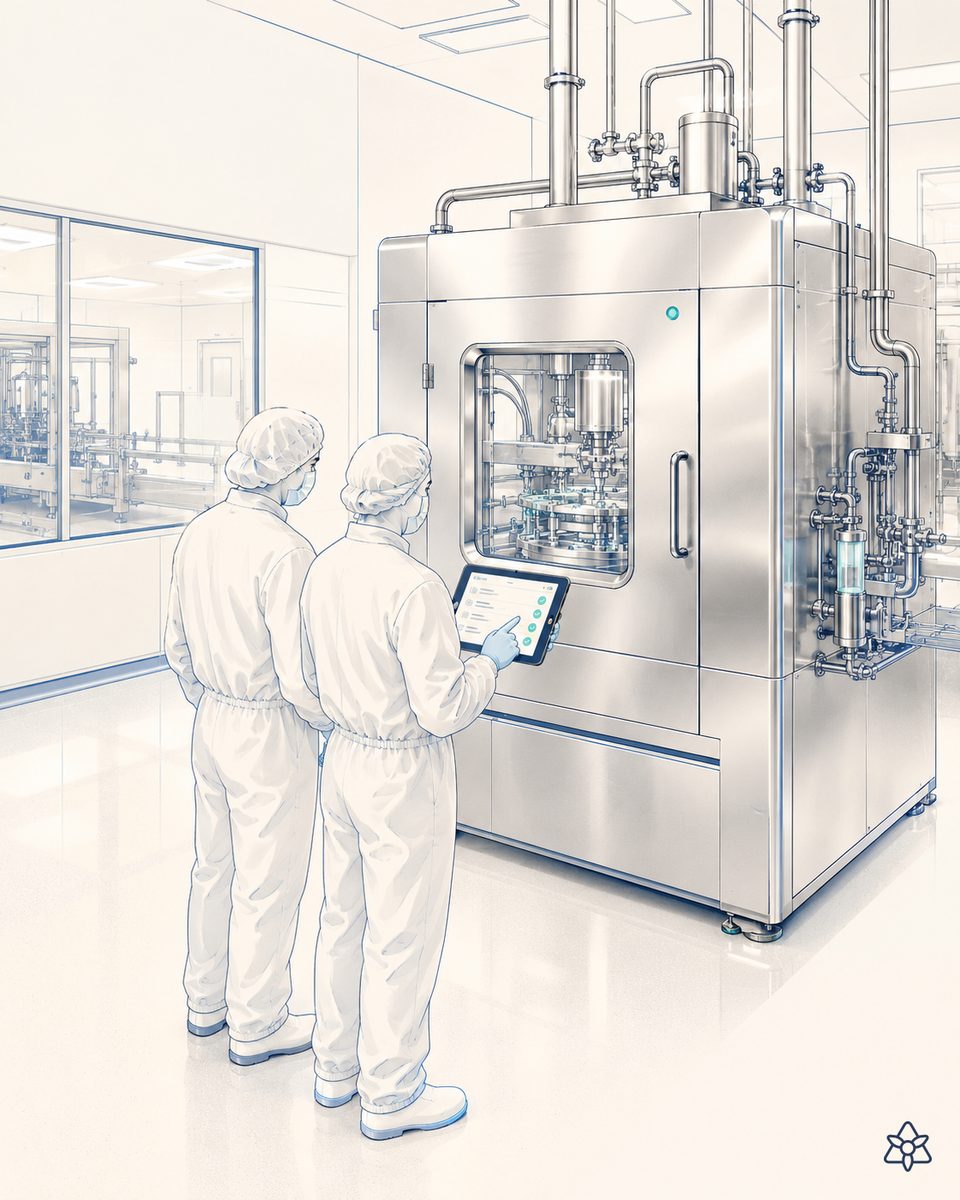
The invisible break — the one that passes on paper and fails in the clinic.
The quality manager at a vaccine or biologics manufacturer lives with a problem that classic GDP does not solve well: the invisible break in the chain. Three realities that never talk to each other:
- The shipment's data logger gives an aggregate temperature curve per box or container. If the curve stays inside the range, the shipment "passes". But a 2-hour spike inside a 3-day trip can compromise a sensitive biologic even though the average curve still looks flat.
- The administrative link (email, EDI, carrier portal, delivery note) tells a tidy, linear story. Reality — the 25 minutes on the Frankfurt dock at 8 °C ambient, the truck transfer that took longer than planned, the hub cold room whose compressor failed in the early hours — almost never makes it onto the delivery note.
- The SKU and the batch have different sensitivities. An mRNA vaccine does not tolerate what a lyophilized biologic tolerates. The rule "it stayed within 2-8 °C" does not apply the same way to every product.
When the complaint arrives from the distribution center (a batch with reduced efficacy, a patient with a poor clinical response), reconstructing what happened takes weeks — and sometimes it is impossible. It is not that the chain fails: it is that it fails without warning.
iLEAN does not replace the carrier — it seals the crack between the temperature, the link and the SKU.
The problem is not a lack of data, it is three pieces of data living in islands: the temperature sensor, the administrative delivery note and the sensitivity of the SKU. iLEAN acts as the putty that joins the three, without asking you to change carrier, data logger or TMS. The architecture, applied to the biologics cold chain:
Connect reads the data logger and the administrative link at second zero. Edge watches the critical dock and cold room. The agent cross-references the SKU's sensitivity and flags the break before the patient. The person signs.
- Connect — captures every channel around the shipment: the data logger (via API or read on receipt), the carrier's EDI/email/portal, the dock supervisor's WhatsApp messages, the photographed delivery note. Everything enters at second zero, with nobody forwarding anything or calling a meeting.
- Edge — terminals with vision over the critical points: the loading dock, the hub cold room, the link change at the distribution center. They detect the vial left outside the cold room, the truck with its door open longer than usual, the tray forgotten on the dock. It works without a network.
- Agent — cross-references the recorded temperature, the administrative itinerary, the real duration of each link and the sensitivity of the SKU/batch. When it detects a real excursion (not merely a limit excursion, but one that this specific product does not tolerate), it alerts the person responsible, holds the shipment at destination and prepares the GDP dossier. The decision to release or recall is always signed by a person.
Traditional cold chain vs. cross-referenced cold chain with iLEAN
| Aspect | Data logger + delivery note + TMS, separately | With iLEAN Connect + Edge + Agent |
|---|---|---|
| Temperature granularity | Aggregated per box/container | Box + link + SKU sensitivity |
| Link change | Signed delivery note, logger data read at the end | Real-time capture, automatic cross-reference |
| Excursion detection | When the data logger is downloaded, days later | In real time, before the next link |
| "Invisible" excursion (inside the average range) | Not detected | Detected with a rule per SKU/batch |
| GDP dossier per shipment | Rebuilt by hand at closeout | Automatic dossier per shipment and per vial |
| Multiple carriers | Data siloed by carrier | Single consolidated view per shipment |
Impact estimate for your plant — to be validated with your numbers.
The block below is an estimate to be validated with your chain's data. We put it forward so the committee has an order of magnitude; we refine it during the diagnostic.
- Biologics or vaccine manufacturer with 3-10 active carriers, box-level data loggers, excursions documented but detected late.
- Connect pilot on multi-carrier integration + Edge on two critical points (your own dock and the main hub or DC). First value expected within a few weeks: a single view per shipment and proactive detection of the first invisible excursion.
- Reduction in documented loss per excursion of the order of ≥30%, conservatively. Indicative payback between 4 and 9 months, depending on annual shipment volume and the average value of a unit.
- Hard lever: a single box saved where before it was written off, or a single batch held in time before it reached the patient. In high-value biologics, one box pays for the pilot.
And the technical argument for the CAIO
“What if the AI infers an excursion wrongly and we hold good product?” — hallucination is a problem of free generation, not of anchored tasks. In tasks where the AI cross-references data from verifiable sources (data logger, delivery note, per-SKU rule), the best models brought error below 1.5% [1]. And even so, the decision to hold or release is always signed by a person: iLEAN's three safety rings guarantee that the AI proposes and the person decides on anything critical.
[1] OpenAI paper “Why Language Models Hallucinate”, 2025 — on the reliability of AI in anchored tasks.
What people ask about an AI cold chain for vaccines and biologics
What does GDP require in the cold chain?
The Good Distribution Practices (EU 2013/C 343/01 and its revisions) require you to maintain and demonstrate an unbroken cold chain between manufacturer and dispensing point. For vaccines and biologics that includes: temperature traceability per shipment, qualified thermal mapping of cold rooms and vehicles, documented excursion management, carrier qualification, and an explicit procedure for what happens when the chain breaks. The difference from classic GDP for an ordinary drug is that here a 1-hour excursion can compromise clinical efficacy without the vial looking any different.
How do you monitor an individual vial?
There are three levels, and iLEAN unifies them: (1) shipment level — a data logger per box or container (the most widespread option); (2) grouping level — small passive tags per tray, read at each link change; (3) vial level — a smart label with an irreversible indicator (TTI) or an active tag, viable for high-value biologics. iLEAN does not impose a level: it reads what the chain already has and cross-references it with the batch recipe and the SKU history to infer the real risk per unit.
What about the critical points in the chain?
The critical points are not the long refrigerated legs, they are the link changes: the outbound dock at the factory, the airport hub, the distribution center, the last mile. These are the zones where the vial is in transition, the person responsible changes and information frequently gets lost. iLEAN Connect captures the handshakes (email, the carrier's WhatsApp messages, TMS integration) at second zero, and an Agent cross-references the physical event (vial left the cold room) with the administrative event (delivery note signed) to detect the invisible break — the one that looks fine on paper.
Does it work with multiple carriers?
Yes. The reality for a vaccine/biologics manufacturer is a network of 3-10 different carriers by geography, each with its own system. Connect has three integration modes: native API with the large players (DHL, UPS Healthcare, Maersk Pharma), email/EDI/portal capture with the mid-sized ones, and assisted capture (a photo of the delivery note + voice dictation) with small regional carriers. The Agent unifies all the data into a single view per shipment, without forcing any carrier to change anything on their side.
How much loss does it prevent?
Estimate to be validated. Product loss in the cold chain has two components: (1) detected excursions that force you to destroy the product, and (2) undetected excursions that reach the patient with reduced efficacy — a brand cost that is hard to quantify but high. A conservative estimate is a reduction in documented loss per excursion of the order of ≥30%, with first value within a few weeks. Indicative payback between 4 and 9 months. The hard lever is a single box saved where before it was written off — for high-value biologics, one box pays for the pilot.
More cases in pharma
- Tablet coating with AI — the defect is not visible in the lab: it is visible in the pan.iLEAN cross-references the coating pan image, process parameters and batch recipe to catch picking,…
- Pharmaceutical topical cream manufacturing with AI — the emulsion does not break during packing, it breaks on the previous shift.How iLEAN cross-checks viscosity, emulsion homogeneity and GMP specs to guarantee consistent…
- Transdermal patch control with AI — one micron of thickness out is one dose released out.How iLEAN cross-checks laminate thickness, API content in the matrix and pouch die-cutting to secure the…
- AI for veterinary pharma — multi-species, multi-dose, a single safety net.How iLEAN cross-checks multi-species recipes, batch data, EMA-CVMP rules and traceability to release…
- AI control of pharma WFI water — the invisible utility that decides the batch.How iLEAN cross-references TOC, conductivity and endotoxins from the WFI loop with the batch in progress…
- An always-ready FDA/EMA audit — the inspection walks in “prepared” because the evidence is live, not filed away.iLEAN keeps GMP evidence live so an FDA/EMA inspection is prepared in hours, not in weeks of sprint.
Tell us your case and in 48h we'll send you the estimated ROI of this AI project for your cold chain.
We work on your chain's real data, not ours. Diagnostic with no commitment.
Request estimated ROI in 48h See pharma