AI control of pharma WFI water — the invisible utility that decides the batch.
Water for injection is the invisible raw material — if TOC, conductivity or endotoxins drift for an instant, the batch is OOS. iLEAN Connect captures the WFI loop parameters whether they come from a modern SCADA or an old PLC, and the agents cross-reference them with every batch in progress, at second zero. The person signs the release.
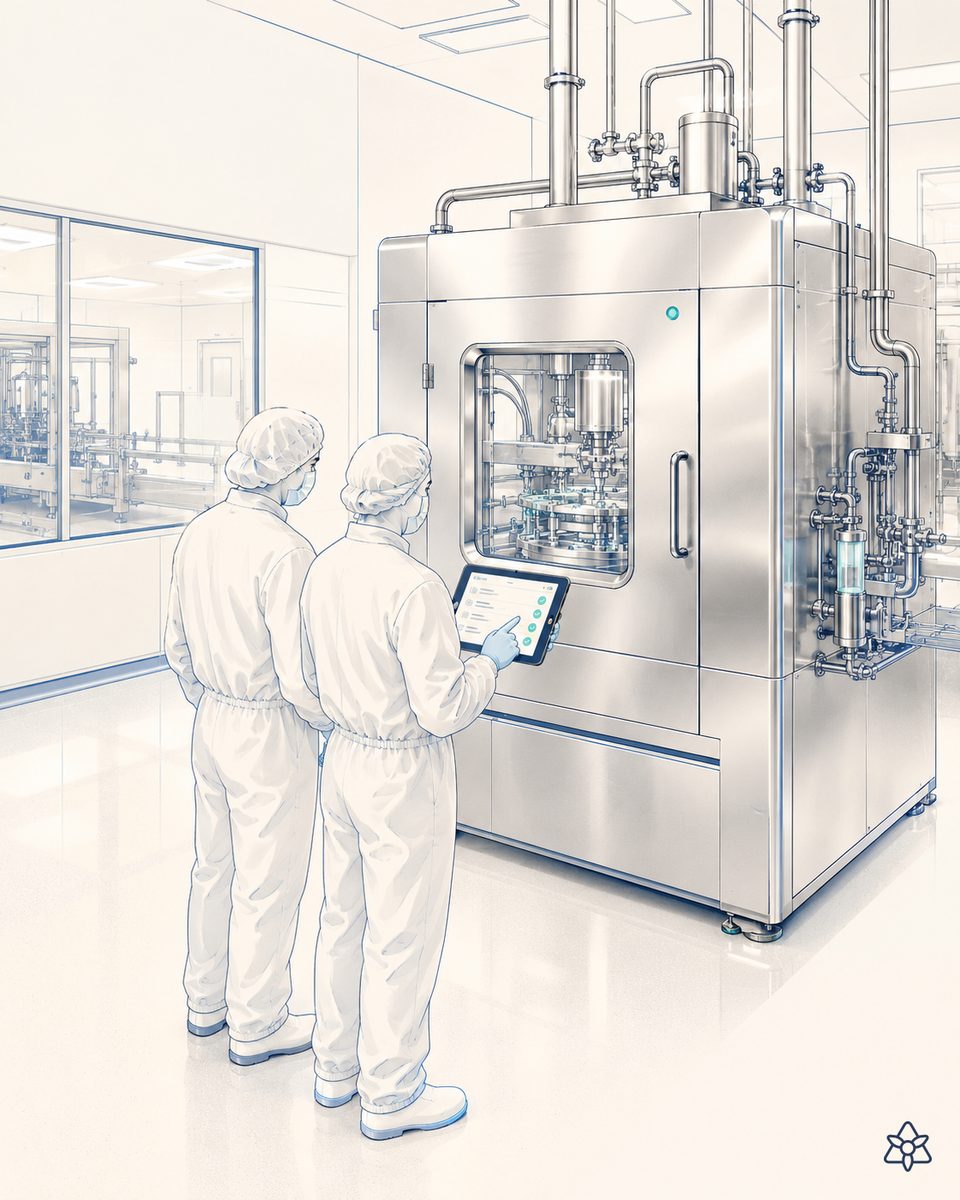
The WFI SCADA holds the truth. And nobody ties it to the batch in time.
Under normal conditions a pharma WFI loop meets USP <1231> and Ph.Eur. 0169 without difficulty — TOC below 500 ppb, conductivity below 1.3 µS/cm, endotoxins below 0.25 EU/mL. The crack is not in the quality of the water: it is in when and how that quality gets cross-referenced with each batch.
- The loop's SCADA has the data every second — but it is usually 15-25 years old, GAMP 5 validated, and it exports daily CSVs that nobody cross-references with the MES.
- The batch MES or EBR knows which point of use drew water and at what time — but it does not know in real time whether TOC drifted for 3 minutes during that draw.
- The QC lab takes periodic samples for endotoxins — but the results arrive hours later, once the batch has already moved on.
The quality director knows this, and an FDA/EMA audit always asks about WFI-to-batch traceability. The classic system works 99% of the time. That 1% is the OOS that reaches the inspector — and a WFI-driven OOS is not an observation, it is a lost batch and a root cause to document.
iLEAN does not replace the SCADA — it cross-references it with the batch at second zero.
The WFI problem is not one of instrumentation: it is information living in islands between the loop SCADA, the batch MES and the QC LIMS. iLEAN acts as the putty that fills those gaps, without asking you to open the validated SCADA or change the LIMS.
Connect reads the SCADA exactly as it is. The agent cross-references with the MES, identifies which batch was drawing water at which point of use, and if TOC, conductivity or endotoxins drift, holds the batch. The person signs — never the other way round.
The iLEAN pieces applied to WFI water control:
- Connect — captures the loop SCADA parameters (TOC, conductivity, temperature, flow, pressure) whether they arrive over modern OPC UA or as a CSV export from a Siemens S7-300. It captures the endotoxin lab results (LAL test) from the LIMS. It captures the CIP/SIP cycles from the cleaning system. All of it, at second zero, without touching anything.
- Agent — cross-references the loop reading with the batch MES/EBR. If TOC rises to 480 ppb for 3 minutes at 14:00, it identifies which batch was drawing water at which point of use at that moment, holds the batch at the next step and generates the deviation file with a cross-referenced root cause (the UV lamp regeneration? the carbon cartridge change? a backflow in the loop?).
- Three rings — the WFI SCADA lives in ring 1 (critical OT, sacred, no inbound connections). iLEAN reads through an armored mailbox: the SCADA only emits, it never receives. The agents that decide live in ring 3, validate in ring 2, and drop signed JSON for ring 1 to pick up. It meets GAMP 5 and the AI Act.
Manual WFI traceability vs. cross-referenced traceability with iLEAN
| Aspect | SCADA + spreadsheet + LIMS | With iLEAN Connect + Agent |
|---|---|---|
| TOC/conductivity reading | SCADA in an island, daily CSV export | Second zero, tied to each batch |
| Instantaneous deviation | Spotted on review, days later | Immediate detection, batch held |
| WFI-to-batch traceability | Rebuilt by hand in a spreadsheet | Cross-referenced automatically per point of use |
| CIP/SIP before the batch | A separate vertical system | Validated and cross-referenced with the schedule |
| OOS file | Manual reconstruction, weeks | Cross-referenced root cause, ready for CAPA |
| Changes to the validated SCADA | n/a | Zero — read-only through an armored mailbox |
Impact estimate for your plant — to be validated with your numbers.
The block below is an estimate to be validated with the specific data of your plant. We put it forward so the committee has an order of magnitude; we refine it during the diagnostic.
- Pharma plant with a 15-25 year old WFI generation loop, legacy SCADA (Siemens S7, Rockwell, Wonderware), 20-40 points of use, a LIMS for endotoxins.
- Connect pilot on the WFI SCADA + an agent cross-referencing the batch MES/EBR. Without opening the validated SCADA. First value expected within a few weeks.
- Indicative payback between 4 and 9 months, depending on how often utility-driven OOS events have occurred in recent years and the average cost of a held batch in your portfolio.
- The hard lever is a ≥30% reduction in WFI-driven OOS investigations (most of them are false OOS events that cross-referenced traceability closes in minutes) plus a single batch rescued through inline detection.
And the pharma IT director's reasonable doubt
“What if the AI ends up with access to the validated SCADA and breaks the qualification?” — the iLEAN architecture is designed precisely so that cannot happen. The WFI SCADA lives in ring 1, sacred. The AI lives in ring 3, where it has freedom. Between the two there is a ring 2 that validates and an armored mailbox (a plant-signed file drop) that only opens from the inside. The SCADA only emits; it accepts no inbound connections. The loop's GAMP 5 qualification is never touched. And the model is anchored to sources — error on anchored tasks falls below 1.5% [1], against the >10% typical of free generation.
[1] OpenAI paper “Why Language Models Hallucinate”, 2025 — on the reliability of AI in anchored tasks.
What people ask about AI-assisted WFI water control
What do the USP/Ph.Eur require for WFI water in pharma?
USP <1231> and Ph.Eur. 0169 define WFI water by three critical parameters: conductivity <1.3 µS/cm at 25 °C, TOC <500 ppb and endotoxins <0.25 EU/mL. On top of that, Annex 1 requires the WFI loop to run in continuous hot recirculation or with periodic sanitization, and every point of use to be monitored online. If any parameter drifts at the moment water is drawn for a batch, the batch is compromised — and the traceability of that deviation is exactly what the inspector will ask for.
How do you cross-reference WFI quality with each batch in progress?
The WFI loop's SCADA has the parameters, but nobody ties them to each batch in real time. If TOC rose to 480 ppb for 3 minutes at 14:00, which batch was drawing water at that point of use at that moment? Without IRIS, that question gets answered in a spreadsheet with help from the shift lead, days later. iLEAN Connect captures the SCADA parameters and ties them to the batch MES/EBR at second zero. The Agents alert the QC manager before the batch is finished. The person signs.
Can iLEAN integrate with an old WFI SCADA without touching it?
Yes — it is the typical case. The WFI loop is usually 15-25 years old, validated under GAMP 5, and nobody wants to open it. iLEAN does not open it: Connect reads the SCADA by whichever method the SCADA allows — OPC UA if it has it, a scheduled CSV/spreadsheet export if that is all it offers, or even a periodic photo of the HMI that the agents recontextualize with less than 1.5% error on anchored tasks. The SCADA stays untouched. The integration lives in ring 3 and the data crosses into ring 1 as signed JSON, validated in ring 2.
What happens if WFI TOC drifts while water is drawn for a critical batch?
Without IRIS: the batch carries on, the deviation surfaces in final QC, the batch is segregated and an OOS investigation opens that takes weeks. With iLEAN: the Agents detect the deviation at second zero, identify which batch was drawing water at that point of use, hold the batch at the next step and generate the deviation file with a cross-referenced root cause. It connects with the digital OOS file.
How is WFI loop CIP/SIP cleaning tied to batch traceability?
Sanitizing the loop (thermal CIP, steam SIP) is a critical operation that has to be documented, validated and tied to the batch schedule. iLEAN Connect captures the CIP/SIP cycles from the SCADA or from the cleaning system, the Agents cross-reference them with the batch calendar and warn if a batch starts before the last sanitization has been validated and signed. It connects with cleaning validation with AI.
More cases in pharma
- Transdermal patch control with AI — one micron of thickness out is one dose released out.How iLEAN cross-checks laminate thickness, API content in the matrix and pouch die-cutting to secure the…
- AI cold chain for vaccines and biologics — one hour short of −70 °C does not show up on the label.iLEAN traces the temperature of every vaccine and biologic vial from manufacturing to administration. No…
- AI for veterinary pharma — multi-species, multi-dose, a single safety net.How iLEAN cross-checks multi-species recipes, batch data, EMA-CVMP rules and traceability to release…
- An always-ready FDA/EMA audit — the inspection walks in “prepared” because the evidence is live, not filed away.iLEAN keeps GMP evidence live so an FDA/EMA inspection is prepared in hours, not in weeks of sprint.
- Annex 1 2023 with AI in sterile packaging — CCS, EM and QRM stopped being paperwork.iLEAN covers the pillars of Annex 1 2023: CCS, environmental monitoring and quality by design in sterile…
- Annex 11 with AI — every change triggers revalidation, and your quality team can no longer keep up.iLEAN keeps continuous CSV and Annex 11 compliance running without falling back on heavy revalidation…
Tell us your case and in 48h we'll send you the estimated ROI of this AI project for your WFI loop.
We work on your plant's real data, not ours. Diagnostic with no commitment.
Request estimated ROI in 48h See pharma