OOS and GMP deviations with AI — QA should not spend weeks looking for what is already in the system.
Investigating an OOS takes weeks of QA team time leafing through records in systems that do not talk to each other. iLEAN cuts that effort with assisted root cause (automatic cross-referencing of method, history, raw materials and deviations), a report draft written by Writer, and CAPAs with real follow-up. The hypothesis and the decision are signed by the QA manager.
An OOS investigation takes weeks — and almost all of that work is searching, not deciding.
The quality director of a pharma plant lives with a chronic bottleneck: every OOS (out-of-specification) opens an investigation the QA team has to close within a legal deadline — and most of the time is not spent thinking, it is spent searching:
- The analytical result is in the LIMS, with its method and its conditions.
- The batch record is in the EBR or on paper — the process conditions of that specific batch.
- Nearby deviations are in the QMS (TrackWise, MasterControl, Veeva, whatever it is).
- The history of the method and the reagent is in another database — when it was calibrated, when the batch was changed, which standard was used.
- Previous batches with similar conditions are scattered across the ERP, the MES, the LIMS and the EBR, and nobody has a cross-referenced view.
The QA manager cross-references all of that by hand, week after week. And then comes the second bottleneck: the CAPA. Corrective and preventive actions live in the QMS with a due date, but real follow-up (was it done? did it work?) gets lost because there is no automatic link to process events. It is not that QA does not know how to investigate: it is that their time goes into finding what the system already holds, only scattered.
iLEAN does not replace the QMS — it puts a librarian inside the labyrinth.
The problem is not a lack of data: having the data joined up with no agent is a library with no librarian; an agent with no capture is a librarian with no library. iLEAN brings both pieces at once: it unifies the islands and puts agents to work on top, without asking you to replace the QMS, the LIMS or the EBR. The architecture, applied to OOS and deviations:
Brain unifies QMS, LIMS, EBR and MES. Agent prepares the root cause dossier in hours. Writer drafts the report. The person validates, decides and signs — always.
- Brain (unified layer) — a knowledge base connected through Connect to your QMS, LIMS, EBR, MES and ERP. It does not move the data somewhere else: it indexes it where it lives and enables natural-language search and automatic cross-referencing. “Give me every batch from the last 18 months with the same raw material as batch 4,537” in seconds, not in a morning.
- Agent (root cause) — when an OOS is opened, the agent automatically prepares the first dossier: it cross-references the analytical method, the LIMS history, the batch record, nearby deviations, batches with similar conditions and the risk matrix. It proposes hypotheses ranked by plausibility. The QA manager validates or rejects them — and the time that used to go into searching now goes into thinking.
- Writer (report + CAPA) — drafts the OOS report following the GMP template and the format the QMS expects. It keeps the CAPA alive: when a corrective action is pending, it flags it; when it has been implemented, it proposes closure with the process-event evidence that demonstrates effectiveness. The signature is always human.
Traditional OOS investigation vs. investigation assisted by iLEAN
| Aspect | Classic OOS investigation (QMS + LIMS + Excel) | With iLEAN Brain + Agent + Writer |
|---|---|---|
| Average investigation time | Weeks, mostly manual searching | Substantially reduced; QA moves from searching to deciding |
| Cross-referencing previous batches | Manual search, system by system | Automatic cross-referencing via Brain in minutes |
| OOS report draft | Written by hand from scratch | Draft generated by Writer, the person validates and signs |
| CAPA follow-up | A due date in the QMS, with no link to the process | Automatic link to process events |
| Decision on batches already distributed | Painful search, with the risk of missing batches | Cross-referenced view by critical conditions |
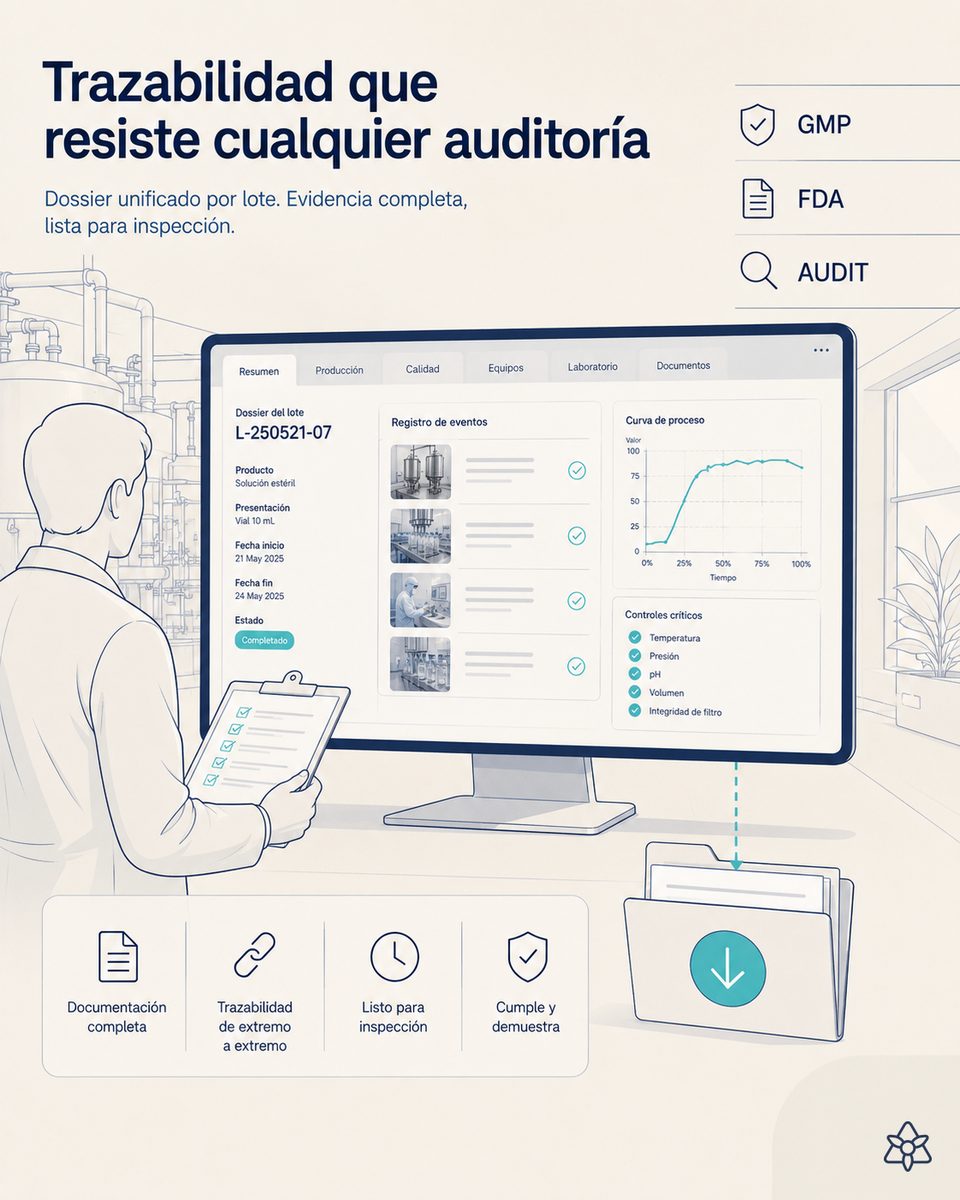
| Audit | Evidence rebuilt by hand | Evidence pack prepared in minutes |
Impact estimate for your plant — to be validated with your numbers.
The block below is an estimate to be validated with your plant's data. We put it forward so the committee has an order of magnitude; we refine it during the diagnostic.
- Mid-sized pharma plant with 50-150 OOS per year, a QMS in place (TrackWise, MasterControl or equivalent), a partially connected LIMS, and a suboptimal on-time CAPA closure rate.
- Brain pilot (QMS + LIMS + EBR integration) + OOS Agent + Writer over the investigation workflow. First value expected within a few weeks: the first assisted root cause dossier and a cross-referenced view per batch.
- Reduction of the average investigation time on the order of ≥30%, conservatively. Indicative payback between 4 and 9 months.
- Hard levers: QA team time freed up for higher-value work, informed and faster batch release decisions (less product held in the warehouse), CAPAs with real follow-up and a measurable effectiveness rate.
The CAIO's data point: digitalization separates who survives from who falls behind
Between 2000 and 2021, the least digitalized sectors barely improved productivity; the most digitalized ones raised it by up to 40% [1]. In pharma, that translates into plants that close OOS investigations in days and plants that close them in months — the cost is not only QA time, it is a slow response to the regulator and a fragile decision chain.
“What if the AI hallucinates on a GMP data point?” — hallucination is a problem of free generation, not of anchored tasks. In tasks where the AI recontextualizes a verifiable piece of data from one system into another (reading a batch record, cross-referencing deviations, drafting a report), the best models brought error below 1.5% [2]. And the report is always signed by the QA manager — the three safety rings guarantee that the critical operation is only executed by a person.
[1] +40% productivity in the most digitalized sectors (2000-2021) — Fundación BBVA / Ivie.
[2] OpenAI paper “Why Language Models Hallucinate”, 2025 — reliability of AI in anchored tasks.
What people ask about OOS and GMP deviations with AI
How does iLEAN assist the root cause of an OOS?
A properly done OOS root cause (FDA Guidance for Industry and EMA Annex 16) requires cross-referencing many sources: the analytical method, the sampling, the lab instrument, the reagent batch, the operator, the process conditions, previous batches, recent deviations. Today the QA team does that cross-referencing by hand, leafing through records. iLEAN Agent prepares the first dossier in hours: it cross-references the OOS result with the method, the analytical history, nearby deviations, batches with similar raw materials and the risk matrix. The hypothesis and the decision are signed by the QA manager — the agent only saves them the searching.
What about batches already distributed?
When an OOS points to a systemic problem, the QA team has to assess whether batches already distributed could be affected. Today that is the most painful part: hunting for batches with similar conditions across scattered files. iLEAN Brain maintains a unified base of batches, raw materials, process conditions and analytical results, and an Agent can answer in minutes: “which batches in the last 18 months share the same critical conditions as the batch under investigation?”. The recall or field action decision is always signed by the responsible person; what changes is that they decide with the complete picture, not with whatever fits into one morning.
Does it integrate with our current QMS?
Yes. The reality of pharma QA is a heterogeneous landscape (TrackWise, MasterControl, Veeva QMS, Excel + email at smaller sites). iLEAN does not replace the QMS: it integrates on top via API where one exists, or via Connect (portal reading, email capture, a photo of the record) where it does not. QMS data enters at second zero; the drafts written by Writer go back into the QMS for signature. Nothing lives outside the official system.
Does it speed up audits?
Yes. The bottleneck in an audit is not answering, it is finding the evidence: where the batch record for batch 23 is, which deviations were opened in April, which CAPA is still open. iLEAN maintains a unified base with natural-language search, and the agent prepares the evidence pack for each inspector question in minutes. Every answer is still signed by the QA manager — the agent only saves them the search.
How much does investigation time go down?
Estimate to be validated. In plants where the average investigation time per OOS runs between 2 and 6 weeks (typical when the QA team does all the cross-referencing by hand), a conservative estimate is a reduction in investigation time on the order of ≥30%, with first value in a few weeks. Indicative payback between 4 and 9 months, depending on OOS per year and the loaded cost of the QA team. The hard lever is a single accelerated batch release decision — the cost of a batch held in the warehouse is high, and the informed decision arrives sooner.
More cases in pharma
- MDI inhaler control with AI — one gram of propellant out of range is one delivered dose out of range.How iLEAN cross-checks propellant fill, valve crimping and leak testing to secure the right MDI inhaler…
- AI mRNA vaccine control — a batch is not signed off on hunches.How iLEAN cross-checks mRNA synthesis, LNP encapsulation and the Annex 1 CCS to secure mRNA vaccine…
- AI nasal spray control — a crimp out of height is a dose out of specification.How iLEAN cross-checks volumetric dose, pump actuation testing and valve crimping to secure the right…
- Granulation and compression in oral solids with AI — real RTRT, not a slide deck for the audit.iLEAN controls granulation, hardness and dissolution in line. Support for real Real-Time Release Testing…
- OTC manufacturing with AI — the line runs too fast to watch. Edge watches it.How iLEAN cross-checks recipe, batch, retail volume and regulation to pack OTC medicines with no…
- Subvisible particles in parenterals with AI — by the time you read it, the batch is already rejected.iLEAN integrates light obscuration data and USP 788 rules to spot subvisible particle trends batch by…
Tell us your case and in 48h we'll send you the estimated ROI of this AI project for your OOS/CAPA system.
We work on your plant's real data, not ours. Diagnostic with no commitment.
Request estimated ROI in 48h See pharma