OTC manufacturing with AI — the line runs too fast to watch. Edge watches it.
An OTC line chains SKU changeovers every hour at consumer-goods speed — ibuprofen 400, ibuprofen 600, pediatric paracetamol, cold-and-flu combos. A label from the previous SKU reused by mistake during the changeover is a recall. iLEAN cross-checks the order, the line history, allergens in excipients and the standard at second zero, and holds the batch before close-out when something does not add up. The person signs.
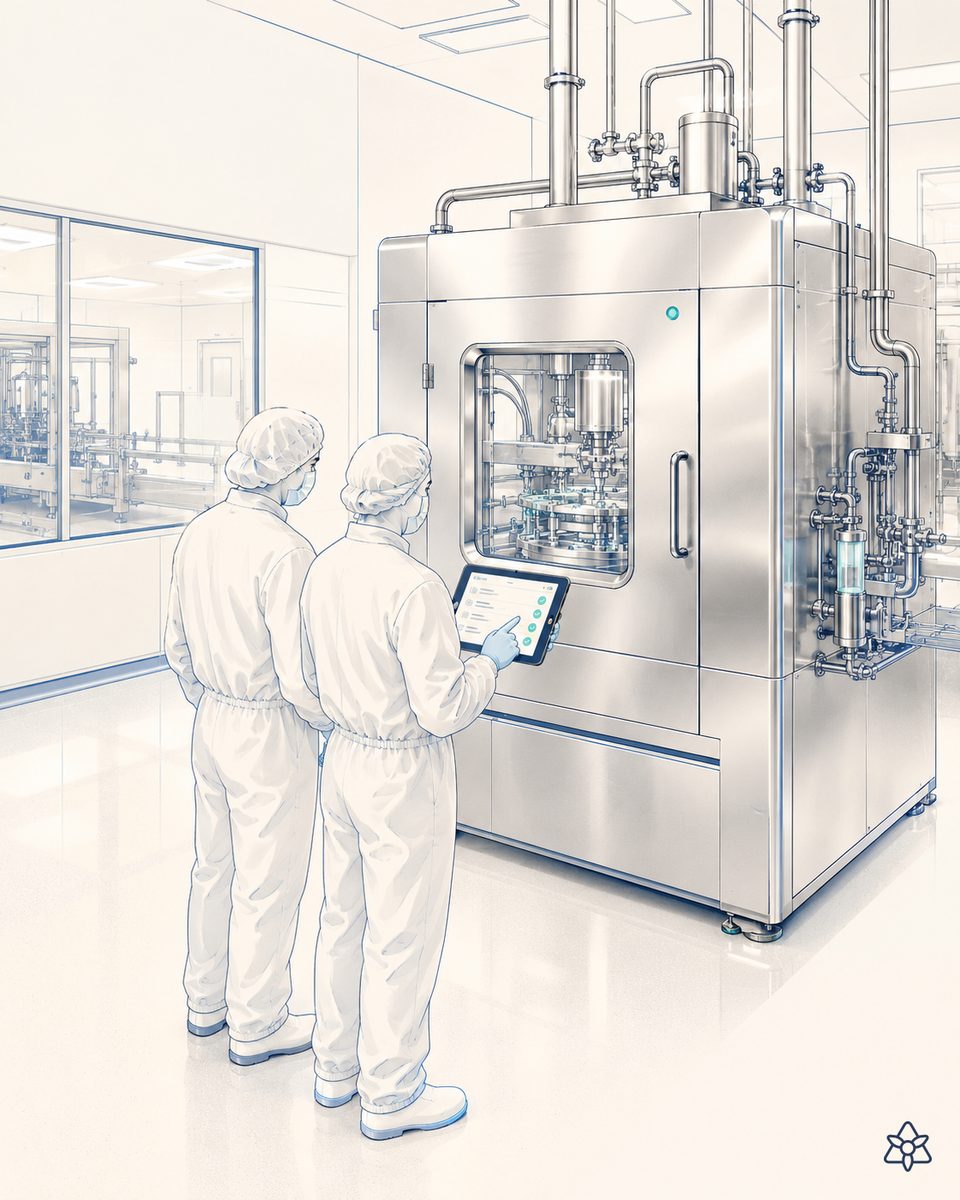
Consumer-goods speed, medicine-grade care — and a SKU changeover every hour.
An OTC line looks like a consumer-goods line in cadence and like a prescription line in risk:
- Constant SKU changeovers — ibuprofen 400 vs. 600, pediatric vs. adult paracetamol, cold-and-flu combos with three different actives, the same brand in 10/20/40 tablet formats. Every changeover is the most vulnerable moment.
- Allergens in excipients — lactose, gluten, wheat starch, aspartame, sorbitol. EU Regulation 1169/2011 requires them to be visibly declared. A supplier changes the tablet excipient without telling packaging and the old label keeps running.
- Retail-ready labeling — the retail chain wants the GTIN/DataMatrix code readable on the first scan. A badly engraved code or a miscoded carton across a whole batch means an entire pallet quietly returned.
The packing manager knows it, but at 200 cartons/minute nobody inspects by eye. The operator has a checklist and a reel changeover every shift. The classic system works 99% of the time. It is that 1% that reaches the shelf — and every time it is a recall, not an incident.
iLEAN does not add a fourth system — it seals the cracks between the ones you already have.
The problem in OTC is not a lack of information: it is information living on islands that, at the SKU changeover, does not reach the person who decides in time. iLEAN acts as the putty that fills those gaps, without asking you to change the ERP, the MES or the packing line.
Edge sees the blister, the carton and the DataMatrix code. Connect reads the order, the new excipient data sheet and the retailer's email with the updated rule. The agent cross-checks against OTC regulation and, if something does not add up, holds. The person signs — never the other way round.
The three iLEAN pieces applied to an OTC line:
- Edge — a terminal with machine vision (CNN) over the blistering machine, the cartoner and the final run-out. It inspects tablet shape, color, blister completeness, carton reading, DataMatrix code and leaflet. If it does not match the SKU of the active order, it fires the reject gate in milliseconds. It works with no network.
- Connect — captures the order whether it comes from the ERP, the MES or a spreadsheet; reads the supplier's excipient data sheet that arrives by email; transcribes the WhatsApp from the chain's buyer with the retail-ready change; reads the cartoner's legacy panel. Everything comes in at second zero.
- Agent — cross-checks the order + line history + pack image + EU Regulation 1169/2011 + the AEMPS product data sheet. If there is a deviation, it does not send an email at 10 p.m.: it holds the batch and alerts the quality manager on whatever channel they use. It generates the dossier ready for inspection.
Manual OTC packing vs. packing cross-checked with iLEAN
| Aspect | Classic packing + checklist | With iLEAN Edge + Connect + Agent |
|---|---|---|
| Hourly SKU changeover | Paper checklist, the line lead's eye | Edge confirms blister + carton + DataMatrix of the active SKU |
| Allergens in excipients | Operator checks the data sheet and assumes it is current | Connect captures the supplier's latest data sheet at second zero |
| DataMatrix/GTIN code | Manual sampling; a failure is found late | 100% in-line reading, batch held if the rate drops |
| The chain's retail-ready rules | An email from the buyer that reaches whoever it reaches | Email + WhatsApp + data sheet captured — available on the floor |
| Operation with no network | n/a — depends on the MES and the server | Edge keeps running on the cabinet's own power |
| Dossier for the regulator/audit | Rebuilt by hand, weeks of work | Per-batch dossier, automatic, with images and signed JSON |
Impact estimate for your plant — to be validated with your numbers.
The block below is an estimate to be validated with the specific data of your plant. We put it forward so the committee has an order of magnitude; we refine it during the diagnostic.
- OTC line doing primary packaging (blister) + secondary packaging (cartoning), 80+ SKUs, changeovers every 1-2 shifts, excipients with declarable allergens in the mix.
- Edge pilot on the cartoner and the final run-out (cameras + DataMatrix reading + actuator + integration with the ERP/MES order). First value expected within a few weeks.
- Indicative payback between 4 and 9 months, depending on the history of non-conformities at SKU changeover, the frequency of returns for retail labeling, and the average cost of a recall.
- The hard lever is one single recall avoided: product pulled from the shelf, reverse logistics, destruction, brand damage. One recall pays for the pilot and leaves the line prepared.
- Reference bar borrowed from automotive (quality per million): on the order of 25 PPM [1]. OTC is not automotive, but the recall risk demands a bar of the same order.
And the quality manager's reasonable doubt
"What if the AI gets it wrong and lets a mislabeled carton through?" — hallucination is a problem of free generation, not of anchored tasks. In tasks where the AI merely recontextualizes a piece of data from one system into another (reading the carton and comparing it with the order), the best models brought error below 1.5% [2]. And even so, what is critical is never decided alone: iLEAN holds the batch and the person signs. The three safety rings exist precisely for this.
[1] The 25 PPM standard in automotive quality — Symestic.
[2] OpenAI paper "Why Language Models Hallucinate", 2025 — on the reliability of AI in anchored tasks.
What people ask about OTC manufacturing with AI
Why is OTC more vulnerable to labeling errors than prescription medicine?
Because the line runs at fast-moving-consumer-goods speed: blisters, cartons and cardboard packs by the thousand per hour, with continuous SKU changeovers driven by the range of presentations (ibuprofen 400 / 600, pediatric / adult paracetamol, cold-and-flu combos with different actives). A label from the previous SKU reused by mistake, a miscoded carton or an allergen wrongly declared on a combo containing lactose means an immediate recall. The classic system (operator + checklist) works 99% of the time. The 1% that fails reaches the shelf and the regulator.
How does AI control constant SKU changeovers on an OTC line?
By cross-checking, at second zero, the work order, the line history (which SKU has just run, with what intermediate cleaning) and the image of the pack, blister, leaflet and carton that iLEAN Edge reads at line speed. If the carton label belongs to the previous SKU, or if the leaflet declares an active ingredient that is not the one in the active order, the agent holds the batch before close-out and alerts the manager. The person signs — the line does not restart on its own.
What does OTC regulation require that a classic system does not cover well?
OTC is still a medicine and moves within EudraLex Vol. 4 GMP, the FMD / Directive 2011/62/EU (serialization where applicable, although OTC is usually excluded), EU Regulation 1169/2011 as far as allergens in excipients go (lactose, gluten, aspartame, sorbitol), and the AEMPS/AESAN guidance on visible composition. A classic ERP-MES covers the nominal case, but the deviations (a supplier changing an excipient, a new allergen, a batch with an unreadable QR code) usually live in spreadsheets or in email. iLEAN Connect captures those islands and the Agents cross-check them against the order and the standard.
Can iLEAN Edge inspect at OTC line speed?
Yes. Edge is a terminal with machine vision (CNN) on the line — it inspects the blister (shape, color, contents), the carton's DataMatrix/QR code, the leaflet and the closure. With actuators in milliseconds (45 ms in paint applications). If the pack does not match the SKU of the active order, it fires a reject gate or a stack light. It works with no network: if the plant loses WiFi, Edge keeps reading and holding, because what is critical cannot depend on connectivity.
How much does an AI pilot cost for a high-speed OTC line?
The order of magnitude of an Edge pilot on an OTC line is close to that of any Edge pilot in a pharma plant doing primary/secondary packaging: an initial investment covering terminals + cameras + actuator + ERP/MES integration, plus an annual license. The reasonable payback to put in front of the committee is several months — the hard lever is the cost of a single recall avoided (product pulled from the shelf, reverse logistics, destruction, brand damage with pharmacy chains and large retail). We ask for your plant's data and send you the estimated ROI in 48h, with your numbers, not ours.
Related: Veterinary pharma with AI · Drug-device combination products · FMD serialization with AI.
More cases in pharma
- AI nasal spray control — a crimp out of height is a dose out of specification.How iLEAN cross-checks volumetric dose, pump actuation testing and valve crimping to secure the right…
- OOS and GMP deviations with AI — QA should not spend weeks looking for what is already in the system.iLEAN cuts OOS investigation time and keeps every CAPA under real follow-up. No deviation forgotten, no…
- Granulation and compression in oral solids with AI — real RTRT, not a slide deck for the audit.iLEAN controls granulation, hardness and dissolution in line. Support for real Real-Time Release Testing…
- Subvisible particles in parenterals with AI — by the time you read it, the batch is already rejected.iLEAN integrates light obscuration data and USP 788 rules to spot subvisible particle trends batch by…
- Pharma Class I/II/III recall with AI — in a Class I every hour counts, and the downstream trail is never ready.iLEAN runs a pharma recall in hours: batch identification, affected hospitals and pharmacies, and the…
- Real AI cases in hormonal pharma13 real AI cases for hormonal oral solid pharma plants: a paperless MBR, Edge-validated cleaning, zero…
Tell us your case and within 48h we'll send you the estimated ROI of this AI project for your OTC line.
We work on your plant's real data, not ours. Diagnostic with no commitment.
Request estimated ROI in 48h See pharma