Combination products with AI — two regulatory worlds, one line, no gap in between.
An autoinjector, an MDI inhaler or a prefilled syringe carries pharma GMP on the drug and ISO 13485 + MDR 2017/745 on the device at the same time. The plant ends up with two parallel QMS and a gap in the middle where mismatches slip through. iLEAN cross-checks batch, UDI, physical fit and standard at second zero, and holds the assembly before packaging if something does not add up. The person signs.
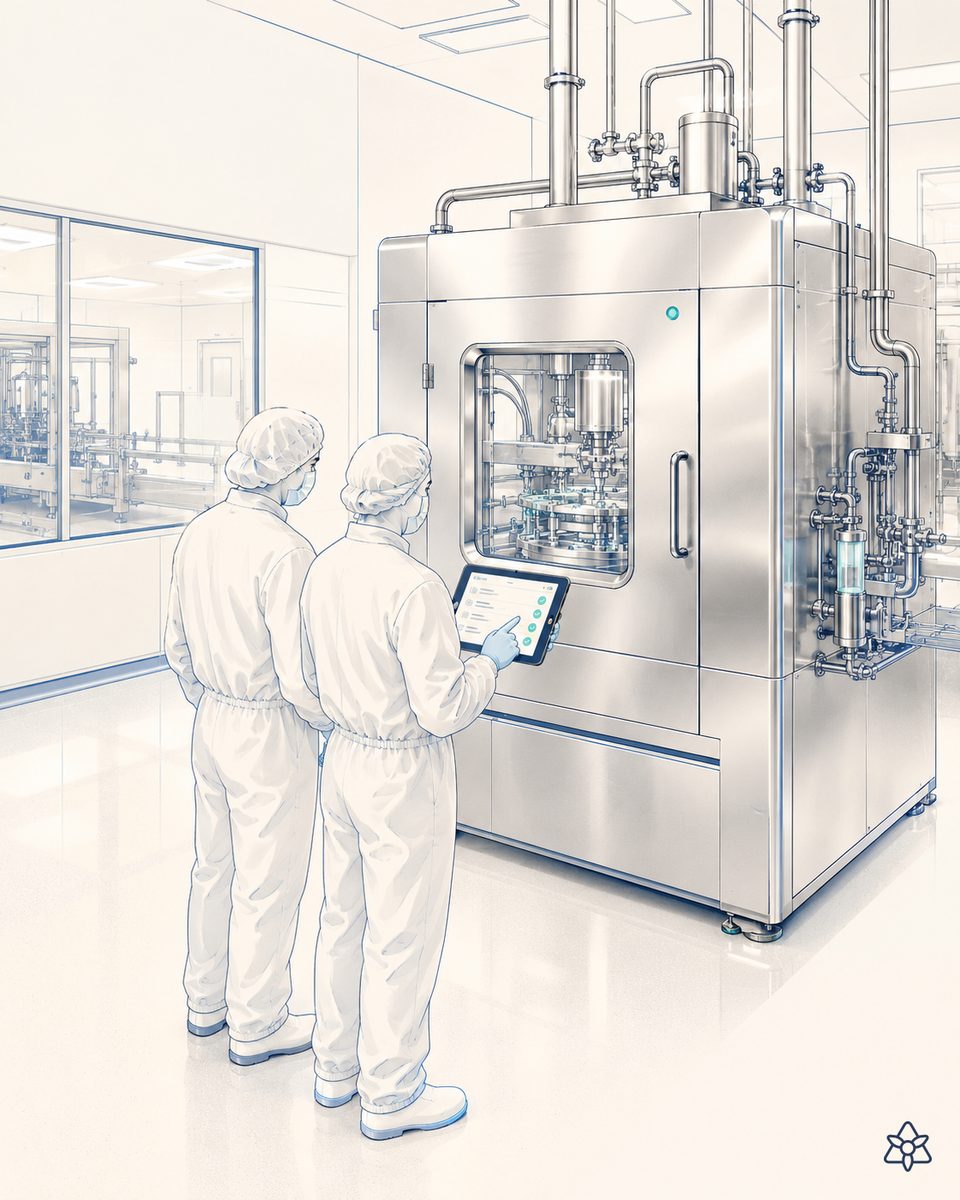
Two regulatory frameworks in the same box — and the dead zone right in between.
A combination product (autoinjector, MDI/DPI, active patch, prefilled syringe, kit with a reagent) carries two quality systems at once:
- Pharma GMP on the drug — EudraLex Vol. 4, the relevant annexes, data integrity, batch dossier, QP release.
- ISO 13485 + MDR 2017/745 on the device — Notified Body, living technical file, mandatory UDI, EUDAMED, Article 117, post-market surveillance.
- And the assembly — where the two meet: physical fit, firing force, reading of the engraved UDI, pairing between drug batch and device serial. This is where the two QMS stop talking to each other.
The plant ends up with two parallel MES (one pharma, one medical device), two quality teams, and a spreadsheet kept by the line lead that "joins" both sides by hand every shift. The classic system works 99% of the time. It is that 1% the Notified Body finds during the audit — or, worse, the one that reaches the patient as an autoinjector that does not fire.
iLEAN does not add a third QMS — it seals the dead zone between the two you already have.
The problem with combination products is not a lack of information: it is information living on two regulatory islands that do not talk to each other and that, at assembly (the critical moment), do not reach the decision-maker together. iLEAN acts as the putty that fills that gap, without asking you to change the pharma MES, the device MES, or either QMS.
Edge sees the assembly, reads the engraved UDI and measures the firing force. Connect captures the drug batch and the traceability of the device component. The agent cross-checks against GMP + MDR and, if something does not add up, holds the assembly. The person signs — never the other way round.
The three iLEAN pieces applied to a combination product line:
- Edge — a terminal with machine vision (CNN) over the assembly station. It verifies the drug-device fit (the syringe going into the autoinjector body, the canister going into the MDI), reads the laser-engraved UDI on the device, and indirectly measures firing force or the weight of the assembly. It fires a reject gate or a stack light in milliseconds if something does not add up. It works with no network.
- Connect — captures the drug batch from the pharma MES, the component serial number from the medical device MES, the CE certificate from the spring supplier that arrives by email, the latest version of the technical file that R&D updates in a shared folder. Everything comes in at second zero, without anyone having to forward anything.
- Agent — cross-checks pharma batch + device UDI + physical assembly + EudraLex Vol. 4 + ISO 13485 + MDR 2017/745. If there is a mismatch or a deviation, it holds the batch and alerts the QP and the device lead at the same time. It generates the combined dossier (pharma batch + device DHR) ready for the Notified Body without anyone rebuilding it by hand.
Manual combination product assembly vs. assembly cross-checked with iLEAN
| Aspect | Two QMS + the line lead's spreadsheet | With iLEAN Edge + Connect + Agent |
|---|---|---|
| Pairing drug batch + device serial | Manual spreadsheet at the end of the shift | Automatic pairing at second zero, unit by unit |
| UDI engraved on the device | Sampling; a failure is found late | 100% read by Edge, batch held if the rate drops |
| Physical fit syringe-body / canister-MDI | Operator's visual check | Edge verifies fit + indirect firing force |
| Documentation for the Notified Body | Rebuilt by cross-checking two MES, weeks of work | Combined dossier generated continuously |
| Component supplier change | Email to QA → it may reach the line | Connect captures the CoA and the CE certificate at second zero |
| Operation with no network | n/a | Edge keeps running on the cabinet's own power |
Impact estimate for your plant — to be validated with your numbers.
The block below is an estimate to be validated with the specific data of your plant. We put it forward so the committee has an order of magnitude; we refine it during the diagnostic.
- Combination product assembly line (autoinjector, MDI, prefilled syringe, active patch) with two parallel MES and a single or multiple supplier for the device component.
- Edge pilot on the assembly station (camera over the fit + UDI reading + actuator) + Connect bridging the pharma batch with the device serial number. First value expected within a few weeks.
- Indicative payback between 4 and 9 months, depending on the frequency of mismatches detected late, the average cost of a Notified Body finding on UDI/technical file, and the current QA workload spent reconciling two MES.
- The hard lever is one single drug-device mismatch avoided in production + a sustained reduction in QA time spent reconciling two MES. One recall or one MDR finding pays for the pilot.
- Reference bar borrowed from automotive to anchor quality per million: on the order of 25 PPM [1]. Combination products are not automotive, but the bar is useful.
And the reasonable doubt of the QP / device lead
"What if the AI gets it wrong and releases a combination product with a mispaired UDI?" — hallucination is a problem of free generation, not of anchored tasks. In tasks where the AI merely recontextualizes a piece of data from one system into another (reading the engraved UDI and comparing it with the pharma batch), the best models brought error below 1.5% [2]. And even so, what is critical is never decided alone: iLEAN holds the batch and the person signs. The three safety rings exist precisely for this.
[1] The 25 PPM standard in automotive quality — Symestic.
[2] OpenAI paper "Why Language Models Hallucinate", 2025 — on the reliability of AI in anchored tasks.
What people ask about combination products with AI
What is a combination product and why is manufacturing it more complex?
A combination product is a healthcare product in which a medicine and a medical device are integrated: an autoinjector with a prefilled syringe, an MDI/DPI inhaler, an active transdermal patch, a diagnostic kit with a reagent, a prefilled syringe. Manufacturing it carries two regulatory frameworks at once: pharma GMP (EudraLex Vol. 4) for the drug and ISO 13485 + MDR 2017/745 for the device. Each framework has its own language, its own quality system and its own traceability expectation — and between the two there is usually a dead zone where problems slip through.
How does AI control drug + device assembly in line?
By cross-checking, at second zero, the drug batch (prefilled syringe, vial, MDI canister), the device traceability (autoinjector UDI, actuator serial number, spring batch) and the assembly result as seen in line by iLEAN Edge (correct fit, firing force within spec, reading of the engraved UDI). If a device component does not match the drug batch being loaded, the agent holds the assembly before packaging. The person signs — the line does not restart on its own.
How do GMP and MDR / ISO 13485 coexist in one plant without duplicating systems?
The classic option is to run two parallel QMS (one pharma, one device) and a team that reconciles them by hand. The iLEAN option is Connect capturing both systems as data at second zero (the drug batch from the pharma MES, the device UDI from the medical device MES, the CE declaration of conformity for the component that arrives by email from the supplier) and Agents cross-checking them against both standards. It does not replace either QMS; it seals the dead zone between them.
What does MDR 2017/745 require for combination products that a classic pharma system does not cover?
MDR 2017/745 introduces: mandatory UDI (Unique Device Identification) on the device, the European EUDAMED database, a living technical file, post-market surveillance with PSUR, and Article 117, which obliges the medicine manufacturer to provide evidence of device conformity. A pharma ERP-MES covers the drug batch; it rarely manages UDI or the device technical file. iLEAN covers the gap by capturing both sides and generating the combined dossier.
How much does an AI pilot cost for a combination product line?
The order of magnitude of an Edge pilot on a combination product line (autoinjector, MDI or active patch assembly) is close to that of an Edge pilot in pharma primary packaging, with an additional Connect module to bridge the device side. The reasonable payback to put in front of the committee is several months — the hard lever is the cost of a single recall for a drug-device mismatch or of a Notified Body finding on UDI/technical file. We ask for your plant's data and send you the estimated ROI in 48h, with your numbers, not ours.
Related: Autoinjector / pen with AI · MDI inhaler with AI · Prefilled syringe with AI.
More cases in pharma
- Pharmaceutical capsule filling with AI — the dose drifts before blistering, not after.iLEAN cross-references dose, capsule integrity and residual powder inline with the MES recipe; the agent…
- Cleaning validation with AI — dynamic MACO and continuous swab/rinse, without a bottleneck at every changeover.iLEAN runs continuous cleaning validation with dynamic MACO for multi-product equipment.
- Clinical trial supply with AI — a site with no kit is a patient lost.How iLEAN cross-references IRT/RTSM, depots, sites and kit traceability to anticipate stockouts, protect…
- AI-assisted CIP/SIP on direct impact equipment — an excursion you see coming never becomes a deviation.How iLEAN cross-references CIP, SIP and direct impact (DI) equipment — skid, BMS and MES capture, plus…
- Pharmaceutical dispensing with AI — one badly signed weighing costs the whole batch.How iLEAN cross-checks weighings, raw material and work order in the dispensing booth: Edge reads the…
- EBR with AI — the batch ships in hours because QA only sees what departs from what was approved.iLEAN generates the electronic batch record with review by exception. QA only looks at what is anomalous.
Tell us your case and within 48h we'll send you the estimated ROI of this AI project for your combination product line.
We work on your plant's real data, not ours. Diagnostic with no commitment.
Request estimated ROI in 48h See pharma