Prefilled syringe inspection with AI — every unit leaves with its own file, not just its batch number.
A prefilled syringe is a parenteral with a device attached: it needs flawless visual inspection, dose within spec and serialized FMD traceability. iLEAN Edge sees every unit in line, Connect cross-checks with MES/SCADA and the serialization system, and the agent assembles the Annex 1 file ready for the auditor — per batch, and per unit when needed. The QP signs with the evidence in hand.
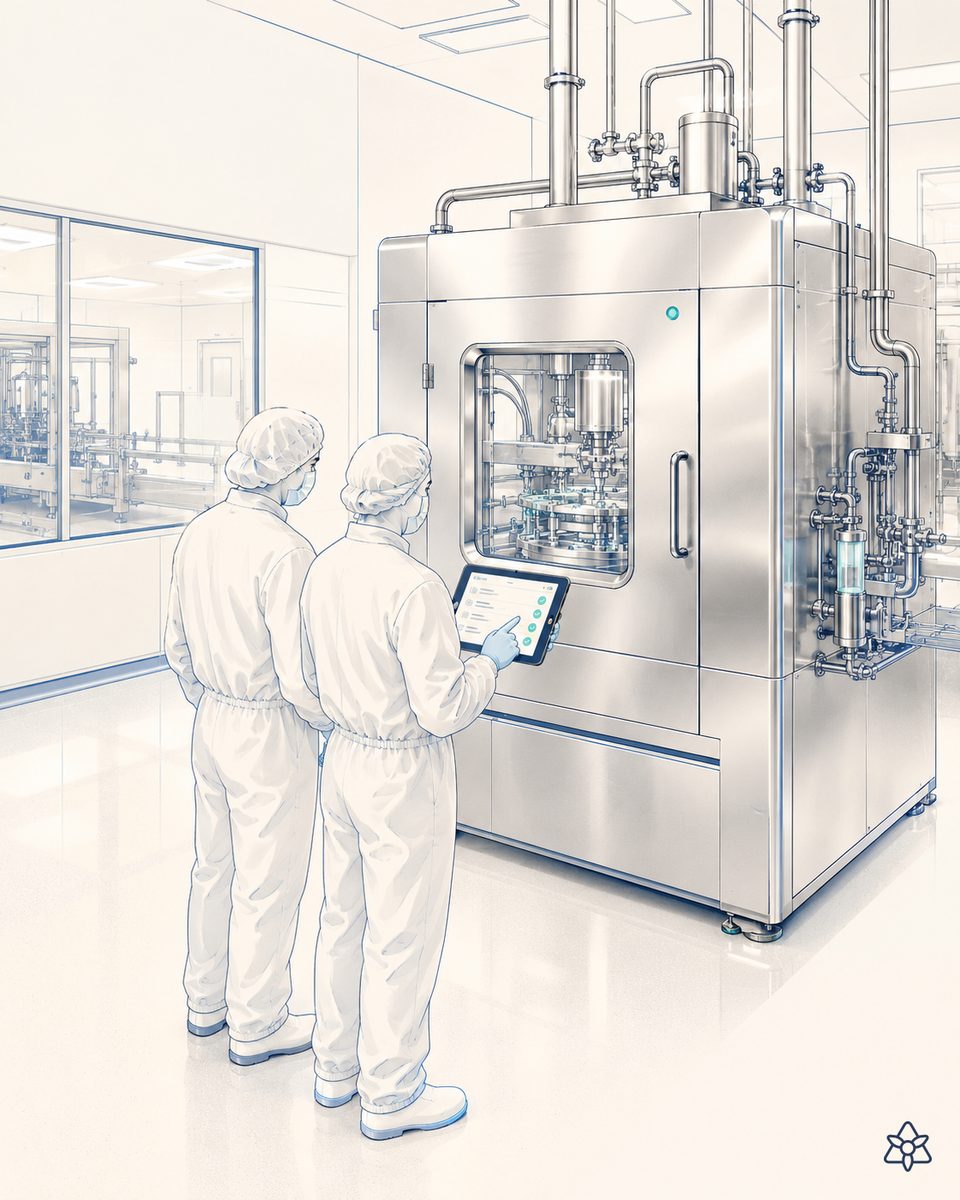
The inspection machine fires a false alarm — and the operator loosens the thresholds.
A prefilled syringe line has the equipment. The problem is that everyday reality forces people to cheat with it:
- The automatic visual inspection machine fires hundreds of false alarms per shift: glass reflections, micro-bubbles that are not defects, label positions inside tolerance that the model reads badly. The operator, under pressure on OEE, loosens the thresholds — and then a real particle slips through.
- The FMD serialization system stores the serial number, batch, expiry date and parent-child aggregation. It works. But that data is never cross-checked with the inspection machine: if one specific serialized unit triggered a cosmetic alarm that the operator reclassified, that stays in another log.
- The batch's Annex 1 file is rebuilt by hand: BMS, interventions, filter integrity, AQL, inspection machine data, aggregator data. Every batch, one person, several days.
The demanding standard in control-driven industries has historically hovered around 25 parts per million in automotive [1]; parenterals demand more. The problem is not a lack of equipment — it is that each machine only tells its own part of the story and nobody puts together the full history of the serialized unit. And that is why there is always a column missing when the inspector arrives.
iLEAN does not replace the inspection machine or the FMD system — it cross-checks them.
The problem is not a lack of equipment — it is information living on islands. The automatic inspection machine does its job well, the serialization system does too, so does the BMS. iLEAN acts as the putty that joins the three stories into a single file per unit and per batch, without asking you to throw anything away.
Edge adds vision where the inspection machine fires false alarms. Connect cross-checks with FMD and the MES. The agent assembles the dossier per batch — and per unit when that is what you need. The QP signs with the evidence in hand.
The three iLEAN pieces applied to prefilled syringes:
- Edge — a terminal with machine vision (CNN) in line, next to the inspection machine or as a second step. It adds a layer of judgment over the false alarms (discarding harmless reflections and micro-bubbles) and cuts the noise so the operator does not loosen the thresholds. It also detects plunger and cap defects. It works with no network. What is critical does not depend on WiFi.
- Connect — captures data from the pharma MES (PAS-X, Werum, Korber), from the serialization system (Tracelink, Antares, SAP ATTP), from the filling SCADA and from the current inspection machine. It also captures excipient sheets and CoAs. Through whatever route each piece of equipment offers: direct integration, local reading, a camera on the panel.
- Agent — cross-checks serial numbers + inspection machine alarms + process data + environment + interventions. When a unit has an atypical history, it flags it. At batch closure, the QP receives the Annex 1 file already assembled. The three safety rings guarantee that release remains a human decision.
PFS line with an isolated inspection machine vs. a line cross-checked with iLEAN
| Aspect | Inspection machine + FMD in isolation | With iLEAN Edge + Connect + Agent |
|---|---|---|
| Inspection machine false alarms | Operator relaxes the thresholds | Edge's second vision filters; the threshold holds |
| Cross-check with FMD serialization | Two separate logs | A history per serialized unit |
| Grade A environmental data | BMS on the side, hourly CSVs | Cross-checked with the batch and the unit |
| Annex 1 file per batch | A dedicated person for several days | Dossier assembled at batch closure |
| Deep audit capability | Manual rebuild | History already cross-checked and searchable |
| Operation with no network | n/a | Edge keeps inspecting on the panel's own power |
Impact estimate for your plant — to be validated with your numbers.
The block below is an estimate to be validated with the specific data of your plant. We put it forward so the QP and the committee have an order of magnitude; we refine it during the diagnostic.
- Plant with a PFS line (biologic or small molecule), an automatic inspection machine + FMD deployed, and a manual Annex 1 file.
- Pilot with iLEAN Connect (MES + serialization + BMS) + Edge (second vision over the inspection machine). First value expected within a few weeks: the first batch dossier assembled automatically.
- Reduction of false alarms requiring manual rework of ≥ 30% against the documented history.
- Indicative payback between 4 and 9 months. The hard levers: recurring QA time spent assembling files + one Annex 1 deviation avoided on re-inspection + less inspection machine rework.
And the CAIO's reasonable doubt
“What if the AI hallucinates while filtering false alarms?” — hallucination is a problem of free generation, not of anchored tasks. In tasks where the AI judges a real image against real reference patterns (Edge's second vision), the best models brought error below 1.5% [2]. And even so, Edge does not discard potential defects: the flow is filter → the inspection machine keeps running, but the noise drops → the operator keeps the thresholds. What is critical — a confirmed defect, batch release — remains a human decision.
[1] Quality standard of ~25 PPM in automotive — source Symestic.
[2] OpenAI paper “Why Language Models Hallucinate”, 2025 — on the reliability of AI in anchored tasks.
What people ask about prefilled syringes with AI
What defects typically show up on prefilled syringe lines?
Four families keep coming back: visible and sub-visible particles in the content (glass, fiber, protein aggregates in biologics); cosmetic defects in the glass barrel (cracks, scratches, Luer cone defects); plunger and cap defects (wrong position, potential leaks); label and serialization defects. Automatic inspection machines do exist — but false alarms lead to thresholds being relaxed, and then what should not get through does.
How do you meet Annex 1 + FMD (serialization) on the same line?
They are two requirements on the same object: Annex 1 covers the quality of the sterile product (vision, particles, filling environment); FMD/EU 2016/161 covers serialized traceability all the way to dispensing. iLEAN does not replace the serialization system or the automatic inspection machine — it integrates them. Connect captures the serial number, batch, expiry date and parent-child link at aggregation, Edge sees the defects on the serialized unit, and the agent assembles a batch file that brings both requirements together in a single dossier.
Automatic visual inspection vs. operator — what does GMP say?
USP <790> and EU GMP Annex 1 accept 100% machine inspection provided it is validated against reference human inspection and AQL sampling is maintained. AI does not replace validation: it makes it easier, because it lets you retrain the model on the plant's own real samples and document the detection curve against the human benchmark. What is critical — batch release and decisions on deviations — remains the person's.
Does iLEAN connect with a pharma MES without throwing anything away?
Yes. iLEAN is designed to add, not to replace. Connect integrates with pharma MES platforms (PAS-X, Werum, Korber), with serialization systems (Tracelink, Antares, SAP ATTP) and with SCADA through whatever route each one offers. If an old machine only has an analog panel, Connect reads it with a camera. It does not ask you to throw away your current inspection machine or your MES: it adds the cross-checking and file-building layer that is done by hand today.
How long does it take to assemble the batch file for the auditor?
Continuously. The agent builds its block of the file with every event that happens — an inspection machine alarm, a pressure deviation, an intervention in a critical zone, a reading from the FMD aggregator — and at batch closure the QP receives an already cross-checked dossier. What used to take one person several days per batch becomes a review of a dossier that is already assembled. An estimate to be validated against your plant's history.
Other related topics: Autoinjector pen with AI · Aseptic eye drops with AI · Visual inspection of injectables.
More cases in pharma
- Real AI cases in hormonal pharma13 real AI cases for hormonal oral solid pharma plants: a paperless MBR, Edge-validated cleaning, zero…
- OEE on a pharma line — better performance without breaking GMP validation.iLEAN measures OEE per batch and breaks down the losses while respecting GMP compliance. Optimization…
- Pharma pure gas control with AI — the gas is not in the batch, but it decides the batch.How iLEAN cross-checks the purity of N2, O2 and medical compressed air with every batch without…
- Protein purification with AI — chromatography curve drift shows up before the peak, not after the batch.iLEAN cross-checks the real chromatography curve, pressure and conductivity with the good-batch…
- Radiopharmacy with AI — short half-life, no margin to rebuild the batch afterwards.How iLEAN cross-checks radiotracer synthesis, patient dose, short half-life and traceability to release…
- Rapid microbiology with AI — release batches sooner without touching the reference method.How iLEAN cross-checks plating, environmental monitoring and rapid methods (PCR, ATP, flow) to release…
Tell us your case and in 48h we'll send you the estimated ROI of this AI project for your PFS line.
We work on your plant's real data, not ours. Diagnostic with no commitment.
Request estimated ROI in 48h See pharma