Visual inspection of injectables with AI — the eye must not blink, and by the end of the shift it blinks.
100% visual inspection of injectables produces false rejects through human fatigue: subjective criteria at the end of the shift, a batch rejected out of fear of getting it wrong. iLEAN Vision makes it consistent across 100% of units, validates under USP 790, and leaves evidence per vial traced to the batch. The person signs the final decision.
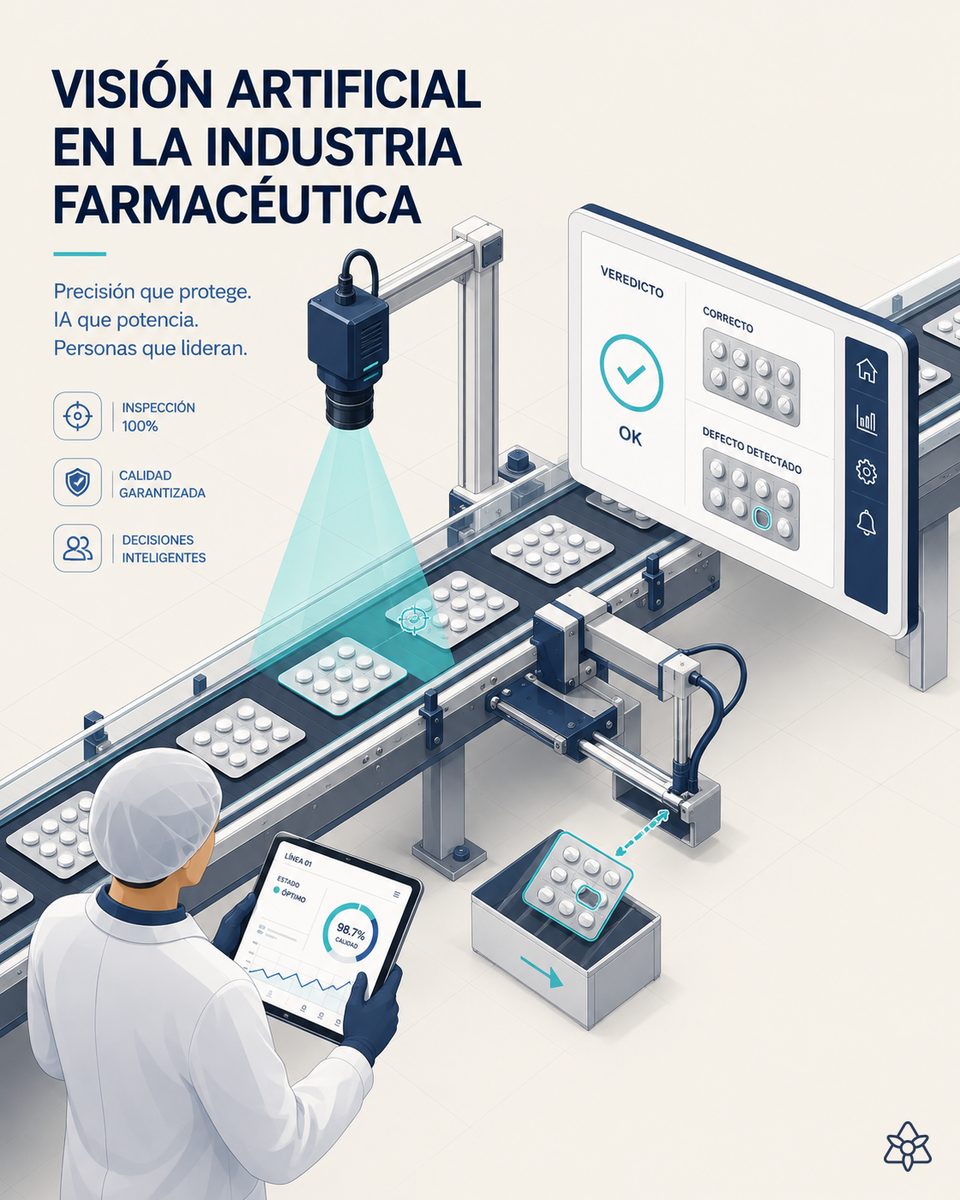
The human inspector is the best system in the world — for the first two hours of the shift.
Visual inspection of injectables is one of the few pharma operations where the standard requires 100% of the units. USP 790 mandates inspecting every vial, every syringe, every ampoule. And the biological reality of the inspector is well known:
- At the start of the shift, the human inspector is the best system in the world: a trained eye, fine judgment, able to tell a real particle from a glass artifact.
- Two hours in, visual fatigue sets in and the criteria start to drift. To protect themselves, the inspector rejects more — "I'll reject it just in case".
- By the end of the shift, the false-reject rate grows, and with it the cost of rework or destruction. And the worst scenario: a unit with a real defect slips through — because to a tired eye everything looks the same.
On top of that, per-unit traceability is what the auditor asks for (USP 790 + GMP audit) and almost nobody has it: the classic system records "batch inspected 100% by person X", not "vial no. 47,233 inspected at 14:32, defect X, decision hold". It is not that the inspector fails: it is that a human eye should not be doing seven hours of microscope work in a row.
iLEAN does not remove the inspector — it removes the dumb work so they can do the work that matters.
The expert inspector remains essential: for borderline cases, for validating the model, for the final decision. What iLEAN replaces is the repetitive and exhausting work of looking at 60,000 vials per shift. iLEAN Vision + Edge on the inspection line:
The AI inspects 100% of the units without fatigue. The inspector reviews the borderline cases the AI flags with low confidence. The person signs the final batch decision — always.
- iLEAN Vision (CNN on Edge) — inspects every vial with multiple lighting modes (bright field, dark field, backlighting) and a model trained per SKU. It classifies each unit: accepted, rejected, uncertain. The uncertain ones go to the human inspector; the rest is processed without stopping. Every decision is traced to the vial with image, classification and timestamp.
- Edge working with no network — if the connection drops, inspection does not stop. Edge keeps classifying and storing locally, and syncs when the network comes back. What is critical cannot depend on there being WiFi.
- Agent / Writer — consolidates the batch: how many accepted, how many rejected, how many uncertain cases resolved by a human, complete evidence for the USP 790 dossier. If the defect pattern shifts (drift, an upstream problem), it alerts the quality manager before the whole batch gets complicated.
100% manual inspection vs. inspection assisted by iLEAN Vision
| Aspect | 100% human inspection | With iLEAN Vision + Edge |
|---|---|---|
| Consistency across shifts | Variable: excellent at the start, decays with fatigue | Constant; the inspector reviews borderline cases only |
| False reject | Grows toward the end of the shift | Stable; significant reduction in uncertain rejects |
| Per-unit traceability | Batch "inspected 100%" on paper | Image + classification + timestamp per vial |
| Cadence | Limited by the sustainable human pace | Sustained industrial cadence |
| Operation with no network | The inspector carries on, the data is lost | Edge keeps inspecting and recording |
| USP 790 dossier | Rebuilt by hand | Automatic dossier with evidence per vial |
Impact estimate for your plant — to be validated with your numbers.
The block below is an estimate to be validated with your plant's data. We put it forward so the committee has an order of magnitude; we refine it during the diagnostic.
- A 100% manual vial inspection line (clear and/or amber), with a meaningful uncertain-reject rate driven by inspector fatigue, and USP 790 with no per-unit traceability.
- iLEAN Vision pilot on one line (cameras + multiple lighting + Edge + integration with the current line). First value expected within a few weeks: a high percentage classified automatically and borderline cases sent to the inspector.
- Reduction in false rejects on the order of ≥30%, conservatively. Indicative payback between 4 and 9 months, depending on vials per year and the value of each vial.
- Hard levers: less product reworked or destroyed because of a false reject, better consistency across shifts, an automatic USP 790 dossier.
And the context: the bar is set by the most demanding sector
The benchmark quality standard in automotive is on the order of 25 PPM [1]; in injectables, the regulatory bar is tighter still. Anchored AI is the natural tool: in tasks where the AI recontextualizes a piece of data (classifying an image against a validated defect panel), the best models brought error below 1.5% [2]. And where it is critical, iLEAN's three safety rings guarantee that the final batch decision is signed by a person — the AI proposes, the person validates.
[1] 25 PPM as the automotive quality standard — Symestic.
[2] OpenAI paper “Why Language Models Hallucinate”, 2025 — reliability of AI in anchored tasks.
What people ask about visual inspection of injectables with AI
Does iLEAN Vision comply with USP 790?
USP 790 (visible particles in injections) requires 100% inspection with a consistent detection rate for defects above the visibility threshold, plus traceability per unit. iLEAN Vision is validated as an automated inspection system under USP 790 and USP 1790 (guidance): it is qualified with panels of known defects (Knapp test or equivalent), IQ/OQ/PQ is documented, and every vial inspected leaves evidence (image + classification + timestamp) linked to the batch. Periodic model review and drift control are part of the validation package.
Does it work the same with clear vials and amber vials?
Yes, with different lighting configurations. Amber glass reduces visible contrast, which is why the system combines multiple lighting modes (bright field, dark field, backlighting) and models trained specifically on samples of each type. The CNN learns to tell a real particle from an optical artifact of the glass or a bubble, in both clear and amber vials. Qualification is done with panels representative of the actual product, not with generic standard samples.
What about viscous liquids or suspensions?
Viscous liquids (some monoclonal antibody formulations) or suspensions (which contain intentional particles) are the scenario where the human inspector makes the most mistakes, and where well-trained AI gains the most. The system combines dynamic inspection (controlled agitation to tell an intentional particle from a foreign one by its movement pattern) with an SKU-specific model. The detection curve is validated with real product samples and tracked with a periodic benchmark.
How is it validated under GMP?
Under GAMP 5 as a computerized system (typically category 5 for the trained model, category 4 for the platform). The package covers URS, FRS/FDS, IQ/OQ/PQ, traceability matrix, validation plan, change control, and a specific qualification protocol for the AI model (defect panels, acceptance criteria, drift control). What keeps you off the endless road is that iLEAN is designed for the GMP regime, not against it, and the Writer piece drafts each document with the real data.
How much does it cut false rejects?
Estimate to be validated. On lines where human inspection generates a meaningful false-reject rate (fatigue, subjective criteria at the end of the shift), a conservative estimate is a reduction in false rejects on the order of ≥30%, while holding or improving the detection rate for real defects. First value in a few weeks, payback between 4 and 9 months depending on vials per year and the value of each vial. We ask for your data and send back the estimated ROI in 48h.
More cases in pharma
- Galenic formulation with AI — from bench to plant without losing the conversation along the way.iLEAN cross-checks R&D notes, the scale-up file, real plant parameters and the regulatory dossier so the…
- GMP biotech with AI environmental monitoring — particles, microbiology and bioreactor on a single platform.iLEAN covers particles, microbiology and bioreactor in a GMP biotech cleanroom, with no broken…
- GMP validation with continuous AI evidence — IQ/OQ/PQ alive, with no sprints before every audit.iLEAN keeps IQ/OQ/PQ alive and GMP validation always audit-ready, with no sprints before every…
- Pharma QC glassware control with AI — lose the lineage of the vial and you lose the batch.How iLEAN traces pharma QC vials, volumetric flasks and pipettes — calibration, integrity and…
- LAL/rFC endotoxin testing with AI — faster parenteral release, a firmer dossier.How iLEAN cross-checks kinetic reader data, sample identity and method (LAL/rFC) with LIMS and OOS…
- Pharma lyophilization with AI predictive control — a 48-hour cycle, and a deviation takes 5 minutes to destroy the batch.iLEAN tracks the freeze-drying cycle in real time and predicts equipment failures. Every batch keeps its…
Tell us your case and in 48h we'll send you the estimated ROI of this AI project for your injectable inspection.
We work on your plant's real data, not ours. Diagnostic with no commitment.
Request estimated ROI in 48h See pharma