Pharma QC glassware control with AI — lose the lineage of the vial and you lose the batch.
Glassware in a pharma QC lab (volumetric flasks, pipettes, HPLC vials) is the traceability of the analysis — if you lose the lineage of the vial that was used, the batch result is not defensible in an FDA/EMA audit. iLEAN Edge reads the vial code on the bench, Connect captures its calibration certificate, and the agents close the file. The person signs.
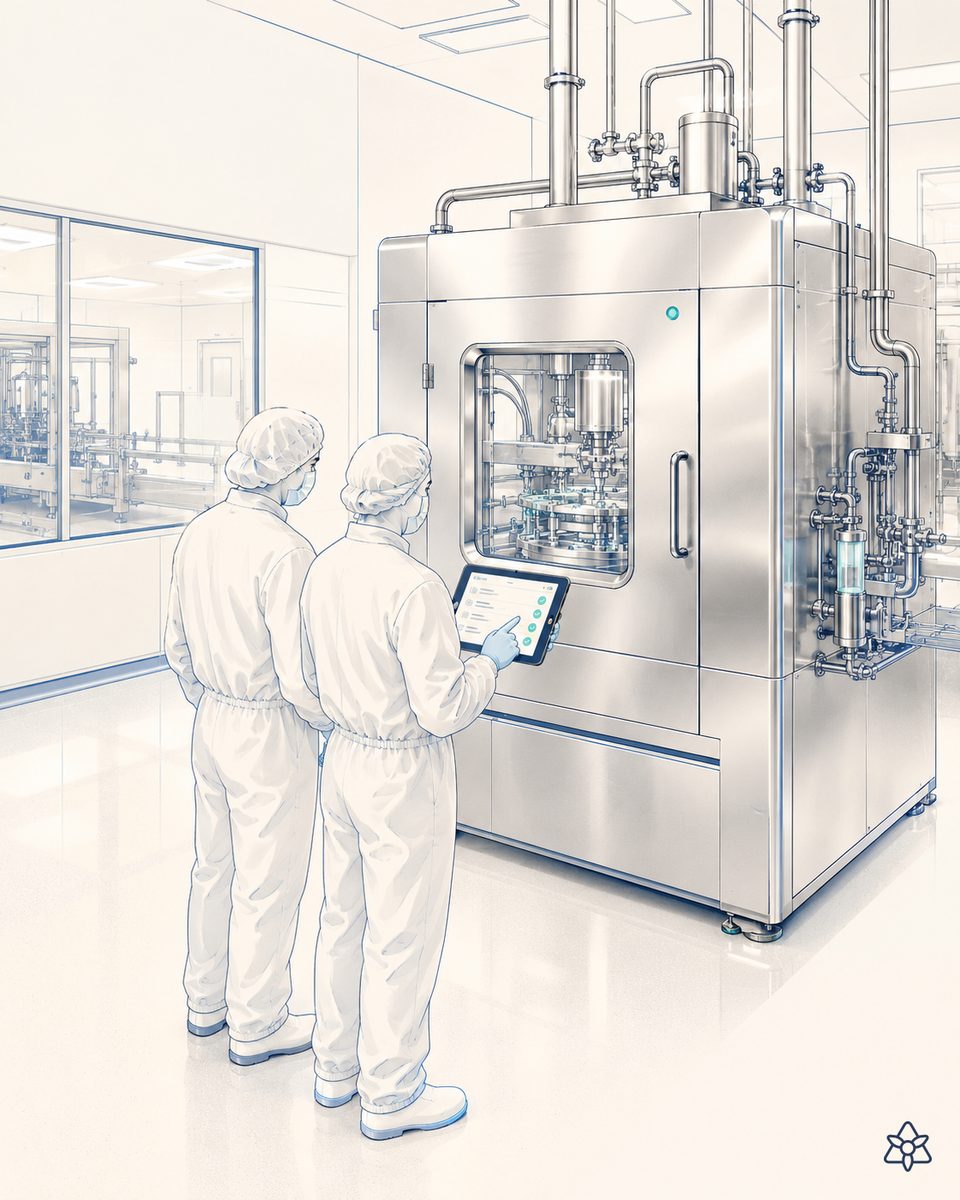
The vial is in the tray. The chromatogram is in the CDS. Between them there is a notebook and a label.
A typical pharma QC lab processes thousands of HPLC vials a month, hundreds of volumetric flasks a day, dozens of volumetric pipettes in permanent use. Each one is a measuring instrument with a calibration, a service life and traceability to the analysis. The classic crack is not a missing system — it is the broken connection between the physical glassware and the digital data of the analysis.
- The vial label — handwritten in marker pen, short code. If it rubs off, if it gets confused, if two analysts use the same number, the data loses its lineage.
- The calibration certificate — for the volumetric flask or the pipette, it lives in a folder or in a stand-alone equipment system. Tying it to the specific use in an analysis is manual work.
- The chromatogram — lives in the CDS (Empower, OpenLab) under the injection method. The CDS does not know whether the vial was cracked, whether the pipette was out of calibration, whether the flask took a knock yesterday.
The QC lead knows this. ALCOA+, MHRA Data Integrity, FDA 21 CFR Part 11 — every inspection goes through here. The classic system (notebook + label + eye) works 99% of the time. That 1% is the audit observation — and a data integrity observation costs more than the entire laboratory.
iLEAN does not replace the CDS — it puts the lineage of the glass on top of the chromatogram.
The glassware problem is not one of equipment: it is information on islands between the flask cabinet, the calibration system, the chromatography CDS and the batch LIMS. iLEAN acts as the putty that fills those gaps without asking you to change the CDS, the LIMS or your procedure.
Edge sees the code on the vial, the flask, the pipette at the bench. Connect captures its calibration and the chromatogram from the CDS. The agent closes the cross-checked file — vial X, calibration of day Y, batch Z, chromatogram W. The person signs.
The iLEAN pieces applied to QC glassware control:
- Edge — a machine-vision terminal at the autosampler bench and at the glassware cabinet. It reads the QR code, barcode or printed label of every vial/flask/pipette when it is taken out, when it is loaded into the autosampler, when it is returned. It works with no network.
- Connect — captures the calibration certificate from the stand-alone system (Antares, Eusoft, Excel). Captures the chromatogram from the CDS by API or PDF export. Captures the batch LIMS. And captures what arrives from outside — incident reports sent by the equipment maintenance lead.
- Agent — closes the ALCOA+ traceable file: every vial/flask has attribution (analyst), a cryptographic timestamp, a valid calibration, an associated chromatogram and the batch analyzed. If a flask goes out of calibration, the agent blocks its use and builds, in hours, the impact assessment covering batches already analyzed.
Manual glassware traceability vs. cross-checked traceability with iLEAN
| Aspect | Notebook + label + folder | With iLEAN Edge + Connect + Agent |
|---|---|---|
| Vial/flask identification | Marker pen, short code, risk of rubbing off | QR/barcode read by Edge at the bench |
| Valid calibration | Manual lookup in a folder or stand-alone system | Automatic block if out of date |
| Vial-chromatogram lineage | Rebuild from the LIMS and the CDS by hand | Cross-checked at second zero |
| Analyst attribution | Manual signature at the end of the shift | Cryptographic timestamp per action |
| Impact of an uncalibrated instrument | Work out by hand which batches used it | Impact assessment in hours |
| Ready for FDA/EMA inspection | Days of preparation | ALCOA+ dossier one click away |
Impact estimate for your plant — to be validated with your numbers.
The block below is an estimate to be validated with the specific data of your laboratory. We put it forward so the committee has an order of magnitude; we refine it during the diagnostic.
- Pharma QC lab with 2-6 HPLC + GC systems, ~600-1,500 vials/month, ~200 volumetric flasks in permanent use, a mixed lab notebook (paper + ELN), Empower CDS or equivalent, validated LIMS.
- Edge pilot at the autosampler bench + Connect over the CDS and the calibration system + an ALCOA+ file agent. First value expected within a few weeks.
- Indicative payback between 4 and 9 months, depending on QC volume and how often traceability observations have come up in recent audits.
- The hard lever is a ≥30% reduction in the time needed to prepare an audit dossier + preventing a single data integrity observation. One 483 observation in an FDA inspection costs more than many pilots.
And the QC director's reasonable doubt
“What if the AI confuses a vial code?” — reading the code is an anchored task (reading a QR/barcode on a vial and comparing it with the CDS record), not free generation. In anchored tasks, the best models brought error below 1.5% [1]. And in pharma QC what is critical is never decided alone: the agent proposes the file, the person signs. If the agent hesitates between two readings, it escalates to the analyst — it does not invent. The human quality of QC is preserved; what disappears is the manual reconstruction work that takes time away from the analysis.
[1] OpenAI paper “Why Language Models Hallucinate”, 2025 — on the reliability of AI in anchored tasks.
What people ask about QC glassware control with AI
What do USP/Ph.Eur. require of glassware in a pharma QC lab?
USP <31>, Ph.Eur. 2.1.5 and the ALCOA+ principles require every piece of critical glassware to have: a unique identification, a calibration certificate traceable to NIST/PTB, a usage record, and traceability to the analysis it was used for. If an analysis decides the release of a pharma batch, the integrity of that analysis depends on the integrity of the glass that measured it.
How is each HPLC vial traced to the batch analyzed?
iLEAN Edge reads the vial's label or code on the bench before it is loaded into the autosampler, Connect captures the chromatogram from the CDS (Empower, OpenLab), and the Agents close the cross-checked vial-chromatogram-batch file at second zero. The person signs — the chain is intact.
What happens if a volumetric flask goes out of calibration between batches?
With iLEAN: Edge identifies the flask as it is taken out of the cabinet, Connect holds its last calibration date, the Agents block its use if it is out of date, and they record which batch was analyzed with which flask. If a deviation shows up later, the cross-checked impact assessment is built in hours, not weeks.
Can iLEAN integrate with the QC LIMS and CDS without touching the validation?
Yes. iLEAN Connect reads through the public APIs of the CDS/LIMS where they exist, or by extracting PDF/Excel/CSV reports where that is all they offer — and the Agents recontextualize with less than 1.5% error on anchored tasks. The CDS/LIMS stays intact, with no change to its qualification. The integration lives in ring 3 and only the validated JSON passes to ring 1 through a shielded mailbox. It complies with Annex 11.
How is ALCOA+ data integrity documented for glassware with iLEAN?
iLEAN records every reading of a vial/flask/pipette with a cryptographic timestamp, the operator's identity and the associated chromatogram. The documentation Agents generate the auditor-traceable file in seconds. It connects with the always-ready FDA/EMA audit and with the digital EBR.
More cases in pharma
- GMP biotech with AI environmental monitoring — particles, microbiology and bioreactor on a single platform.iLEAN covers particles, microbiology and bioreactor in a GMP biotech cleanroom, with no broken…
- GMP validation with continuous AI evidence — IQ/OQ/PQ alive, with no sprints before every audit.iLEAN keeps IQ/OQ/PQ alive and GMP validation always audit-ready, with no sprints before every…
- Visual inspection of injectables with AI — the eye must not blink, and by the end of the shift it blinks.iLEAN Vision inspects 100% of injectables at industrial cadence, without the false rejects that come…
- LAL/rFC endotoxin testing with AI — faster parenteral release, a firmer dossier.How iLEAN cross-checks kinetic reader data, sample identity and method (LAL/rFC) with LIMS and OOS…
- Pharma lyophilization with AI predictive control — a 48-hour cycle, and a deviation takes 5 minutes to destroy the batch.iLEAN tracks the freeze-drying cycle in real time and predicts equipment failures. Every batch keeps its…
- mAb/ATMP bioreactor control — anticipate drift minute by minute and hold per-patient traceability.iLEAN monitors pH, DO, glucose and critical bioreactor metrics, plus per-patient traceability for ATMP.
Tell us your case and in 48h we'll send you the estimated ROI of this AI project for your QC laboratory.
We work on your laboratory's real data, not ours. Diagnostic with no commitment.
Request estimated ROI in 48h See pharma