EBR with AI — the batch ships in hours because QA only sees what departs from what was approved.
A well-managed batch record releases a batch in days, not weeks. iLEAN generates the EBR with review by exception: the system assembles it in full from the MES, SCADA, LIMS and the operator's notebook, what is conforming is accepted because it is signed and traced from source, and QA focuses attention only on what is anomalous. The person signs — the system does not declare itself compliant.
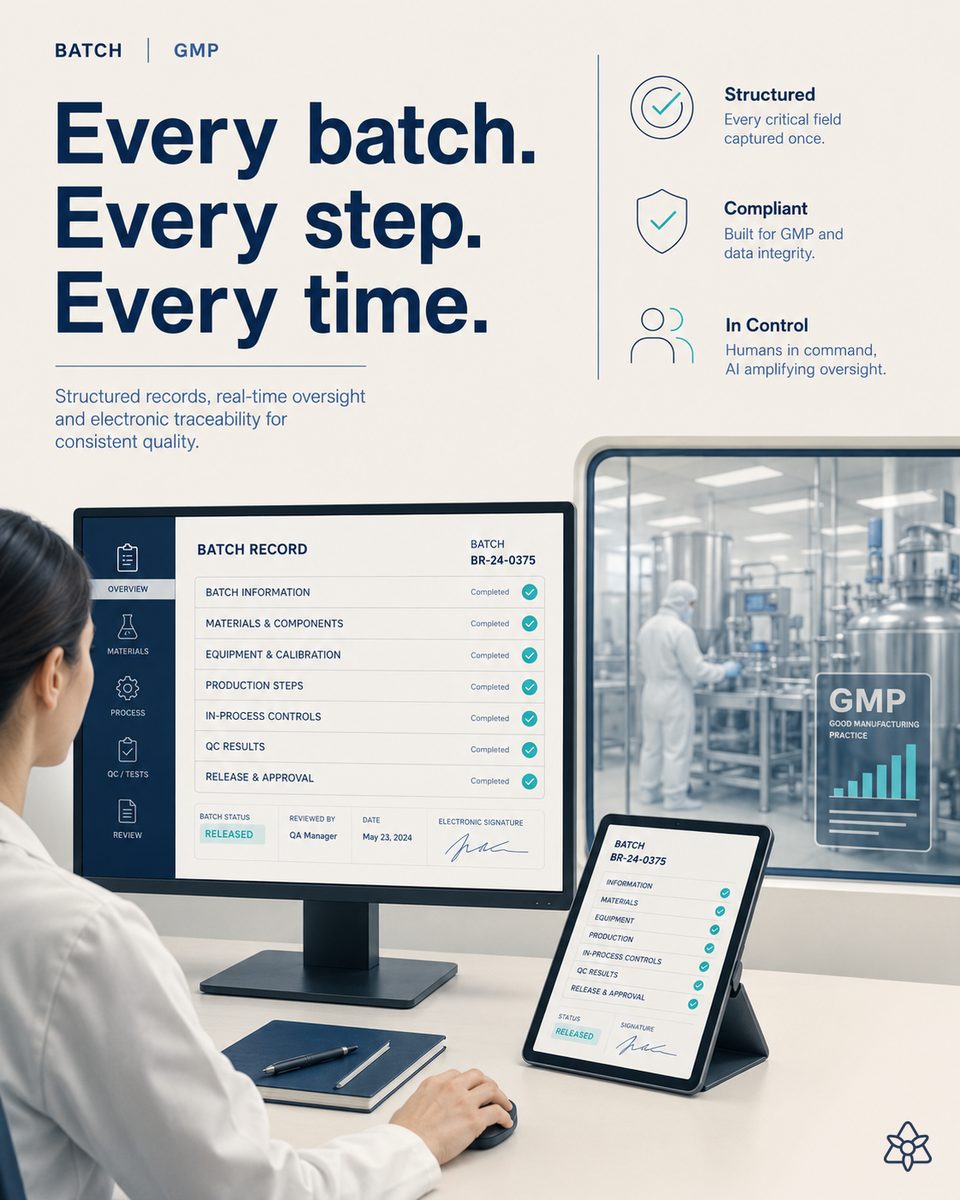
A paper batch record (or a signed PDF) is not traceability — it is archaeology.
In a GMP plant the batch release cycle takes 5 to 15 days on average because QA has to reconstruct, page by page, what happened in production. MES data on one side, SCADA ticks on another, LIMS results arriving late, the operator's notebook with pen annotations, and the photo of the encapsulator panel that the supervisor took because the machine is from 1998 and exposes nothing to the outside.
- Every batch triggers a full QA review — the conforming ones and the problematic ones take the same time, because the system cannot tell them apart until somebody looks at them by hand.
- WIP piles up in quarantine waiting for release, tying up capital and breaking the shipping plan.
- Every product change, change control or deviation adds documents to the batch record stack. More paper is not more control — it is more places to hide an error.
And the day an inspection arrives, QA runs a weeks-long sprint to rebuild the dossier of a batch from two years ago, because the signatures were in format A and the analytical data in format B, and three template changes happened in between. The system works — and every release is a toll in time that nobody should still be paying.
iLEAN does not replace the MES — it seals the cracks between the systems that already sign off your production.
The batch record suffers because batch information lives on islands: MES, SCADA, LIMS, ERP, the production manager's spreadsheet, the operator's notebook, the panel of the old capsule machine with no interface. iLEAN acts as the putty between all those pieces: it does not ask you to change the validated MES, nor to retire the 1998 encapsulator. It collects what each system knows, cross-checks it with the product's master template, and generates the consolidated EBR with a Part 11 audit trail.
The Tracer reads wherever it has to. The Writer assembles the batch record. The agent cross-checks against the master recipe and the validation, and flags only the exceptions. The QA person signs — never the other way round.
The three iLEAN pieces applied to review-by-exception EBR:
- iLEAN Tracer (Connect) — captures the real process data by any route: a modern API on the new MES, a SCADA file, screen reading from the old encapsulator, a photo of the panel, the operator's dictation, an email from the external lab with the analysis result. Capture graded to each machine: integrated where there is an API, intermediate where there is an old local PC, manual where there is only an analog panel — it does not force you to change anything.
- iLEAN Writer — maintains the master batch record template per product/line and fills it in for every batch with the data that came from the Tracer. The output is a structured EBR, signed with a Part 11 audit trail, ready for review.
- iLEAN Agent — cross-checks every step of the batch against the master recipe, the validation ranges and the limits of the change control in force. If everything adds up, the step is marked automatically conforming; if there is a deviation, it prepares the exception dossier for QA with a preliminary root cause, the associated data and the visual evidence. QA focuses attention only on what is worth looking at.
Paper batch record vs. review-by-exception EBR with iLEAN
| Aspect | Classic batch record (paper/signed PDF) | With iLEAN Writer + Tracer + Agent |
|---|---|---|
| Source of the batch data | MES, SCADA, LIMS, notebook — each on its own | Consolidated at second zero by the Tracer |
| QA review | Page by page, batch by batch, conforming and exception alike | Only the exceptions — what is conforming is accepted because it is validated |
| Average release time | 5-15 days | Hours on batches with no exception, ≥30% less on the rest |
| Part 11 audit trail | Manual signatures + dates reconstructed after the fact | Native, cryptographic, non-editable |
| FDA/EMA inspection preparation | A QA sprint rebuilding the dossier of an old batch | Per-batch dossier already assembled; the inspection reads it directly |
| Old machine with no interface | The operator photographs the panel and types it into a spreadsheet | The Tracer reads the screen; the data enters the EBR |
Impact estimate for your plant — to be validated with your numbers.
The block below is an estimate to be validated with the specific data of your plant. We put it forward so the committee has an order of magnitude; we refine it during the diagnostic.
- GMP plant for oral solids or steriles, 2-4 lines, hybrid EBR (part paper, part signed PDF, part vertical MES).
- First product migrated to review-by-exception EBR with iLEAN: first value in a few weeks, usually with the Pareto line that moves the most volume.
- Expected reduction in average release time: ≥30% in the first 6 months; higher as more products are brought in.
- Indicative payback between 4 and 9 months, dominated by WIP trapped in quarantine and the cost of delayed shipments to the customer.
- Quality standard in adjacent sectors already operating on review by exception (automotive): 25 PPM of acceptable defects [1]. That is the order of demand pharma is aligning with.
And the quality director's reasonable doubt
“What if the AI invents a piece of batch record data and QA signs it by mistake?” — hallucination is a problem of free generation, not of anchored tasks. The EBR is exactly an anchored task: the AI reads a data point from a validated system (MES, SCADA, LIMS) and recontextualizes it into the batch record format. On anchored tasks, the best models brought error below 1.5% [2]. And even so, what is critical is never decided alone: iLEAN prepares the dossier and the QA person signs. The three safety rings exist precisely for this.
[1] Automotive quality standard ≈ 25 PPM. Source: Symestic.
[2] OpenAI paper “Why Language Models Hallucinate”, 2025 — the reliability of AI in anchored tasks.
What people ask about AI-driven EBR in pharma
What is review by exception in an EBR?
Review by exception is a batch release model in which QA no longer reviews the entire batch record page by page — the system assembles it in full, flags exclusively the deviations, out-of-range results and critical alerts, and the QA person focuses their attention on those alone. What is conforming is accepted because it is validated, signed and traced from source. That is what makes it possible to go from a 5-15 day release to hours, without giving up a single signature required by GMP.
How does iLEAN comply with 21 CFR Part 11 in the batch record?
Every record in the EBR generated by iLEAN complies with FDA 21 CFR Part 11 and Annex 11 of EU GMP: ALCOA+ integrity (attributable, legible, contemporaneous, original, accurate, complete, consistent, enduring, available), an electronic audit trail of every reading or change to a critical data point, and electronic signature with strong authentication of the operator, the supervisor and QA. The process data is cryptographically signed as it crosses into ring 2 — traceability is native, not bolted on afterwards.
Does it work with multi-API and multi-format production?
Yes. The master batch record template per product and per line is maintained in the Writer, and the Tracer fills it in for every batch by reading what actually happened — whether it comes from the MES, the SCADA, the LIMS, the operator's notebook or a photo of the panel on an old machine. Running API A one day and API B the next does not force you to rewrite anything: the templates coexist and the system knows what is being manufactured from the production order coming in from the ERP.
How much does it cut batch release time?
An estimate to be validated with your numbers: in a GMP plant with a paper or signed-PDF batch record where the QA review cycle takes between 5 and 15 days per batch, the first value with iLEAN shows up within a few weeks — usually with the first product migrated to review-by-exception EBR. The expected reduction in release time is ≥30% in the first months and grows as more products are brought in. Indicative payback between 4 and 9 months, dominated by the cost of WIP trapped in quarantine and by the cost of delayed shipments to the customer.
Do we have to replace the MES or LIMS we already have?
No. iLEAN sits on top of the existing MES, LIMS, SCADA and ERP and fills the cracks — it does not replace them. The Tracer integrates by API, by file or by screen reading if the machine is old and exposes nothing. The Writer generates the consolidated batch record from all those sources, and the agent cross-checks it against the master recipe, the validation limits and the regulation. The customer's IT team signs off the iLEAN validation package under GAMP 5; the MES remains the MES.
More cases in pharma
- Combination products with AI — two regulatory worlds, one line, no gap in between.How iLEAN cross-checks GMP, ISO 13485, MDR 2017/745, drug batch and device traceability to release a…
- AI-assisted CIP/SIP on direct impact equipment — an excursion you see coming never becomes a deviation.How iLEAN cross-references CIP, SIP and direct impact (DI) equipment — skid, BMS and MES capture, plus…
- Pharmaceutical dispensing with AI — one badly signed weighing costs the whole batch.How iLEAN cross-checks weighings, raw material and work order in the dispensing booth: Edge reads the…
- Pharma FMD/DSCSA serialization with AI — one badly aggregated serial is a pallet held at the border.iLEAN covers serialization, aggregation and reporting to the EU Hub and DSCSA on a single platform,…
- Galenic formulation with AI — from bench to plant without losing the conversation along the way.iLEAN cross-checks R&D notes, the scale-up file, real plant parameters and the regulatory dossier so the…
- GMP biotech with AI environmental monitoring — particles, microbiology and bioreactor on a single platform.iLEAN covers particles, microbiology and bioreactor in a GMP biotech cleanroom, with no broken…
Tell us your case and in 48h we'll send you the estimated ROI of your review-by-exception EBR.
We work on your GMP plant's real data, not ours. Diagnostic with no commitment.
Request estimated ROI in 48h See pharma