Pharmaceutical dispensing with AI — one badly signed weighing costs the whole batch.
The dispensing booth is the point where a single out-of-tolerance weighing or one quarantined raw material can invalidate an entire batch. iLEAN cross-checks the master formula, the scale reading and the container scan at second zero, holds the booth if something does not add up and lets the person sign. Traceability builds itself.
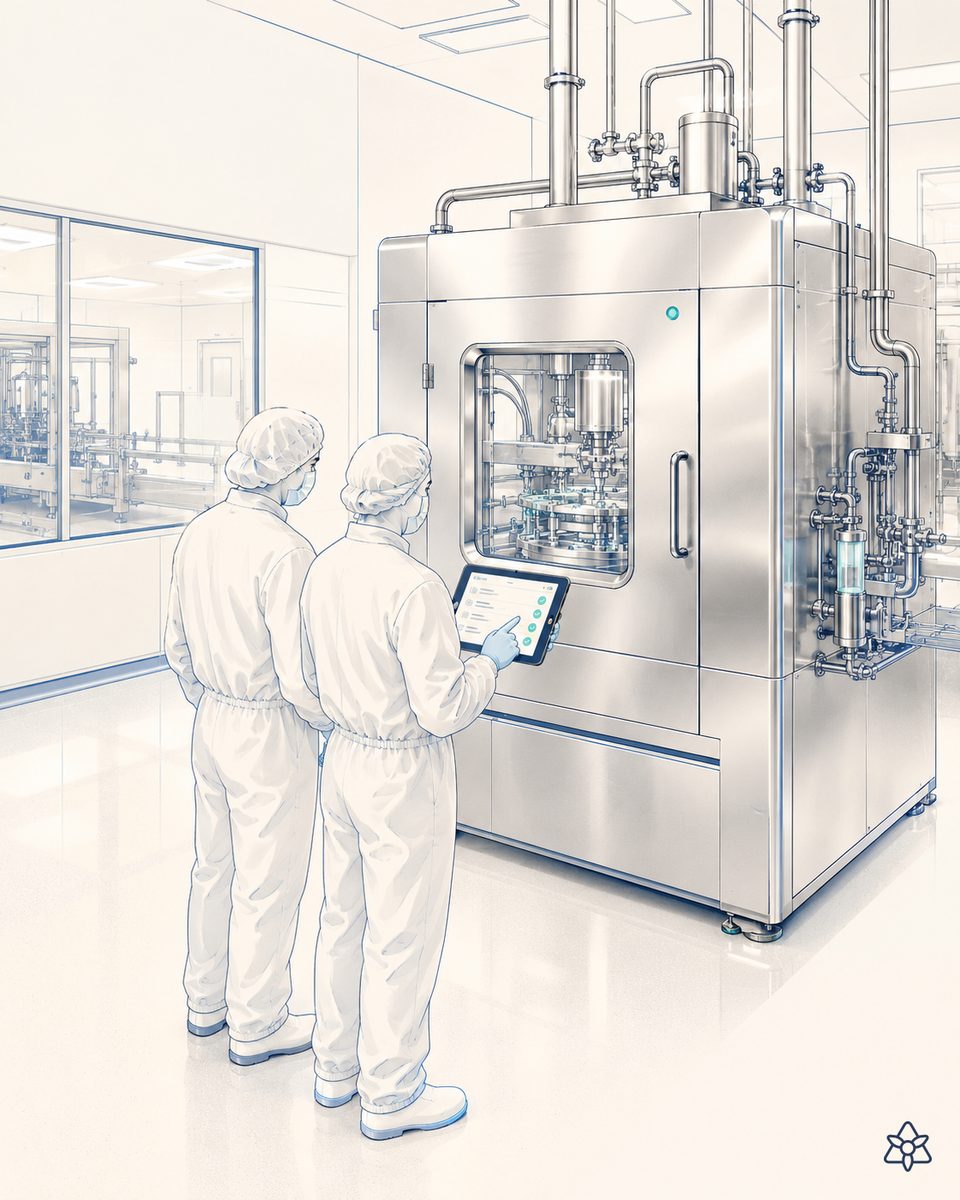
A weighing is signed in four seconds. The deviation costs days.
Raw material dispensing is one of those steps that look simple until an auditor opens the dossier. You have a master formula living in the MES, a container of API or excipient with its code and its status (released, quarantine, retest), a scale that should be within tolerance, and an operator who in four seconds reads the weight, notes it down and signs. When everything lines up, nothing happens. When one of those four pieces breaks, you do not notice it in the booth — you notice it three weeks later, when QA spots the deviation in the batch record.
The typical failure modes are not dramatic, they are quiet: a quarantined API container picked up by mistake because the visual label was identical to the released batch; a scale that drifted 0.8% and nobody recalibrated since the last review; a master formula updated in the MES that the operator had printed on paper from the previous batch; a batch code the operator keyed in by hand because the reader would not scan the label. The classic system (operator + checklist + second signature) works 99% of the time. That 1% is the rework of a whole batch — and in biologics or ATMPs the batch can be worth six figures.
iLEAN does not replace your MES — it seals the cracks between the MES, the scale and the person.
The dispensing problem is not a lack of systems, it is information living on islands and cross-checked by hand at the most critical moment. The MES has the formula. The scale has the weight. The container has its code. The operator has their eyes. And between the four of them there are a couple of cracks where the error slips through. iLEAN acts as the putty that fills those gaps, without asking you to replace the MES, the scale or the booth.
Edge sees the scale and the code. Connect brings the live formula from the MES into the booth. The agent cross-checks everything against the GMP rules and, if something does not add up, holds. The person signs — never the other way round.
The three iLEAN pieces applied to pharmaceutical dispensing control:
- Edge — a machine-vision terminal in the booth. It reads the scale (whether a modern Mettler or an old Sartorius with an analog display), the container code and the MES panel if there is one. It compares the weight it reads against the formula and triggers the hold (red light, weighing close blocked) in milliseconds if the deviation exceeds tolerance. It works with no network.
- Connect — captures the master formula from the MES (Werum, POMS, Camstar or whatever you run) and the container status from the LIMS/WMS. It also captures what arrives from outside — a supplier change with a new CoA, the retest of a batch, an urgent instruction from the compliance lead by email — and puts it in the booth at second zero, with nobody forwarding anything or calling a meeting.
- Agent — cross-checks formula + weight + batch + booth history + Annex 1 and Part I chapter 5 rules. If it detects a deviation, it does not send an email at 10 pm: it holds the weighing, proposes the action (recalibrate the scale, return the container to quarantine, escalate to QA) and alerts the person in charge. The operator validates; the booth does not restart on its own. And it assembles the evidence dossier for the auditor who will come by.
Manual dispensing vs. cross-checked dispensing with iLEAN
| Aspect | Manual dispensing + double signature | With iLEAN Edge + Connect + Agent |
|---|---|---|
| Master formula | In the MES; printed on paper in the booth | In the booth, live, synced with the MES at second zero |
| Scale reading | The operator reads it and keys it in | Edge reads it with vision and publishes it as structured data |
| Container status (released/quarantine) | Visual label + manual scan | Automatic cross-check against LIMS/WMS before the weighing is allowed |
| Tolerance deviation | Spotted by QA when reviewing the batch record | Held in the booth before closing, in milliseconds |
| Operation with no network | n/a | Edge keeps reading and holding on the booth's own power |
| Dossier for the auditor | Rebuild the batch record by hand | Per-batch file with a photo of the scale and the container, automatic |
Impact estimate for your plant — to be validated with your numbers.
The block below is an estimate to be validated with the specific data of your plant. We put it forward so the committee has an order of magnitude; we refine it during the diagnostic.
- Mid-sized pharma plant, 2-4 dispensing booths, a mix of released and quarantined API raw materials, a mix of modern Mettler scales and old RS-232 Sartorius units, MES on site (Werum, POMS or equivalent).
- Edge pilot in one booth (vision terminal + integration with MES and LIMS + validation agent). First value expected within a few weeks.
- Indicative payback between 4 and 9 months, depending on the documented frequency of deviations in the batch record and the average cost of rework / lost batch across your product portfolio.
- The hard lever is a single biological batch saved per year, or a couple of critical deviations avoided. The pilot pays for itself.
- Replication to the other booths done by your own people — the E.1 lesson works in pharma exactly as it does in automotive.
And QA's reasonable doubt
“What if the AI misreads the scale and signs an incorrect weighing?” — hallucination is a problem of free generation, not of anchored tasks. Reading a scale display and comparing it with the formula is an anchored task par excellence. In tasks of that kind, the best models brought error below 1.5% [1]. And even so, the reading does not decide: the booth holds whenever there is doubt and the person signs. The three safety rings exist precisely for this.
[1] OpenAI paper “Why Language Models Hallucinate”, 2025 — on the reliability of AI in anchored tasks.
What people ask about pharmaceutical dispensing with AI
What does GMP require for raw material dispensing in pharma?
EU GMP Annex 1 and Part I chapter 5 require verification of raw material identity, weighing by one operator and checking by a second (double signature or equivalent electronic verification), batch-to-batch traceability and immediate recording in the batch record. In practice that means: scanning the container, reading a calibrated scale within tolerance, checking against the master formula and signing electronically. If any of those pieces breaks, the batch is not released — and the auditor will see it in the dossier.
How does iLEAN catch a dispensing error before the weighing is closed?
By cross-checking, at second zero, the master formula from the MES, the scanned container code, the actual scale reading that Edge picks up with vision and the booth history. If the formula calls for 4.82 kg of API X and the scale reads 4.71 kg, or if the scanned code belongs to a quarantined batch, the system holds the booth and warns the operator through the earpiece. Nobody signs an incorrect weighing because the system does not allow it — the person validates what is right, they do not rubber-stamp what is wrong.
Does it work with old scales that have no digital interface?
Yes. It is one of the usual scenarios: Mettler or Sartorius scales with an analog display or an old RS-232 port that was never integrated with the MES. iLEAN Edge reads the display with machine vision (a CNN trained on that family of scales) and publishes the weight to the system as structured data. It does not force you to replace the scale or recalibrate it with a new supplier. Connect covers the rest: modern integrations where they exist, vision capture where they do not.
What happens if the dispensing booth loses network?
Edge keeps working. The booth terminal has its own local CNN; as long as it has power, it keeps reading the scale, validating the scan against the local copy of the formula and holding weighings that are out of tolerance. When the network comes back, it syncs with Central. In a pharmaceutical clean room, what is critical cannot depend on there being WiFi — Annex 1 is clear about that and so is our architecture.
How much does it cost to deploy AI dispensing control in a pharma plant?
The pilot is sized per booth, not per plant. A single booth with Edge + integration with MES/ERP + a validation agent covers the full case, and it is replicated to the other booths by the customer's own trained people (that is the lesson of the powder coating case in Part E.1). A reasonable payback to take to the committee is on the order of a few months, because the hard lever is the avoided deviation on a biological product or the full rework of a batch. Ask us for the estimated ROI with your data: we send it in 48h.
More cases in pharma
- Clinical trial supply with AI — a site with no kit is a patient lost.How iLEAN cross-references IRT/RTSM, depots, sites and kit traceability to anticipate stockouts, protect…
- Combination products with AI — two regulatory worlds, one line, no gap in between.How iLEAN cross-checks GMP, ISO 13485, MDR 2017/745, drug batch and device traceability to release a…
- AI-assisted CIP/SIP on direct impact equipment — an excursion you see coming never becomes a deviation.How iLEAN cross-references CIP, SIP and direct impact (DI) equipment — skid, BMS and MES capture, plus…
- EBR with AI — the batch ships in hours because QA only sees what departs from what was approved.iLEAN generates the electronic batch record with review by exception. QA only looks at what is anomalous.
- Pharma FMD/DSCSA serialization with AI — one badly aggregated serial is a pallet held at the border.iLEAN covers serialization, aggregation and reporting to the EU Hub and DSCSA on a single platform,…
- Galenic formulation with AI — from bench to plant without losing the conversation along the way.iLEAN cross-checks R&D notes, the scale-up file, real plant parameters and the regulatory dossier so the…
Tell us your case and in 48h we'll send you the estimated ROI of this AI project for your dispensing booth.
We work on your plant's real data, not ours. Diagnostic with no commitment.
Request estimated ROI in 48h See pharma