Clinical trial supply with AI — a site with no kit is a patient lost.
Clinical Trial Supply moves little volume but reaches many sites, in many countries, with multi-language labels, mandatory blinding and audited drug accountability. Today the cross-referencing between IRT/RTSM, depots, couriers and production is done in parallel spreadsheets that arrive too late. iLEAN joins the IRT, the depot and the packing line, anticipates the kit stockout and closes the accountability dossier. The blind stays intact; the person signs.
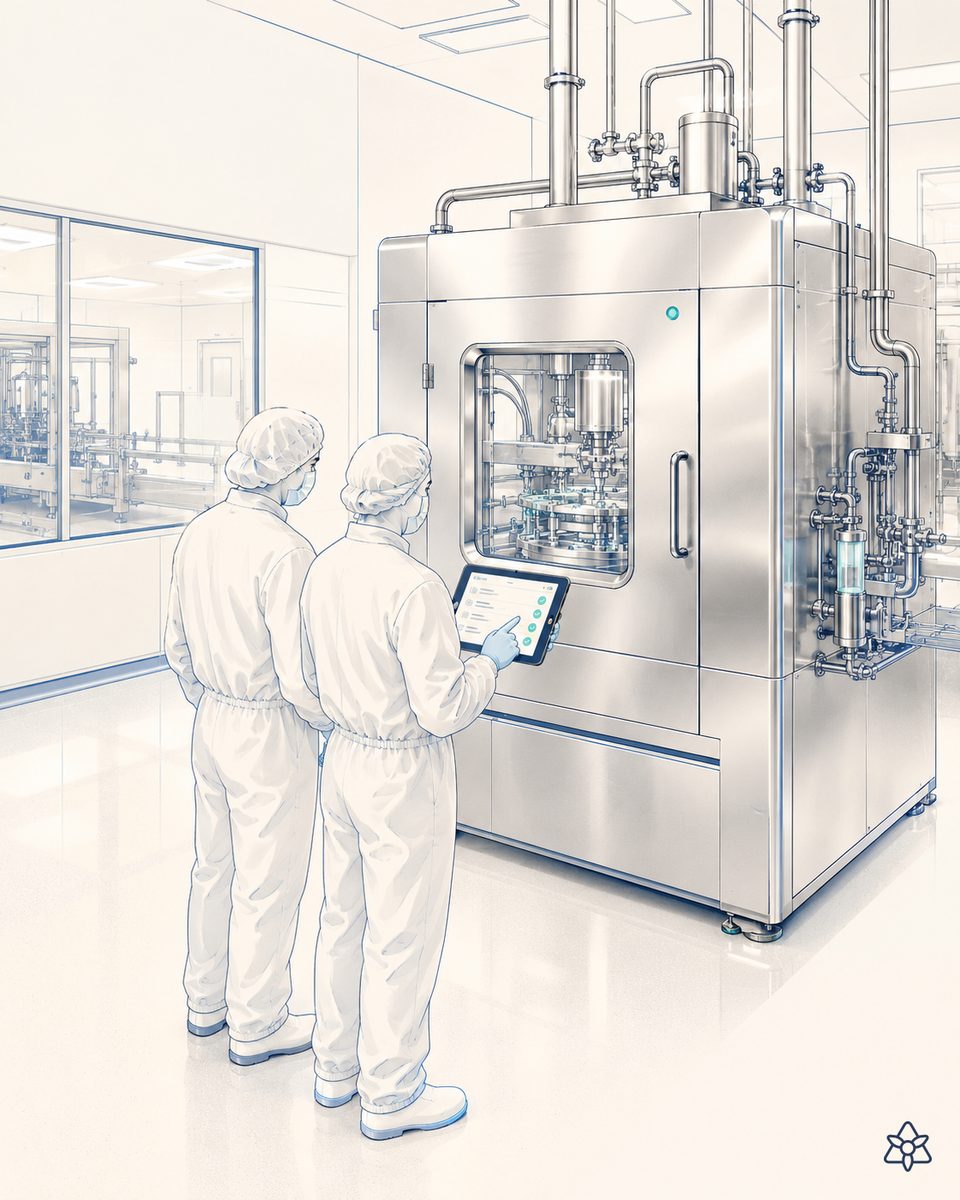
The IRT says what has been dispensed. Everything else lives in parallel spreadsheets.
Clinical trial supply (CTS) has a pain profile unlike anything else in pharma: little volume, many sites, many countries, multi-language labels, mandatory blinding. The IRT/RTSM is the regulatory heart — Veeva, Endpoint, Almac, Bracket, Suvoda, whichever it is — and it does its job well: randomizing patients and recording dispensations. But around the IRT there is a constellation of systems that never talk to each other.
Three broken points come up again and again in pharma companies and in clinical packing CMOs:
- Kit forecasting: the IRT knows what has been dispensed, but cross-referencing that with actual enrollment speed, stock by depot, expired kits or the production pipeline is done in monthly spreadsheets. By the time a kit stockout is forecast, it is late — and "late" in CTS means a patient lost and time-to-market delayed.
- Blinding: clinical packing has to maintain the study's double blind without getting the multi-language label wrong for any country. A label change from the regulatory lead that takes time to reach the packing line is a blinding risk. And a kit carrying the previous label version on its way to a site is a deviation QA has to investigate.
- Drug accountability: at the end of the study, every kit produced has to be reconciled against every kit dispensed, returned and destroyed. In global studies with 100+ sites and 4-6 depots, that is a project in its own right, done with manual exports and emails to the site coordinator. And the regulatory audit looks at all of it.
iLEAN does not replace the IRT — it seals the cracks between the IRT, depots, couriers and packing.
The IRT/RTSM does its job well. CTS operations suffer because the context that determines whether a site is about to run out of kits, whether a multi-language label matches the right version, whether accountability adds up at the end of the study — that context lives scattered. iLEAN acts as the putty that fills those gaps, without asking you to change the IRT, the packaging ERP or the depot. Assist and simplify.
Connect joins the IRT, depots, couriers and packing. Edge verifies the label on the kit line. The agent anticipates the stockout, closes accountability and assembles the dossier. The person signs — never the other way round.
The three iLEAN pieces applied to Clinical Trial Supply:
- Connect — captures the IRT/RTSM, the depot systems, the courier APIs (World Courier, Marken, QuickSTAT), the clinical packaging ERP, and the emails from the site coordinator and the clinical supply lead. The constellation of parallel spreadsheets is unified at second zero.
- Edge — a vision terminal over the clinical packing line. It reads the kit's multi-language label, compares it against the batch randomization (without revealing the arm, only verifying that the label is the correct version) and holds at the depot if an obsolete version slips into a shipment. The blind stays intact.
- Agent — cross-references actual enrollment + dispensations + stock by depot + production + courier lead time. If a site is heading for a kit stockout, it raises the alert while there is still time to reallocate from another depot or accelerate production. And at study close it assembles drug accountability by cross-referencing IRT + depots + sites + returns — the audit dossier comes out ready-made.
Classic CTS vs. cross-referenced CTS with iLEAN
| Aspect | IRT + parallel spreadsheets | With iLEAN Edge + Connect + Agent |
|---|---|---|
| Kit forecasting | Monthly review; late alerts | Live cross-referencing of enrollment + stock + production |
| Multi-language label | Changes propagate by email; risk of an obsolete version | Edge verifies the version inline, holds at the depot if it does not match |
| Blinding | Risk at every label or site change | Verification without revealing the arm; the blind stays intact |
| Drug accountability | A project at close — weeks of exports and emails | Dossier cross-referenced throughout the study — ready in hours |
| Kit stockout at a site | Discovered when the site calls | Anticipated by the agent, with time to reallocate |
| IRT/RTSM | Untouched | Untouched — iLEAN sits outside the IRT |
Impact estimate for your plant — to be validated with your numbers.
The block below is an estimate to be validated with the specific data of your program. We put it forward so the committee has an order of magnitude; we refine it during the diagnostic.
- CMO or pharma company with 3-10 active studies, a commercial IRT (Endpoint, Almac, Suvoda), 2-6 depots, 50-300 sites, clinical packing in house or subcontracted.
- Connect pilot with the IRT + depots + couriers + packaging ERP, plus an agent for kit forecasting and drug accountability. First value expected within a few weeks (the sites stop complaining before the IRT reports anything).
- Drug accountability close-out time cut by roughly ≥30% (a conservative estimate), thanks to the file being assembled live.
- Indicative payback between 4 and 9 months, with two levers: the kit stockout avoided (a patient not lost = time-to-market protected — an extremely high-value lever in oncology and rare disease) and CTS operations hours freed from spreadsheets.
- The IRT/RTSM is never touched; iLEAN sits on top.
And the clinical supply / compliance team's reasonable doubt
“What if the AI touches the blind or a regulated data point and the audit challenges it?” — hallucination is a problem of free generation, not of anchored tasks. Cross-referencing IRT + depot + courier + packaging ERP is an anchored task par excellence. In tasks of that kind, the best models brought error below 1.5% [1]. And even so, iLEAN sits outside the IRT, the blind is never revealed to the operational user (only the label version vs. the assignment is verified), and the person signs every critical action. The three safety rings exist precisely for this.
[1] OpenAI paper “Why Language Models Hallucinate”, 2025 — on the reliability of AI in anchored tasks.
What people ask about Clinical Trial Supply with AI
What is Clinical Trial Supply (CTS) and why does it hurt differently than commercial manufacturing?
Clinical Trial Supply (CTS) is the supply of investigational medication (Investigational Medicinal Product, IMP) to research sites across many countries, in small quantities, with multi-language labeling, mandatory blinding and real-time kit forecasting from the IRT/RTSM. It is not commercial manufacturing: volume is low, the rate of change is high, the cost of a site running out of kits is enormous (a patient lost, time-to-market delayed) and regulatory traceability (GMP Annex 13/Annex 1, GCP, drug accountability) is strict.
Where does the CTS flow break today in a pharma company or a CMO?
In three places: (1) kit forecasting — the IRT/RTSM says which kits have been dispensed, but cross-referencing that with production, depot stock and enrollment forecasting is done in spreadsheets; (2) blinding — randomized labeling per kit, separation of active/placebo materials, a multi-language label per country; every broken link compromises the study blind; (3) drug accountability — returned and unused kits reconciled against the site and the depot; in global studies this can be a project in its own right at study close.
How does iLEAN help without touching the IRT/RTSM?
iLEAN does not replace the IRT/RTSM (Veeva, Endpoint, Almac, Bracket, Suvoda) — it sits on top. Connect captures the IRT, the depot systems, the courier APIs (World Courier, Marken), the packaging ERP and the site coordinator's emails. The agent cross-references forecasting, actual enrollment and stock by depot, and raises the alert when a site is heading for a kit stockout. If a multi-language label has been updated and a kit already in transit carried the previous version, it is held at the depot — not at the site.
Can Edge read kit labels and check blinding on the packaging line?
Yes. On the clinical packing line, Edge reads the kit's multi-language label, compares it against the batch randomization (without revealing the blind, only verifying that the label matches the correct study arm according to the IRT) and fires the actuator if something does not add up. The plant never sees the patient's arm — the system only verifies that the label and the kit assignment are aligned. The study blind stays intact.
How much does it cost to deploy AI in clinical trial supply?
The pilot is sized per study or per clinical packing line. Connect with the IRT/RTSM, depots and couriers; an agent for kit forecasting and drug accountability; optionally Edge over the IMP packaging line. A reasonable payback to put in front of the committee is a few months; the hard levers are the kit stockout avoided (a patient not lost = time-to-market protected) and the drug accountability dossier closed in hours, not weeks, at the end of the study. Ask us for the estimated ROI with your data: we send it in 48h.
More cases in pharma
- Pharma blister control with AI — the half-empty cavity that comes back as a patient complaint.How iLEAN inspects every blister cavity, seal and serialization inline with Edge and agents — GMP, Annex…
- Pharmaceutical capsule filling with AI — the dose drifts before blistering, not after.iLEAN cross-references dose, capsule integrity and residual powder inline with the MES recipe; the agent…
- Cleaning validation with AI — dynamic MACO and continuous swab/rinse, without a bottleneck at every changeover.iLEAN runs continuous cleaning validation with dynamic MACO for multi-product equipment.
- Combination products with AI — two regulatory worlds, one line, no gap in between.How iLEAN cross-checks GMP, ISO 13485, MDR 2017/745, drug batch and device traceability to release a…
- AI-assisted CIP/SIP on direct impact equipment — an excursion you see coming never becomes a deviation.How iLEAN cross-references CIP, SIP and direct impact (DI) equipment — skid, BMS and MES capture, plus…
- Pharmaceutical dispensing with AI — one badly signed weighing costs the whole batch.How iLEAN cross-checks weighings, raw material and work order in the dispensing booth: Edge reads the…
Tell us your case and in 48h we'll send you the estimated ROI of this AI project for your Clinical Trial Supply program.
We work on your operation's real data, not ours. Diagnostic with no commitment.
Request estimated ROI in 48h See pharma