Cleaning validation with AI — dynamic MACO and continuous swab/rinse, without a bottleneck at every changeover.
Cleaning validation on multi-product equipment is a tangle: stale MACO calculations, a sampling sprint at every changeover, lab waits that block the line. iLEAN runs dynamic MACO, reads CIP/SIP and the LIMS continuously, cross-references swab/rinse results and keeps the cleaning dossier alive under ICH Q9. The QA person signs — and the changeover stops costing hours of dead line time.
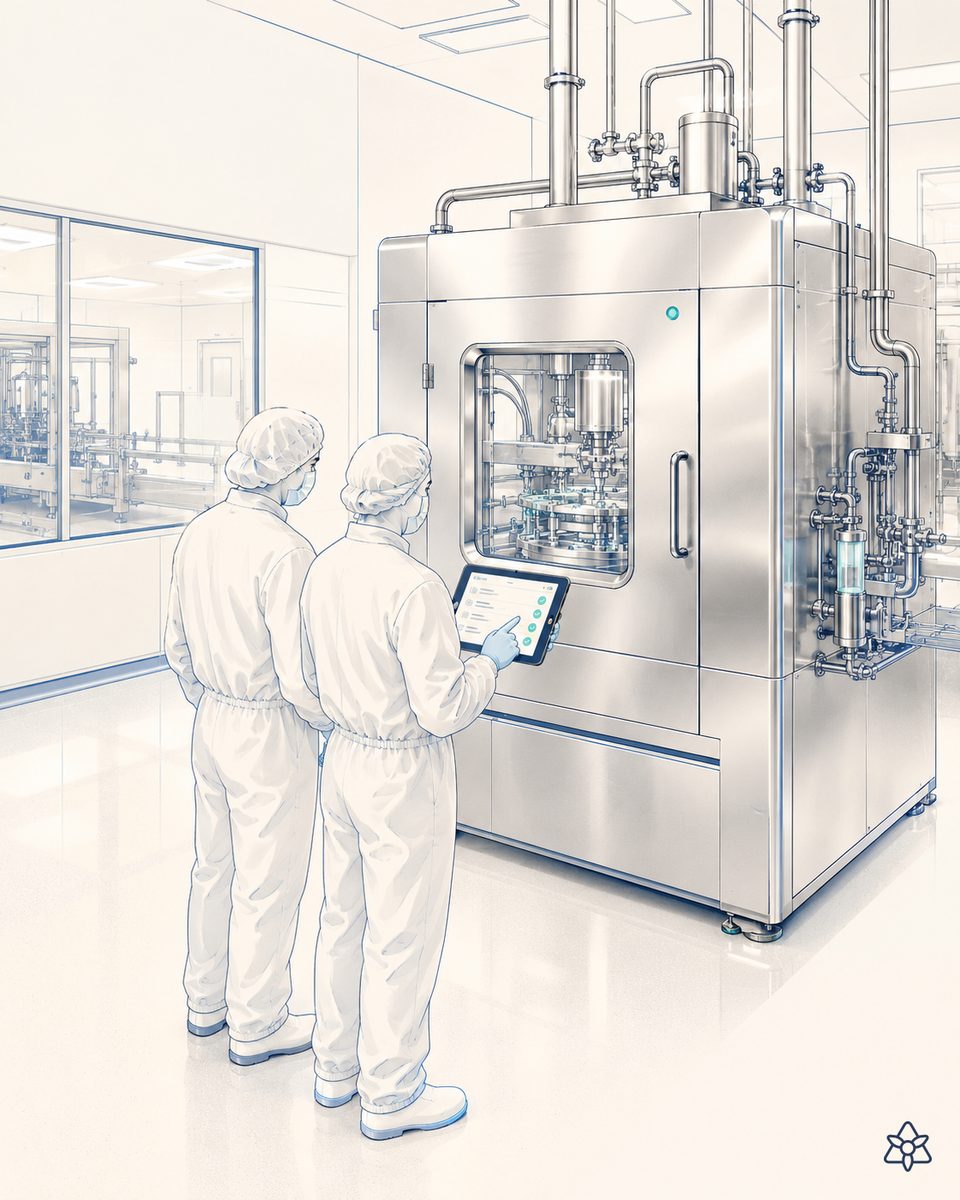
The changeover between products is where the dead time nobody looks at piles up.
In a multi-product GMP plant, the changeover from product A to product B always follows the same script:
- CIP/SIP cleaning to a fixed SOP. The CIP system runs the programmed cycle — the same one for every product pair, because sizing it for the worst case is the safe option.
- Manual swab/rinse sampling by the QA technician. Samples are taken from the equipment's critical points (hard-to-reach areas, gaskets, elbows), labeled and sent to the lab.
- Waiting on the LIMS. The lab analyzes the swab and the rinse. Results in hours or days, depending on the plant. The line, stopped.
- Cleaning release. QA reviews, compares against the MACO calculated in a spreadsheet 3 years ago using the worst case for toxicity, signs and releases. The line restarts on product B.
The result: between 8 and 24 hours of cleaning blocking the line at every changeover. In a plant with 12 products sharing equipment and a weekly changeover, that is several shifts a month lost that nobody charges to any product. The MACO is set for the worst case because recalculating it is manual work; the sampling plan is the same for high and low risk because the SOP does not distinguish; the lab is a bottleneck because the wait is linear. And on audit day, someone has to rebuild all of it — because the cleaning dossier lives in a folder of signed spreadsheets.
iLEAN does not replace CIP/SIP — it recalculates MACO against reality and closes a living dossier.
The cleaning problem is not a lack of validation: it is frozen validation. The MACO was calculated once for the worst case and never recalculated; the SOP is the same for high and low risk; the dossier lives in a folder. iLEAN acts as the putty over your CIP/SIP, SCADA, LIMS and MES systems — it does not replace them, it reads what each one knows and keeps the MACO recalculated, the sampling proportional to risk and the dossier alive under Part 11.
Tracer reads CIP, SIP, LIMS and MES. Writer keeps the cleaning dossier alive. Edge sees the inspectable surface, and the agent recalculates MACO against the reality of the next batch. The QA person signs — the system does not declare itself clean.
The three iLEAN pieces applied to continuous cleaning validation:
- iLEAN Tracer (Connect) — reads the CIP/SIP cycle parameters (conductivity, TOC, temperature, phase times) from the SCADA or from the CIP's own local PC. If the old machine exposes nothing, it reads the panel by vision. It also reads the swab and rinse results from the LIMS as soon as they land.
- iLEAN Writer — keeps the living cleaning dossier per piece of equipment, product pair and campaign. Traceable master template, Part 11 audit trail, ALCOA+ integrity. The audit reads it directly — nothing gets rebuilt.
- iLEAN Edge — a terminal with vision over the equipment's inspectable surface after the CIP. It visually verifies residue, foam and soil before the technician goes in to take the swab. It works without a network.
- iLEAN Agent — recalculates the dynamic MACO before every changeover, with the real data of the next batch (size, equipment train, updated PDE toxicological figure). It classifies the cleaning by risk level under ICH Q9 and proposes a proportional sampling plan. QA decides and signs.
Classic cleaning validation vs. cleaning validation with iLEAN
| Aspect | Classic cleaning validation | With iLEAN Tracer + Writer + Edge + Agent |
|---|---|---|
| MACO calculation | Once, worst case, in a signed spreadsheet | Dynamic, recalculated for every changeover |
| Sampling plan | Same SOP for high and low risk | Proportional to risk under ICH Q9 |
| Visual verification | Manual inspection with a flashlight | Edge with vision before the swab |
| Waiting on the lab | A linear bottleneck | Continuous verification + swab/rinse in parallel |
| Cleaning dossier | Signed spreadsheet in a folder | Living, Part 11 audit trail, inspection-ready |
| Changeover time | 8-24 h blocking the line | ≥30% less in the first 6 months |
Impact estimate for your plant — to be validated with your numbers.
The block below is an estimate to be validated with the specific data of your plant. We put it forward so the committee has an order of magnitude; we refine it during the diagnostic.
- GMP plant making oral solids or sterile products, multi-product equipment (typically 8-15 products sharing critical equipment), weekly or fortnightly changeovers with 8-24 h of cleaning.
- First value expected within a few weeks: the first product pair migrated to dynamic MACO + living dossier + Edge on the inspectable surface.
- Expected reduction in changeover time: ≥30% in the first 6 months, driven by the continuous verification that removes the wait on the lab.
- Indicative payback between 4 and 9 months, dominated by the line capacity recovered during changeovers.
- An adjacent standard already running on continuous verification and dynamic limits: automotive quality demands 25 PPM [1]. That is the level multi-product pharma moves toward with continuous cleaning validation.
And the quality manager's reasonable doubt
“What if the AI recalculates MACO wrongly and we let contaminated product through?” — the rule is strict: the dynamic MACO is proposed with the evidence behind the calculation (batch size, updated PDE, equipment train, worst case ruled out and why); QA decides and signs. The cleaning is never released without a human signature. And in anchored tasks (reading a PDE from a document and recalculating a formula from the SOP) the best models brought error below 1.5% [2]. The three safety rings exist for exactly this.
[1] Automotive quality standard ≈ 25 PPM. Source: Symestic.
[2] OpenAI paper “Why Language Models Hallucinate”, 2025 — on the reliability of AI in anchored tasks.
What people ask about AI-driven cleaning validation in pharma
What is dynamic MACO?
MACO (Maximum Allowable Carryover) is the maximum residue of product A that can remain on the equipment when product B comes in without creating a risk to the patient. Traditionally it is calculated once per product pair and then stays fixed for years, using the worst case for toxicity, the smallest batch and the shared surface area. Dynamic MACO recalculates the limit every time the real conditions change: a new batch of product B with a different size, a new equipment train, a new toxicological figure (PDE) updated by the safety officer. Validation stops running in sprints — it lives with reality.
What about dedicated single-product equipment?
Dedicated equipment (equipment used for a single product) has no product-to-product carryover problem, but it does have a problem with degradants of the API itself, detergent residues and bioburden — and it requires visual plus analytical verification of the cleaning just as multi-product equipment does. iLEAN applies the same flow: Edge vision on the inspectable surface, capture of swab and rinse results from the LIMS, and the agent closes the cleaning dossier against the current SOP. The calculation changes, the flow does not.
How is it validated under ICH Q9 / Q10?
ICH Q9 (Quality Risk Management) and Q10 (Pharmaceutical Quality System) call for a risk-based approach and continual improvement. iLEAN fits by design: the agent classifies every cleaning by risk level (product A → product B with a vulnerable patient population + small batch + high toxicity = critical risk, maximum verification required; product B → the same product B = low risk, simplified verification), applies rigor proportional to risk and keeps the improvement cycle alive with real data. Classic validation said “the system is validated” in a PDF — this one says “the system is validated and here is the evidence that it still is today”.
Does it work with existing CIP/SIP?
Yes. iLEAN does not replace the installed CIP (Clean-in-Place) or SIP (Steam-in-Place) system — it reads the cycle parameters from it (conductivity, TOC, temperature, pressure, phase times) through whatever integration it already has with the SCADA. If an old machine exposes nothing to the SCADA, Tracer reads from the CIP's local PC or, as a last resort, from a photo of the panel. The cycle data is cross-referenced with the dynamic MACO for the product changeover and with the swab/rinse results from the LIMS — the agent closes the cleaning dossier without CIP/SIP changing at all.
How much does it cut changeover time?
An estimate to be validated with your numbers: in a multi-API oral solids plant where a campaign changeover between products costs between 8 and 24 hours (cleaning + sampling + analysis + cleaning release) and blocks the line, the first value with iLEAN shows up within a few weeks — usually with the first product pair migrated to dynamic MACO and a living cleaning dossier. Expected reduction in changeover time: ≥30% in the first 6 months, driven by the continuous verification that removes the wait on the lab. Indicative payback between 4 and 9 months, dominated by the line capacity recovered during changeovers.
More cases in pharma
- Autoinjector pen control with AI — the patient activates it alone, so the assembly leaves no room for doubt.iLEAN inspects autoinjector pen assembly, activation force and serialization, and builds the FDA/EMA…
- Pharma blister control with AI — the half-empty cavity that comes back as a patient complaint.How iLEAN inspects every blister cavity, seal and serialization inline with Edge and agents — GMP, Annex…
- Pharmaceutical capsule filling with AI — the dose drifts before blistering, not after.iLEAN cross-references dose, capsule integrity and residual powder inline with the MES recipe; the agent…
- Clinical trial supply with AI — a site with no kit is a patient lost.How iLEAN cross-references IRT/RTSM, depots, sites and kit traceability to anticipate stockouts, protect…
- Combination products with AI — two regulatory worlds, one line, no gap in between.How iLEAN cross-checks GMP, ISO 13485, MDR 2017/745, drug batch and device traceability to release a…
- AI-assisted CIP/SIP on direct impact equipment — an excursion you see coming never becomes a deviation.How iLEAN cross-references CIP, SIP and direct impact (DI) equipment — skid, BMS and MES capture, plus…
Tell us your case and in 48h we'll send you the estimated ROI of continuous cleaning validation.
We work on your GMP plant's real data, not ours. Diagnostic with no commitment.
Request estimated ROI in 48h See pharma