Pharma blister control with AI — the half-empty cavity that comes back as a patient complaint.
Blisters fail through an incomplete cavity, the wrong tablet, a pinhole in the seal or serialization linked to the wrong batch. Sample-based inspection delivers the news too late, and a market recall costs far more than the saving. iLEAN Edge sees every cavity before die-cutting, cross-references the SKU with the batch, and an agent builds the GMP/Annex 1 dossier with data integrity. The person signs — the line does not restart on its own.
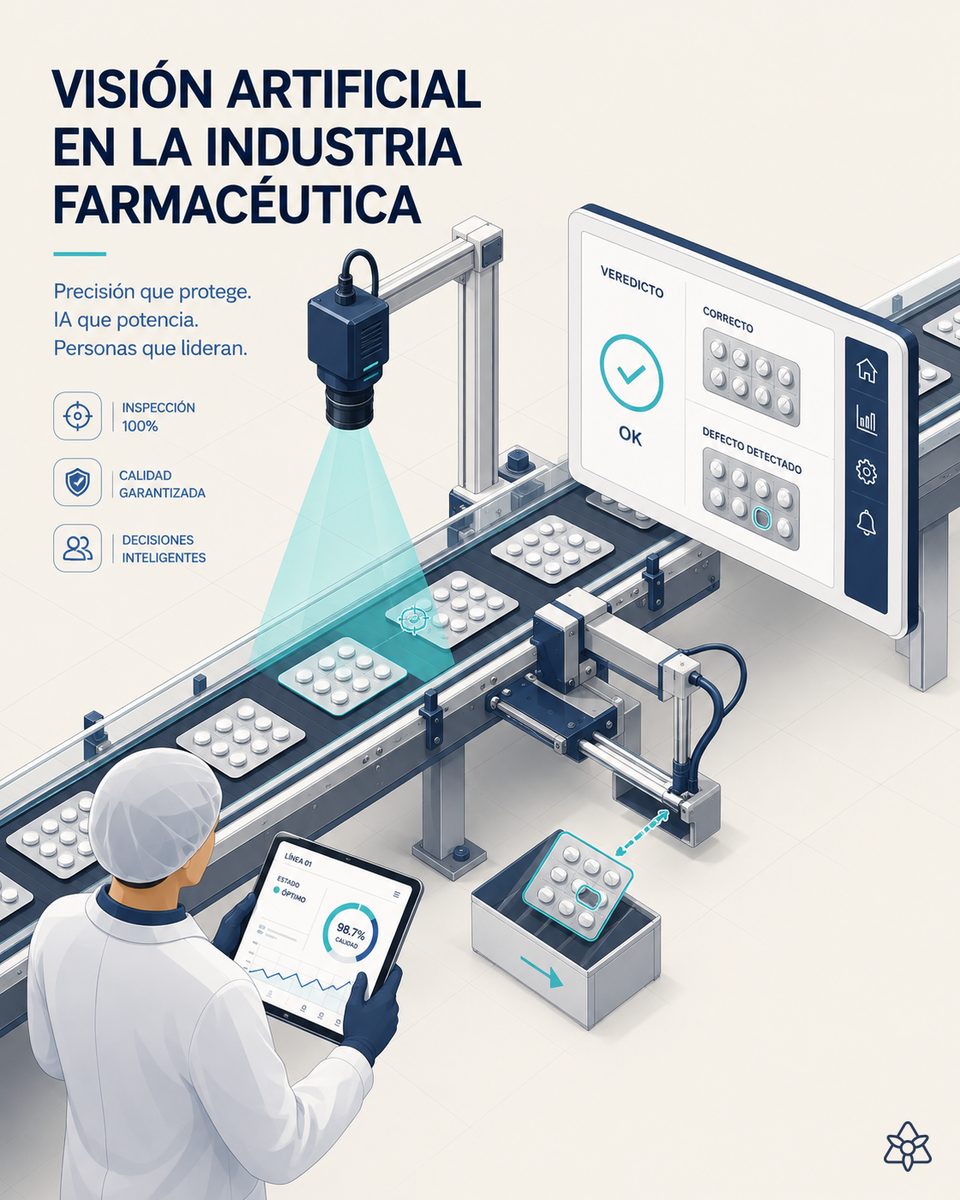
The blister is right 99% of the time. The remaining 1% is a market recall.
The blister is where several sources of error converge, and they almost never show up in isolation:
- Empty cavity or broken tablet — the operator cannot inspect every cavity at line speed; classic systems do it on samples.
- The wrong tablet — a mix-up in the feed after an SKU changeover that was badly propagated, two active ingredients sharing a commercial color but differing in dose.
- A pinhole or channel in the seal — invisible to the eye. It breaks the moisture barrier and the product degrades on the shelf.
- Serialization / braille — the code is not linked to the right batch at changeover, the braille comes out of spec; the regulator and the customer both notice.
The quality manager knows it. So does the operator. And even so, on a running thermoformer line, the classic system works 99% of the time. That 1% is what reaches the EMA or the FDA — and in pharma, a market recall is work for an entire team for months.
iLEAN does not replace QA — it hands QA data integrity by default.
The problem is not a lack of quality: it is that quality is measured on samples and that process information (the MES recipe, the granulate batch, the serialization, the SKU changeover) lives on islands and never reaches the camera or the batch record in time. iLEAN acts as the putty between the thermoformer, the MES, the serialization system and the QA room.
Edge sees every cavity before die-cutting. Connect reads the SKU, the batch and the serialization code wherever they live. The agent cross-references them with the approved blister layout, holds the batch if something does not add up, and builds the dossier with a timestamp. The person signs — never the other way round.
The three iLEAN pieces applied to blister control:
- Edge — a terminal with machine vision (CNN) over the thermoformer. It inspects every cavity: presence, color, geometry, tablet integrity, seal (with dedicated lighting where applicable), braille position and serialization code. It fires the actuator before die-cutting. It works with no network.
- Connect — captures the SKU, the granulate batch and the serialization code whether they come from the MES, the ERP or the track & trace system. And it captures what arrives from outside (a regulator alert, a customer spec change, a note from the aluminum supplier) at second zero.
- Agent — cross-references recipe + batch + image + approved blister layout + serialization. If there is a deviation, it holds the batch, alerts QA and builds the dossier with a timestamp, a hash and the user's signature (ALCOA+ data integrity). The person releases the batch; the line does not restart on its own.
Classic sample-based inspection vs. 100% control with iLEAN
| Aspect | Sampling + visual check | With iLEAN Edge + Connect + Agent |
|---|---|---|
| Coverage | 1 blister in every N | 100%, cavity by cavity |
| Wrong tablet / dose | Caught in sampling or in a complaint | Caught inline by color and geometry |
| Pinhole in the seal | Leak test on samples | Dedicated lighting + CNN |
| Serialization / braille | Verified on samples | Verified and linked to the batch by the agent |
| Dossier for EMA/FDA | Rebuilt by hand, weeks | Automatic per batch, with ALCOA+ |
| Response time to a deviation | Days | Seconds |
Impact estimate for your plant — to be validated with your numbers.
The block below is an estimate to be validated with the specific data of your plant. We put it forward so the committee has an order of magnitude; we refine it during the diagnostic.
- Oral solids plant with 2-3 blister lines, a mix of PVC/aluminum and aluminum/aluminum, 6-12 active SKUs.
- Edge pilot on the priority thermoformer (camera + lighting + actuator + integration with MES and serialization). First value expected within a few weeks.
- Indicative payback between 4 and 9 months, dominated by the avoided cost of a single market recall and by lower scrap at batch changeover.
- Expected reduction in deviations detected in QA of ≥30% in the first quarter and ≥70% by month six. The regulatory lever (an ALCOA+ dossier by default) is one of the strongest in pharma — it is worth a great deal ahead of your next audit.
And QA's reasonable doubt
“What if the AI hallucinates and releases a bad batch?” — hallucination is a problem of free generation, not of anchored tasks. In tasks where the AI merely recontextualizes a piece of data (reading the cavity and comparing it with the batch SKU), the best models brought error below 1.5% [1]. And even so, what is critical is never decided alone: iLEAN holds and the person releases. The three safety rings — a hallmark of IRIS architectures — exist precisely for this, and they fit the spirit of Annex 11 on human oversight of computerized systems.
[1] OpenAI paper “Why Language Models Hallucinate”, 2025 — on the reliability of AI in anchored tasks.
What people ask about pharma blister control with AI
What are the typical inline defects on a pharma blister?
Four families: an empty cavity or one with a broken/split tablet, the wrong tablet (mix-up in the feed or an SKU changeover badly propagated), a lidding foil seal defect (a pinhole or a channel) that breaks the moisture barrier, and serialization/braille out of spec or not linked to the right batch. The operator cannot inspect every blister at line speed; classic systems do it on samples and deliver the news too late.
How does iLEAN Edge verify every cavity without slowing the thermoformer?
Edge is a terminal with vision (CNN) and, where applicable, dedicated lighting for the seal (UV/IR). It inspects every blister cavity inline: presence, color, geometry, tablet integrity, seal integrity, braille position and serialization code. At thermoformer speed it fires the actuator before die-cutting, before cartoning. If the plant loses its network, Edge carries on — the critical cycle does not depend on connectivity.
Does it comply with GMP Annex 1, Annex 11 and data integrity (ALCOA+)?
The system is designed for it. The images, the results and the signature of the person who validates a batch are stored with a timestamp, a hash and user traceability (attributable, legible, contemporaneous, original, accurate + complete, consistent, enduring, available). The agents operate in the outer and middle rings; the final release decision is signed by a person, as the regulator requires for critical product.
Does it work with light-sensitive products and with tablets of very similar color?
Yes. The lighting is calibrated so it does not degrade photosensitive product, and the CNN is trained on samples from your own plant. Vision distinguishes color shades and geometries that the eye cannot separate at line speed — especially useful in families with several active ingredients that share a commercial color but differ in dose.
How much does an Edge pilot cost for a pharma blister line?
The order of magnitude of an Edge pilot on a blister line is close to that of any industrial Edge pilot: terminals + cameras + lighting + actuator + integration with MES/ERP and serialization, plus an annual license. A reasonable payback to put in front of the committee is several months — the hard lever is a single market recall avoided, plus lower scrap at batch changeover. We ask for your data and send you the estimated ROI in 48h.
More cases in pharma
- Aseptic packaging with AI vision — a vial with a particle is not an incident, it is a recalled batch.iLEAN Vision inspects every vial leaving the aseptic filler: level, particles, sealing. Without stopping…
- ATMP vein-to-vein custody chain — a lost CAR-T is not an incident, it is a patient without treatment.iLEAN traces the autologous ATMP custody chain from apheresis to infusion without ever losing the…
- Autoinjector pen control with AI — the patient activates it alone, so the assembly leaves no room for doubt.iLEAN inspects autoinjector pen assembly, activation force and serialization, and builds the FDA/EMA…
- Pharmaceutical capsule filling with AI — the dose drifts before blistering, not after.iLEAN cross-references dose, capsule integrity and residual powder inline with the MES recipe; the agent…
- Cleaning validation with AI — dynamic MACO and continuous swab/rinse, without a bottleneck at every changeover.iLEAN runs continuous cleaning validation with dynamic MACO for multi-product equipment.
- Clinical trial supply with AI — a site with no kit is a patient lost.How iLEAN cross-references IRT/RTSM, depots, sites and kit traceability to anticipate stockouts, protect…
Tell us your case and in 48h we'll send you the estimated ROI of this AI project for your blister line.
We work on your plant's real data, not ours. Diagnostic with no commitment.
Request estimated ROI in 48h See pharma