Aseptic packaging with AI vision — a vial with a particle is not an incident, it is a recalled batch.
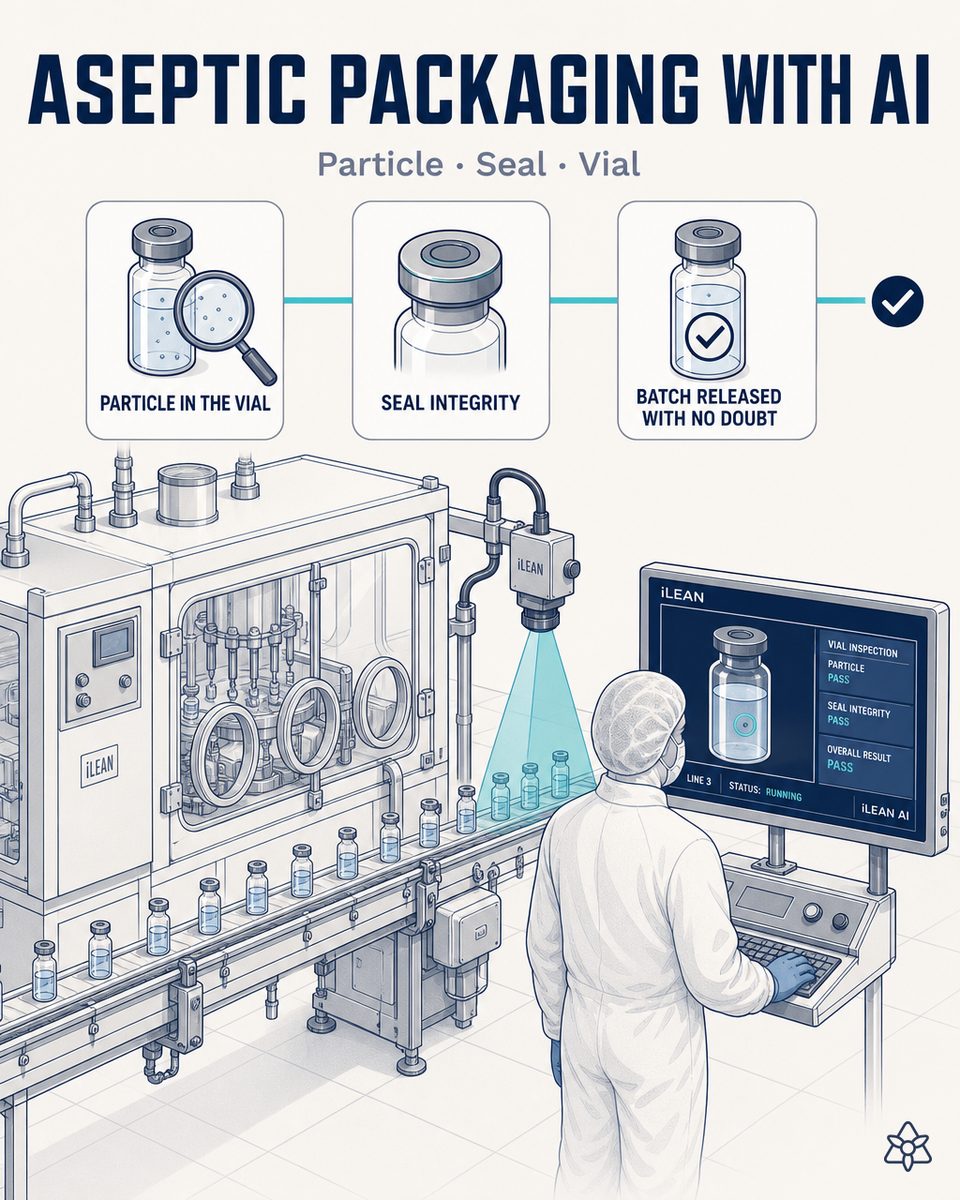
A vial with a particle means a recalled batch. iLEAN Vision inspects level, particles and sealing as vials leave the aseptic filler, in line, without stopping the conveyor. It does so in an ISO 5 cleanroom, integrated with your isolator, and leaves the dossier ready for the inspector. The person signs — the line does not restart on its own.
The inspector qualified under the pharmacopeia is essential — and is asking for help.
Visual inspection of injectable vials is one of the most closely watched points in the regulation: USP <790>, Ph. Eur. 2.9.20, the revised GMP Annex 1. And the reality for the pharma operations director is this:
- The qualified visual inspector gets tired. Reviewing 60 vials a minute for a full shift is physically exhausting. Fatigue is a fact documented in the pharmacopeia, not an opinion. And where the eye tires, the defect slips through.
- The SKU changeover is the critical moment. Amber vial, clear vial, viscous liquid, lyophilized product, a monoclonal antibody formulation — every SKU calls for its own optical criteria, and calibration is done against a bag of reference defects that ages.
- Defect traceability is lost. When something is rejected, why was it rejected? At what point in the isolator did the particle get in? Was it glass, fiber, detergent residue? Without systematic capture, every incident is investigated from scratch.
The financial consequence is brutal: a single batch recalled for particulate contamination in an injectable product costs far more than the industrial cost — there is the brand cost, the report to the health authority, and the replacement batch the hospital is still waiting for. The classic system works 99.9% of the time — and that 0.1% is what reaches the pharmaceutical RASFF.
iLEAN does not replace the inspector — it takes away the mechanical tedium and hands them the cases where their judgment counts.
The problem in aseptic packaging is not a lack of eyes: it is that the qualified human eye should be resolving borderline cases, not counting vials on a conveyor at 60 ppm until it fatigues. iLEAN acts as the putty that covers the capture window: it sees every vial leaving the isolator, does the mass screening and passes the qualified inspector the doubtful ones already classified, with the image and the batch history.
Vision sees every vial leaving the isolator. Edge runs inference locally without taking images out of the cleanroom. The agent cross-checks against the formulation, the isolator cleaning and the batch history. The person signs; the line does not restart on its own.
The three iLEAN pieces applied to aseptic packaging:
- iLEAN Vision + Edge — a machine vision terminal (CNN) mechanically integrated over the isolator outfeed. It reads level, particles (including glass, fibers and residues), seal integrity (stopper, aluminum cap, crimp) and the appearance of the lyophilized/liquid product. Inference runs locally: the image does not leave the cleanroom except for the dossier. It works without a network: if the plant loses WiFi, Edge keeps rejecting defective vials.
- iLEAN Connect — captures the batch formulation (prior CIP/SIP, autoclave parameters, stopper type, viscosity) and makes it available to the model. If a SKU changeover means retraining parameters, it happens when the order is loaded, not halfway through the shift.
- iLEAN Agent — cross-checks Vision's rejects against the formulation, the isolator cleaning, the primary vial batch and the sterilization autoclave curve. If it detects a pattern (a cluster of glass particles at a specific position on the conveyor), it holds the batch and alerts the Qualified Person. It composes the per-batch GMP dossier automatically: list of rejects, image of each one, probable cause, required signatures.
Classic qualified inspection vs. inspection with iLEAN Vision + Edge + Agent
| Aspect | Classic human visual inspection | With iLEAN Vision + Edge + Agent |
|---|---|---|
| Coverage | 100% by inspector, with fatigue accumulating through the shift | 100% by machine, doubtful ones to the qualified inspector |
| Glass particle detection | Depends on the inspector's condition and the lighting | Constant per SKU, recorded with an image |
| SKU changeover | Manual recalibration, risk during the transition | Specific model loaded when the order is launched |
| Defect traceability | Signed sheet with a manual tally | Image + probable cause + batch history per reject |
| Operation without a network | n/a | Edge keeps running inference on the panel's own power |
| GMP / Annex 1 dossier | Rebuild by hand, days | Generated per batch, signed, ready for the inspector |
Impact estimate for your plant — to be validated with your numbers.
The block below is an estimate to be validated with the specific data of your plant. We put it forward so the committee has an order of magnitude; we refine it during the diagnostic.
- Aseptic line of 2-10 ml injectable vials, integrated isolator (Bosch/Optima/IMA), typical speed 50-120 ppm, multi-SKU with clear and amber vials.
- Deployment of iLEAN Vision over the isolator outfeed + Agent for the GMP dossier. First value expected within a few weeks: detection for the pilot SKU.
- Indicative payback between 4 and 9 months, depending on the average cost of your current rejects from manual inspection, the frequency of past recalls and the qualified inspector time recovered for higher-value tasks.
- Expected reduction of the inspector's visual fatigue and of inter-inspector variability ≥ 30%, based on the pattern seen in other sectors with Edge inspection on the line.
- The hard lever is a single recalled batch avoided. One recall of a sterile injectable pays for the entire pilot and leaves change to scale up.
And the technical director's / Qualified Person's reasonable doubt
“What if the AI misses a critical particle?” — hallucination is a problem of free generation, not of anchored tasks. In tasks where the AI merely classifies what it sees against a validated pattern (which is what Vision does with every vial), the best models brought error below 1.5% [1]. And even so, the iLEAN architecture does not decide alone: it holds the doubtful unit and the qualified inspector signs. The pharma quality standard is in the same order of magnitude as the automotive one — 25 PPM [2] — and it is reached with human-machine jidoka, not by eliminating the inspector.
[1] OpenAI paper “Why Language Models Hallucinate”, 2025 — on the reliability of AI in anchored tasks. [2] Symestic, automotive quality standard (25 PPM).
What people ask about aseptic packaging with AI vision
Does it work in an ISO 5 cleanroom?
Yes. iLEAN Vision terminals for aseptic packaging are mounted in cleanroom-compatible enclosures (316L stainless steel, hygienic gaskets, IP65/67) with optics selected so they do not shed particles into the controlled environment. The mechanical integration with the isolator (Bosch, Optima, IMA, Marchesini) is designed not to break the grade A interior and allows CIP/SIP cleaning without dismounting the vision module.
Does it detect particles under 50 µm?
With properly sized lighting and optics, detection above 50 µm is what is reasonable to expect in line — including glass particles (the critical ones in parenteral pharma) and fibers. For smaller particles the bottleneck stops being the AI and becomes the physics of the camera and the lighting; that is where we get into a concrete technical discussion: type of vial (cylindrical, ampoule), fill (clear vs. viscous liquid, amber vs. colorless), line speed. The honest promise: we cover what the regulation requires and physics allows, no more.
What about amber and clear vials?
Both. The challenge with an amber vial (typical for photosensitive products) is the attenuation of visible light — it is compensated with NIR/IR lighting and model retraining. With a clear vial, the opposite challenge: the glare on the curvature generates false positives that the model has to learn to discard. iLEAN Edge trains a specific model per SKU; changing SKU means reloading the model, not rewiring the line.
How is it validated under GMP?
Validation follows the usual GAMP 5 framework (category 5: configured software) plus 21 CFR Part 11 / Annex 11 EU GMP for data integrity and audit. We deliver URS, FS, DS, IQ, OQ and PQ with the protocols prepared; the customer executes the validation with their own QA team. The model's data (versioning, training set, metrics, drift) is kept under custody with a timestamp and a signature — exactly what the AEMPS/EMA inspector wants to see.
Is it better than a human qualified inspector?
It is not “better than”: it is different and complementary. The human inspector qualified under the pharmacopeia remains essential for borderline cases, periodic visual qualification and judgment calls on doubtful units. iLEAN Vision frees the inspector from the mechanical tedium (reviewing 60 vials/min on a conveyor is not where their judgment adds value) and hands them the doubtful ones already classified so they can decide — the AQL is maintained, visual fatigue drops, and the operator contributes where it really counts. Assist and simplify, not replace.
More cases in pharma
- Pharma API weighing control with AI — one misplaced decimal is one lost batch.How iLEAN cross-checks the API weighing, the supplier batch and the GMP recipe in real time to remove…
- Aseptic eye drop filling with AI — contamination is not detected in QC, it is prevented at second zero.How iLEAN cross-references cleanroom vision, HVAC/Grade A parameters and Annex 1 for aseptic eye drop…
- Aseptic eye drops control with AI — sterility is not tested at the end: it is built into every minute of the fill.How iLEAN cross-checks environmental monitoring, 0.22 µm sterilizing filtration and Grade A…
- ATMP vein-to-vein custody chain — a lost CAR-T is not an incident, it is a patient without treatment.iLEAN traces the autologous ATMP custody chain from apheresis to infusion without ever losing the…
- Autoinjector pen control with AI — the patient activates it alone, so the assembly leaves no room for doubt.iLEAN inspects autoinjector pen assembly, activation force and serialization, and builds the FDA/EMA…
- Pharma blister control with AI — the half-empty cavity that comes back as a patient complaint.How iLEAN inspects every blister cavity, seal and serialization inline with Edge and agents — GMP, Annex…
Tell us your case and in 48h we'll send you the estimated ROI of this AI vision project for your aseptic line.
We work on your plant's real data, not ours. Diagnostic with no commitment.
Request estimated ROI in 48h See pharma