Aseptic eye drops control with AI — sterility is not tested at the end: it is built into every minute of the fill.
A multidose eye drop cannot be sterilized in its final container: its sterility rests on 0.22 µm filtration, on Grade A, and on every operator intervention. iLEAN Edge watches the critical zone, Connect reads the environmental monitoring and the filter tests, and the agents cross-check everything against the batch timeline. The person signs — the batch does not move on by itself.
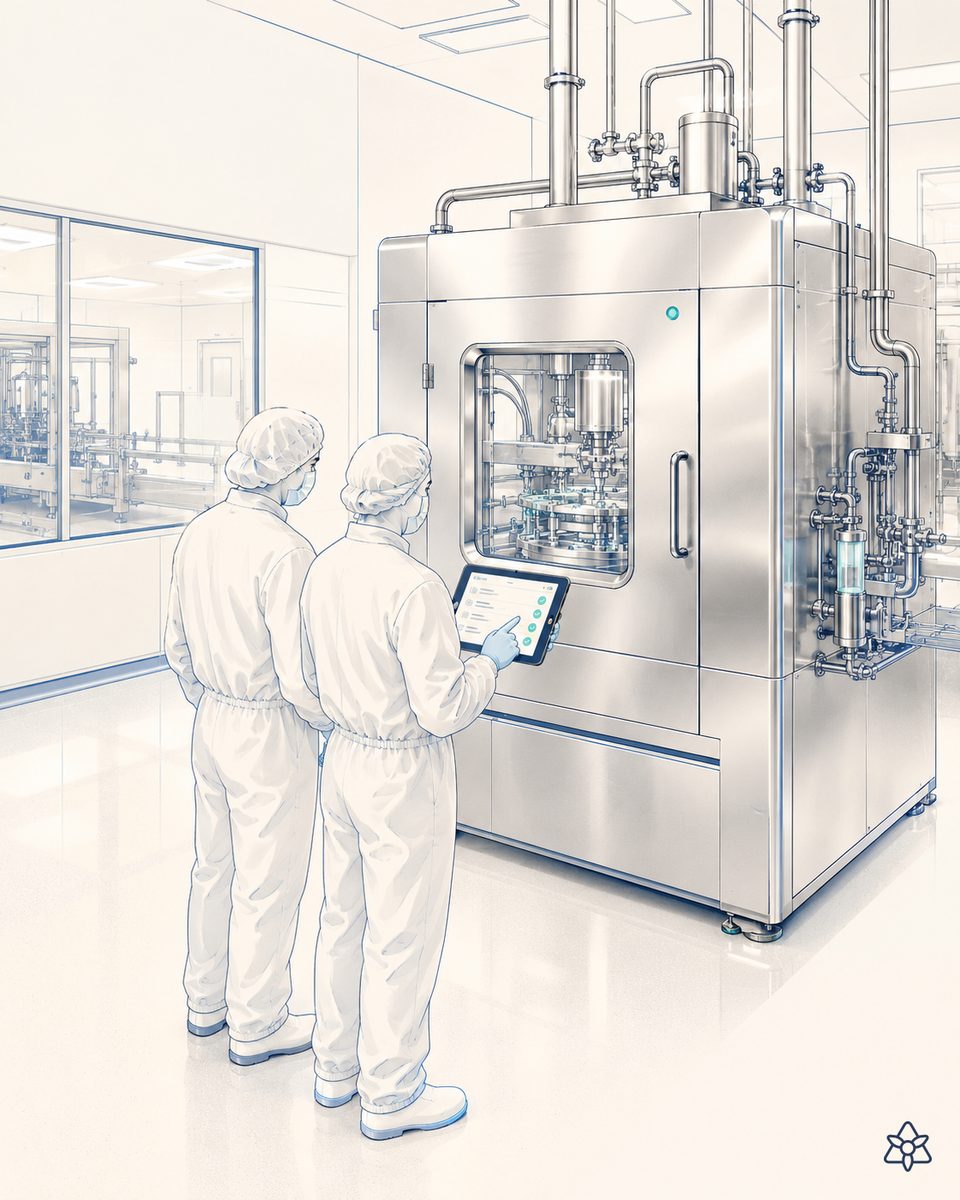
Eye drops cannot be sterilized at the end: whatever happens in the room reaches the patient's eye.
Most multidose eye drops are packaged in an LDPE bottle with a dropper tip — a container that cannot survive terminal heat sterilization. That is why the process is aseptic filling: the solution is sterilized through a 0.22 µm membrane, and everything that happens downstream of that filter has to preserve sterility until the container is closed. The final sterility test samples a handful of units; the real guarantee is the process. And that process is a crossroads of things that almost never sit in the same system:
- The recipe and the filler — from the MES, with filling parameters, capping torque and line speed.
- The environment — a continuous particle counter (≥0.5 µm and ≥5 µm), air and surface sampling, differential pressures. Each with its own system or its own file.
- The interventions — every time an operator reaches into the Grade A unidirectional airflow, the intervention has to be recorded and assessed. Today: the room logbook and someone's memory.
- The tests — sterilizing filter integrity before and after the batch, container closure integrity (CCIT), a current media fill. Results on paper or in the LIMS, reviewed days later.
The sterile production manager knows it. The release review reconstructs after the fact what happened over hours of filling: if a particle excursion coincided with an intervention, the investigation is long and the decision — the whole batch or just a stretch of it? — is made late and on incomplete evidence. Annex 1 (2022) asks for exactly the opposite: a living Contamination Control Strategy with correlated data, not data archived on islands.
iLEAN does not change the filler or the EM system — it puts a safety net under every minute of the fill.
The aseptic filling problem is not one of instrumentation: the room already measures almost everything. It is information on islands spread across the filler, the environmental monitoring system, the intervention logbook and the LIMS. iLEAN acts as the putty that fills those gaps without asking you to change your filler, your EM system or your validated process.
Edge watches the critical zone and every intervention. Connect reads particles, pressures, filter integrity and the recipe. The agent correlates in real time: excursion + intervention + the affected stretch of units. Stack light red if something does not add up. The person signs.
The iLEAN pieces applied to aseptic eye drops control:
- Edge — a terminal with machine vision (CNN) over the critical zone. It records every Grade A intervention with a timestamp and correlates it with the units under the filling point at that moment. It supervises tip and cap presence before closing, and the in-line CCIT station. It works with no network.
- Connect — continuously captures the particle counter and the air sampler, the differential pressures of the room cascade, the filter integrity test result (pre- and post-batch), the validity of the media fill and of personnel qualifications, and the MES recipe with its filling parameters and torque.
- Agent — watches the batch timeline in real time: is there a particle excursion while filling? Does it coincide with a recorded intervention? Did the filter pass its integrity test before start-up? Is the media fill current? If everything checks out, it records and moves on. If something does not add up, it holds the affected stretch and raises the alert. The responsible person assesses and signs. And at the end of the batch, the agent generates the ALCOA+ dossier ready for the release review.
After-the-fact review vs. an aseptic fill correlated with iLEAN
| Aspect | Room logbook + systems on islands | With iLEAN Edge + Connect + Agent |
|---|---|---|
| Particle excursion | Discovered during batch review | Pinned down in seconds to specific units |
| Grade A interventions | Logbook + the operator's memory | Timestamped record, correlated with the fill |
| 0.22 µm filter integrity | Paper result, reviewed at closure | No valid pre-test, the line does not start |
| In-line CCIT | Rejects counted at the end of the batch | Every reject cross-checked with torque and components |
| Media fill and qualifications | Due dates tracked by hand | Alert and lockout when validity expires |
| File for the auditor | Manual multi-system rebuild | ALCOA+ dossier per batch, one click away |
Impact estimate for your plant — to be validated with your numbers.
The block below is an estimate to be validated with the specific data of your plant. We put it forward so the committee has an order of magnitude; we refine it during the diagnostic.
- Ophthalmic plant with 1-3 aseptic filling lines (conventional in RABS/isolator, or BFS), a continuous environmental monitoring system, an MES or electronic batch record in place or in the pipeline.
- Edge pilot over the critical zone of 1 line + Connect over EM/MES/LIMS + a real-time correlation agent. First value expected within a few weeks.
- Indicative payback between 6 and 12 months, depending on the documented frequency of excursions and investigations and the average cost of an eye-drop batch in your portfolio.
- The hard lever is moving from scrapping whole batches for lack of evidence to holding only the affected stretch with correlated evidence + cutting the investigation time per excursion. A single batch rescued on solid evidence pays for the pilot.
And the sterile production director's reasonable doubt
“What if the AI misreads an intervention in Grade A?” — recording that a person reached into the unidirectional airflow, at what timestamp, and which units were under the filling point is an anchored task: detecting an event on video and aligning it with a counter. In anchored tasks, the best models bring error below 1.5% [1]. And even so, in sterile manufacturing what is critical is never decided alone: the agent holds the stretch and the person assesses and signs. The intervention assessment Annex 1 demands does not disappear — it gains the evidence it lacks today: the video, the timestamp and the particle counts from the same minute, on the same screen.
[1] OpenAI paper “Why Language Models Hallucinate”, 2025 — on the reliability of AI in anchored tasks.
What people ask about aseptic eye drops control with AI
What does Annex 1 require for manufacturing sterile eye drops?
EU GMP Annex 1 (2022) requires aseptic filling of ophthalmic solutions to take place in Grade A (ISO 5 in operation) with a Grade B background — or in an isolator/RABS — with continuous particle monitoring (≥0.5 µm and ≥5 µm), microbiological monitoring of air and surfaces, 0.22 µm sterilizing filtration with a filter integrity test before and after the batch, periodic media fills that qualify both the process and the personnel, and a documented Contamination Control Strategy (CCS). Every intervention in the critical zone must be recorded and assessed.
How does AI help monitor particles and interventions in Grade A?
iLEAN Edge watches the critical zone in real time: it records every operator intervention into the unidirectional airflow with its timestamp and correlates it with the stretch of units being filled at that moment. Connect continuously captures the particle counter and the air sampler. If there is an excursion, the Agent pins down in seconds which units of the batch were under the filling point during the excursion and puts them on hold. The person decides and signs — the batch does not move on by itself.
Can iLEAN cross-check environmental monitoring with the batch without changing the EM system?
Yes. iLEAN does not replace the environmental monitoring system or the particle counter: Connect reads their outputs (OPC, serial, files, even PDF reports) and aligns them with the batch timeline from the MES. The equipment qualification and the validated aseptic process are not touched: the integration lives in ring 3 and the validated data passes to ring 1 through a hardened mailbox.
What does AI add to container closure integrity testing (CCIT)?
A multidose eye-drop container (LDPE bottle + dropper tip + cap) is a complex closure: container closure integrity (CCIT, USP 1207) is what keeps the product sterile all the way to the patient's eye. iLEAN Edge supervises the in-line CCIT station (vacuum decay, high voltage or whichever technique you already use) and the Agent cross-checks every reject against capping torque, component batch and filler parameters to catch process drift before it turns into a reject trend.
What aseptic batch dossier is delivered for an audit?
iLEAN generates an ALCOA+-aligned dossier per batch: the filling timeline with the environmental monitoring overlaid, every Grade A intervention with its assessment, the pre- and post-batch filter integrity tests, the CCIT results, the validity of the latest media fill, and the responsible person's electronic signature. It connects with the digital EBR and with the always-ready FDA/EMA audit. Rebuilding the aseptic file by hand — weeks of work today — becomes a single click.
More cases in pharma
- API + excipient blending with AI — content uniformity is confirmed in the blender, not in the lab.iLEAN cross-checks NIR/vision imaging of the blend bed, blender parameters and the recipe to guarantee…
- Pharma API weighing control with AI — one misplaced decimal is one lost batch.How iLEAN cross-checks the API weighing, the supplier batch and the GMP recipe in real time to remove…
- Aseptic eye drop filling with AI — contamination is not detected in QC, it is prevented at second zero.How iLEAN cross-references cleanroom vision, HVAC/Grade A parameters and Annex 1 for aseptic eye drop…
- Aseptic packaging with AI vision — a vial with a particle is not an incident, it is a recalled batch.iLEAN Vision inspects every vial leaving the aseptic filler: level, particles, sealing. Without stopping…
- ATMP vein-to-vein custody chain — a lost CAR-T is not an incident, it is a patient without treatment.iLEAN traces the autologous ATMP custody chain from apheresis to infusion without ever losing the…
- Autoinjector pen control with AI — the patient activates it alone, so the assembly leaves no room for doubt.iLEAN inspects autoinjector pen assembly, activation force and serialization, and builds the FDA/EMA…
Tell us your case and in 48h we'll send you the estimated ROI of this AI project for your aseptic filling line.
We work on your plant's real data, not ours. Diagnostic with no commitment.
Request estimated ROI in 48h See pharma