API + excipient blending with AI — content uniformity is confirmed in the blender, not in the lab.
A non-uniform blend shows up in the tablet three stages later, when it is already a batch — content uniformity out of spec, recall under way. iLEAN Edge sees the whole bed in line (vision / NIR), Connect captures the blender's real parameters and an agent cross-checks them against the recipe and today's API density. If the blend does not replicate the pattern of the good batch, the system holds before discharge. The person signs.
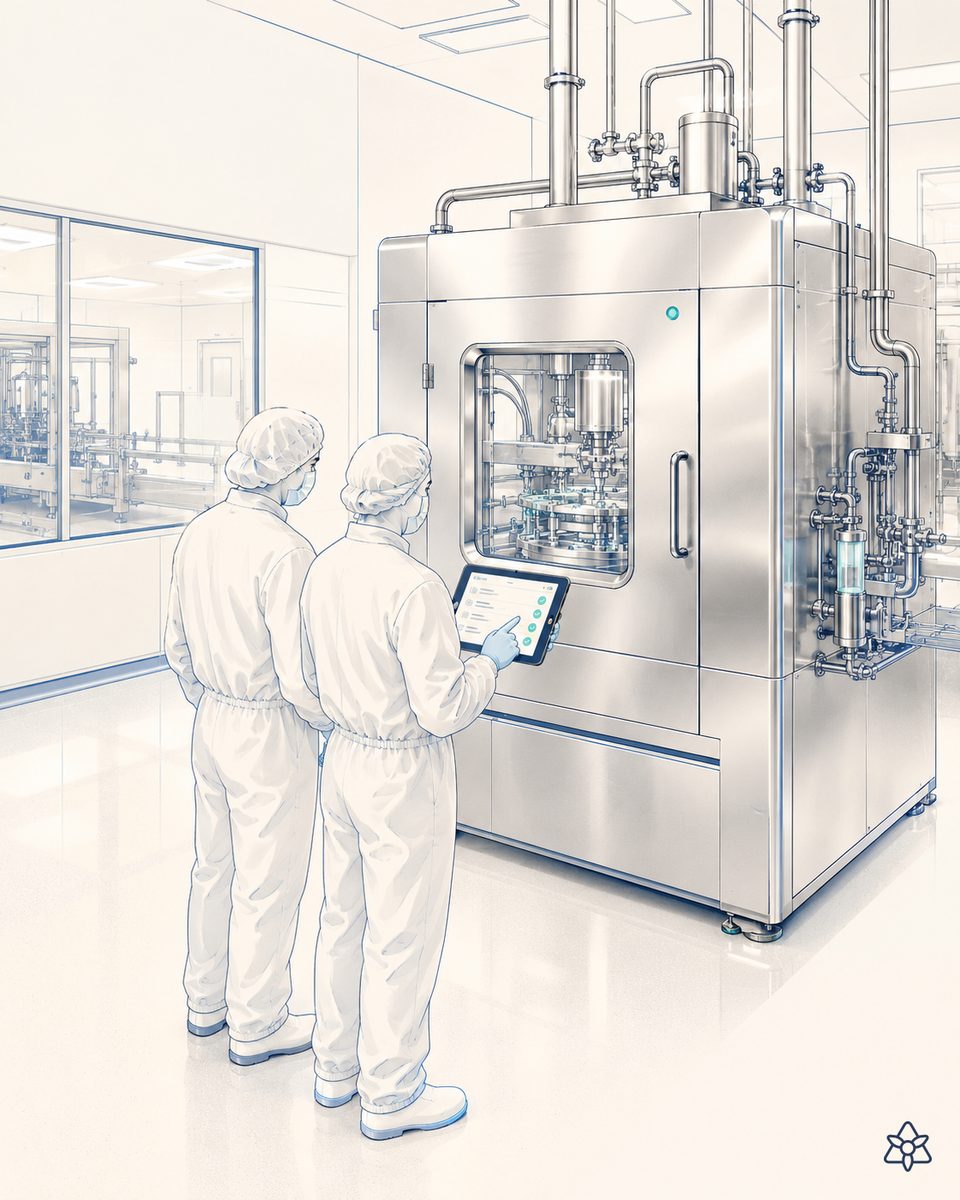
A hot spot in the bed is not seen by the probe. It is seen by the tablet.
Statistical sampling of the API + excipient blend works 99% of the time. It is the remaining 1% that wrecks the whole plan — content uniformity out of spec, batch rejected at compression, and if it travels further, a market recall for a potent API out of specification.
The classic problem is that the probe looks at some points of the bed — not all of them. If a hot spot forms exactly where no probe reaches (because the API agglomerated from static, because the density of the new batch changed, because the blender speed ran 30 seconds higher than usual), the blend passes the lab. And fails three stages later.
The three pieces of data you would need to cross-check to anticipate it live on three islands:
- The batch recipe — nominal proportions of API and excipients, blender time and speed, lubrication instruction. In the MES or on a master manufacturing sheet.
- What is happening in the blender — real speed, real time, real load, possibly in-line NIR if you have it. In the equipment's SCADA, with no cross-check against the recipe.
- What today's raw material was like — real density of the API from the new batch, ambient humidity, excipient flowability. On the supplier's data sheet, in an email, in the warehouse lead's head.
Three islands, none of them talking to the others. The hot spot lives in the joint between the three — and nobody was there listening in time.
iLEAN does not replace sampling — it adds vision over the whole bed.
Blend control is not a problem of missing protocols. The modern plant already has SOPs, probes and uniformity tests. The problem is that sampling is blind between points and nobody cross-checks the bed pattern with the recipe and with the real density of today's API. iLEAN is the putty that seals that crack.
Edge sees the whole bed in line. Connect captures the blender parameters and the raw material data sheet. The agent compares against the pattern of the good batch and, if the blend does not replicate it, holds. The person signs — never the other way round.
The three iLEAN pieces applied to API + excipient blending:
- Edge — a terminal with CNN vision over the blender sight glass (or an in-line NIR sensor if the customer already has the instrumentation). It reads the blending pattern, the presence of agglomerates and incipient segregation. It triggers a hold if the pattern does not match that of a correct batch. It works with no network.
- Connect — captures the recipe from the MES, the real parameters from the blender's SCADA (speed, time, load), the supplier's API batch data sheet (real density, particle size) and the emails that record a supplier change. All of it at second zero.
- Agent — cross-checks the blending pattern with the recipe, the CPPs and the raw material. If it detects that today's pattern diverges from the good batch (a hot spot that was not there before, over-blending caused by excessive speed), it does not write an email at 10 p.m.: it notifies the manufacturing lead and proposes stopping or redistributing before discharging to the next stage. The person signs; the line does not restart on its own.
Blending with after-the-fact sampling vs. blending cross-checked with iLEAN
| Aspect | Sampling + isolated SCADA | With iLEAN Edge + Connect + Agent |
|---|---|---|
| Hot spot detection | Blind between sampling points | Edge sees the whole bed in line |
| API density variation | Assumed from the data sheet | Connect captures the real batch data sheet |
| Over-blending / excess lubrication | Detected at compaction (batch already late) | Agent compares against the good-batch curve |
| Post-blend segregation | Seen in tablet uniformity | Edge detects it in transfer/hopper |
| File for inspection | Rebuilt from 4 systems | Per-batch dossier, automatic, with an image of the bed |
| Operation with no network | n/a | Edge keeps inspecting on the cabinet's own power |
Impact estimate for your plant — to be validated with your numbers.
The block below is an estimate to be validated with the specific data of your plant. We put it forward so the committee has an order of magnitude; we refine it during the diagnostic.
- Oral solids plant with 2-3 blenders (V-blender or bin blender), a multi-SKU mix with APIs of different densities, a vertical MES coexisting with paper batch notes.
- Edge pilot on one blender (sight glass + integration with SCADA and MES). First value expected within a few weeks: a reduction in batches rejected for content uniformity of ≥ 30%.
- Indicative payback between 4 and 9 months, depending on the average cost of a batch rejected for uniformity and the frequency of such incidents.
- The hard lever is one single batch avoided: product rescued, the compression stage not compromised, the packing slot freed up. One batch pays for the pilot.
And the quality assurance manager's reasonable doubt
"What if the AI releases a bad blend and it reaches compression?" — hallucination is a problem of free generation, not of anchored tasks. In tasks where the model merely compares the current blending pattern with the learned good-batch pattern, the best models brought error below 1.5% [1]. And even so, what is critical is never decided alone: iLEAN holds and the person signs with their GMP credential — the three safety rings exist precisely for this. And the cross-industry quality standard — on the order of the 25 PPM demanded in automotive [2] — is only reached with a complete capture of reality, not with after-the-fact sampling.
[1] OpenAI paper "Why Language Models Hallucinate", 2025 — on the reliability of AI in anchored tasks. [2] Symestic — automotive quality standard on the order of 25 PPM, a cross-industry quality reference.
What people ask about AI in API + excipient blending
What typical problems show up in API + excipient blending?
The classics are lack of content uniformity (hot and cold spots of API in the bed), later segregation (the blend is fine but de-mixes on the way to the granulator or the hopper), over-blending (lubricant left with the blend too long, compressibility ruined), agglomeration from static electricity and behavior changes caused by API density varying between batches. They all share one thing: they are born in minutes inside the blender and are only confirmed when the lab analyzes the samples from the bed sampling points — too late.
Why does statistical sampling miss hot spots?
Thief sampling is statistically valid but blind between points. If the API built up in a region of the bed that no probe reaches, the blend passes the lab and fails at compression or in the finished-product uniformity test. iLEAN does not replace sampling: it adds in-line vision (NIR or trained RGB) that sees the whole bed on top of it and cross-checks the pattern against the real curve of time, speed and load of the blender. If the blending pattern does not match that of the good batch, the system holds before discharge.
How do you validate a uniformity AI under ICH Q8 / Q9 / Q10 and QbD?
The AI operates inside the validated design space (ICH Q8 design space). Its job is not to replace the quality system: it is to track CPPs and CQAs (Critical Quality Attributes) in real time against the good-batch model and propose stopping or continuing. Every inference is logged with a timestamp, the model version and image traceability. iLEAN's three safety rings guarantee that the critical decision is signed by the person — the system proposes, it does not execute. It fits ICH Q10 (pharmaceutical quality) by design.
Can iLEAN Edge look inside the blender without entering the ATEX zone?
Yes. Edge is installed outside the ATEX enclosure, reading through an armored sight glass or an optical window, or it is fitted in a certified version when the customer requires it. Inference happens on the local terminal — no video signal leaves the room. It works with no network: if the plant loses WiFi, Edge keeps inspecting and holding, because in a GMP blending room what is critical cannot depend on connectivity.
What is the typical ROI of applying AI to API blend control?
An Edge + Agent pilot on one blender, integrated with the MES and the batch recipe, is usually framed as a moderate initial investment plus a reasonable annual license. Payback moves in a range of several months, depending on the average cost of a non-uniform batch rejected for content uniformity and how often it happens. The hard lever: one single batch saved per quarter pays for the pilot. Ask us for the ROI with your numbers — we send it in 48h.
More cases in pharma
- Annex 1 2023 with AI in sterile packaging — CCS, EM and QRM stopped being paperwork.iLEAN covers the pillars of Annex 1 2023: CCS, environmental monitoring and quality by design in sterile…
- Annex 11 with AI — every change triggers revalidation, and your quality team can no longer keep up.iLEAN keeps continuous CSV and Annex 11 compliance running without falling back on heavy revalidation…
- Pharma traceability from API to patient — one pharmacovigilance alert and you have 24 hours to rebuild the full genealogy.iLEAN joins API, formulation, packaging, distribution and dispensing into a single batch identity that…
- Pharma API weighing control with AI — one misplaced decimal is one lost batch.How iLEAN cross-checks the API weighing, the supplier batch and the GMP recipe in real time to remove…
- Aseptic eye drop filling with AI — contamination is not detected in QC, it is prevented at second zero.How iLEAN cross-references cleanroom vision, HVAC/Grade A parameters and Annex 1 for aseptic eye drop…
- Aseptic eye drops control with AI — sterility is not tested at the end: it is built into every minute of the fill.How iLEAN cross-checks environmental monitoring, 0.22 µm sterilizing filtration and Grade A…
Tell us your case and within 48h we'll send you the estimated ROI of this AI project for your blending room.
We work on your plant's real data, not ours. Diagnostic with no commitment.
Request estimated ROI in 48h See pharma