Pharma traceability from API to patient — one pharmacovigilance alert and you have 24 hours to rebuild the full genealogy.
Serious pharma means following the batch from the API all the way to the patient. iLEAN joins every link into one common identity — API, formulation, packaging, distribution and dispensing — and assembles the batch genealogy in seconds when the authority asks for it. The person signs — the system does not release on its own.
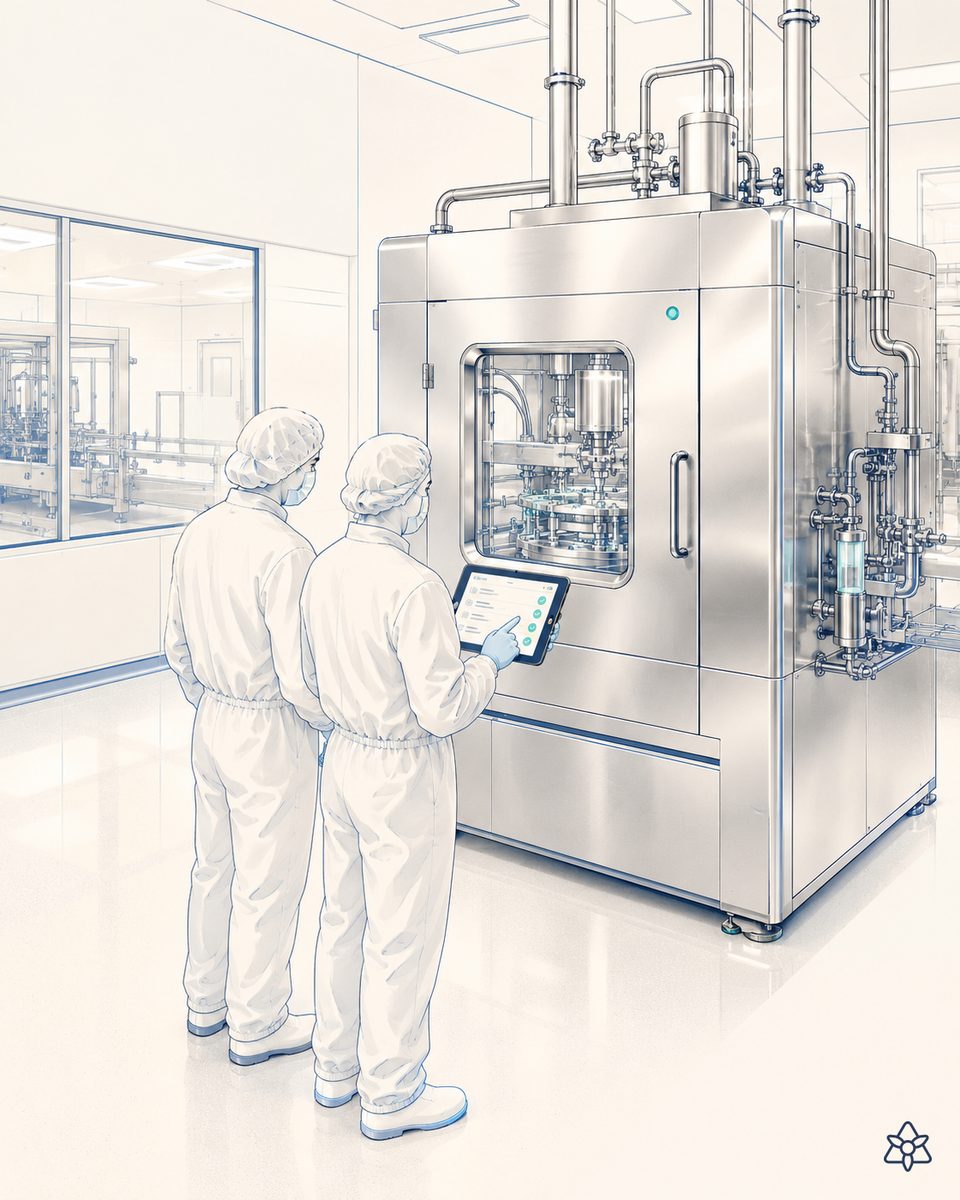
When the alert arrives, the batch is spread across six systems and three companies. And the clock is running.
End-to-end pharma traceability is not a comfortable strategic project: it is what the QA director needs on the day the authority calls. The operational reality looks like this:
- The batch lives in six systems. The API in the purchasing ERP. The formulation in the MES. The packaging in the serialization system. The release in the LIMS. The distribution in the commercial ERP. The dispensing, if you get that far, in the national repository (SEVeM in Spain, the EU Hub in Europe).
- The API supplier is the most opaque island. The CoA arrives as a PDF, sometimes as EDI, sometimes as an email attachment the lab scans and files. When it has to be cross-referenced with a specific batch, somebody goes looking for it by hand.
- When the pharmacovigilance alert appears (EudraVigilance, FAERS), the clock starts. The QA team calls a crisis meeting and starts searching across the five systems. Rebuilding the full genealogy takes days in a normal plant. And every day without an answer is regulatory exposure.
The consequence is not only regulatory: it is that the QA team burns out rebuilding the past instead of improving the future. Every incident steals person-weeks that should be going into process improvement and CAPA. And when the AEMPS/EMA/FDA inspection comes, the inspector asks for the dossier — and the manual rebuild starts all over again.
iLEAN does not replace your ERP or your LIMS — it joins them with a common batch identity that survives every link.
The problem with pharma traceability is not one of new technology: it is one of orchestrating information that already exists in six systems that do not talk to each other. ERP, MES, LIMS, serialization, distribution, pharmacovigilance — each does its own job well, and the joint between them is the dead zone. iLEAN is the putty that covers that joint: you do not tear down the wall or the tiles, you fill in what was left hollow.
Tracer safeguards the batch identity across the whole pyramid. Connect captures the data wherever it lives (supplier CoA, MES, LIMS, national repository). Brain rebuilds the genealogy in seconds when the authority asks. The person signs — the system does not release on its own.
The three iLEAN pieces applied to end-to-end pharma traceability:
- iLEAN Tracer — the identity engine. It gives the batch a unique identifier that survives from the API supplier's delivery note to the serialized pack code at the pharmacy. The parent-child relationships between API batch, intermediate granulate batch, bulk tablet batch, packed batch and pallet are all safeguarded.
- iLEAN Connect — captures the data wherever it lives: the supplier CoA (PDF, EDI, email), data from your MES and LIMS via API, events from the FMD/DSCSA national repository through its official interfaces. Anything unstructured (the supplier's spreadsheet, a photo of the CoA) is recontextualized with an anchored LLM and linked to the batch.
- iLEAN Brain — the multi-agent brain. Given a pharmacovigilance alert or an inspector's question, it rebuilds the batch's full genealogy in seconds (API origin, process parameters, release dossier, downstream events) and assembles the signed response dossier. What today takes a QA team days becomes minutes.
Classic traceability rebuilt by hand vs. traceability with iLEAN Tracer + Connect + Brain
| Aspect | Classic traceability (six systems + spreadsheets) | With iLEAN Tracer + Connect + Brain |
|---|---|---|
| Batch identity | Different codes in ERP, MES, LIMS and serialization | A single identity in Tracer; everything else consumes, it does not copy |
| API supplier CoA | A PDF in a network folder, searched by hand | Captured, indexed and linked to the batch at second zero |
| Pharmacovigilance alert | Crisis meeting, manual search across 5 systems, days | Full batch genealogy in seconds |
| Dossier for the AEMPS/EMA inspector | Rebuilt by cross-referencing exports, days | Assembled automatically, signed, ready |
| API supplier changeover | Trace by hand which batches carry the new one | Genealogy search in real time |
| QA team workload | Person-weeks per incident rebuilding the past | Hours — the team goes back to improving the future |
Impact estimate for your plant — to be validated with your numbers.
The block below is an estimate to be validated with the specific data of your plant. We put it forward so the committee has an order of magnitude; we refine it during the diagnostic.
- Pharma plant with 5 active SKUs, API from 3 different suppliers, distribution in the EU market + 1-2 export markets.
- Deployment of iLEAN Tracer as the identity layer + Connect over ERP/MES/LIMS + Brain for genealogy and dossiers. First value expected within a few weeks: full genealogy for the pilot SKUs.
- Indicative payback between 4 and 9 months, depending on how much time the QA team currently spends per pharmacovigilance incident and the cost of each regulatory inspection with a hand-rebuilt dossier.
- Expected reduction in response time to pharmacovigilance alerts of ≥ 30% in the first year — from days to hours on the SKUs covered.
- The hard lever is QA team time recovered plus the reduced regulatory risk of a late response. The cost of a single regulatory action avoided pays for the pilot.
And the QA director's / QP's reasonable doubt
“What if the AI rebuilds the wrong genealogy and I sign it?” — hallucination is a problem of free generation, not of anchored tasks. In tasks where the AI merely recontextualizes and links data that already exists in other systems (which is what Brain does with the genealogy), the best models brought error below 1.5% [1]. And even so, iLEAN does not sign: it assembles the dossier and the QP signs. The three safety rings are there for precisely this. The most digitalized industries raised productivity by up to 40% [2] — traceability done properly is exactly that lever applied to quality and compliance.
[1] OpenAI paper “Why Language Models Hallucinate”, 2025 — on the reliability of AI in anchored tasks. [2] Fundación BBVA / Ivie, productivity and digitalization 2000-2021.
What people ask about end-to-end pharma traceability
How far does iLEAN trace?
As far as your supply chain lets you. Inside your plant, everything: API receipt, formulation, primary and secondary packaging, palletizing, shipping. Downstream, all the way to the point of dispensing if you have an agreement with the distributor (wholesaler, pharmacy, hospital), leaning on FMD/DSCSA serialization and on the data each link publishes. Where there is no public data, we say so honestly — traceability ends where the available information ends.
What about API suppliers?
iLEAN Connect captures the certificates of analysis (CoA) that every API supplier sends with the batch — whether they arrive as a signed PDF, structured EDI, an email with an attachment, or a spreadsheet. It recontextualizes them, cross-references them with your supplier master data and links them to the batch they were used in. If the supplier also publishes upstream traceability for its API (origin of the intermediate, synthesis route), we hook that in too. This is exactly the putty: covering the dead zones that ERP, MES and SCADA left uncovered, whether the data comes from inside or outside.
Is it GxP compliant?
Yes. Every capture and cross-reference is recorded with a timestamp, user, value and electronic signature in line with 21 CFR Part 11, EU GMP Annex 11, ICH Q9, and ISO 22716 where applicable. The audit trail is complete. Validation is delivered under GAMP 5 (category 4-5 depending on use): URS, FS, DS, IQ, OQ and PQ with protocols ready. For QPs / RPs: the batch dossier is assembled automatically, ready to review and sign for release.
How does it cross-reference with pharmacovigilance?
When a pharmacovigilance report comes in (EudraVigilance, FAERS, a national system), it normally carries the batch and product. Given a batch, iLEAN Brain rebuilds the full upstream genealogy in seconds: the API used and its supplier, the formulation, the granulation/compression/aseptic/lyophilization parameters, previous SKU changeovers on the same line, intermediate cleaning, the release dossier. What today takes a QA team a week of searching across five systems becomes minutes — and the answer to the authority arrives on time.
How does the cost compare with a dedicated solution?
A dedicated pharma traceability solution (track & trace + serialization + pharmacovigilance + LIMS, all separate) has the advantage of being “the standard” and the disadvantage of forcing you to feed three different sets of master data and to integrate three worlds. iLEAN is a single layer that couples onto your existing systems — it does not replace the LIMS or the ERP, it orchestrates them. The operating rule: if you already have a dedicated solution that works, we do not throw it out; iLEAN sits on top and fills in what is missing. If you are starting from zero or from a multi-tab spreadsheet, it saves you several years of integration.
More cases in pharma
- An always-ready FDA/EMA audit — the inspection walks in “prepared” because the evidence is live, not filed away.iLEAN keeps GMP evidence live so an FDA/EMA inspection is prepared in hours, not in weeks of sprint.
- Annex 1 2023 with AI in sterile packaging — CCS, EM and QRM stopped being paperwork.iLEAN covers the pillars of Annex 1 2023: CCS, environmental monitoring and quality by design in sterile…
- Annex 11 with AI — every change triggers revalidation, and your quality team can no longer keep up.iLEAN keeps continuous CSV and Annex 11 compliance running without falling back on heavy revalidation…
- API + excipient blending with AI — content uniformity is confirmed in the blender, not in the lab.iLEAN cross-checks NIR/vision imaging of the blend bed, blender parameters and the recipe to guarantee…
- Pharma API weighing control with AI — one misplaced decimal is one lost batch.How iLEAN cross-checks the API weighing, the supplier batch and the GMP recipe in real time to remove…
- Aseptic eye drop filling with AI — contamination is not detected in QC, it is prevented at second zero.How iLEAN cross-references cleanroom vision, HVAC/Grade A parameters and Annex 1 for aseptic eye drop…
Tell us about your case and in 48h we'll send you the estimated ROI of this end-to-end pharma traceability project with AI.
We work on your plant's real data, not ours. Diagnostic with no commitment.
Request estimated ROI in 48h See pharma