Annex 1 2023 with AI in sterile packaging — CCS, EM and QRM stopped being paperwork.
Annex 1 2023 tightened CCS and environmental monitoring, and put them at the center of the inspection. iLEAN implements them with AI vision + integration with your RABS or isolator, continuous capture traced to the batch and a dossier ready for the inspector. The person signs.
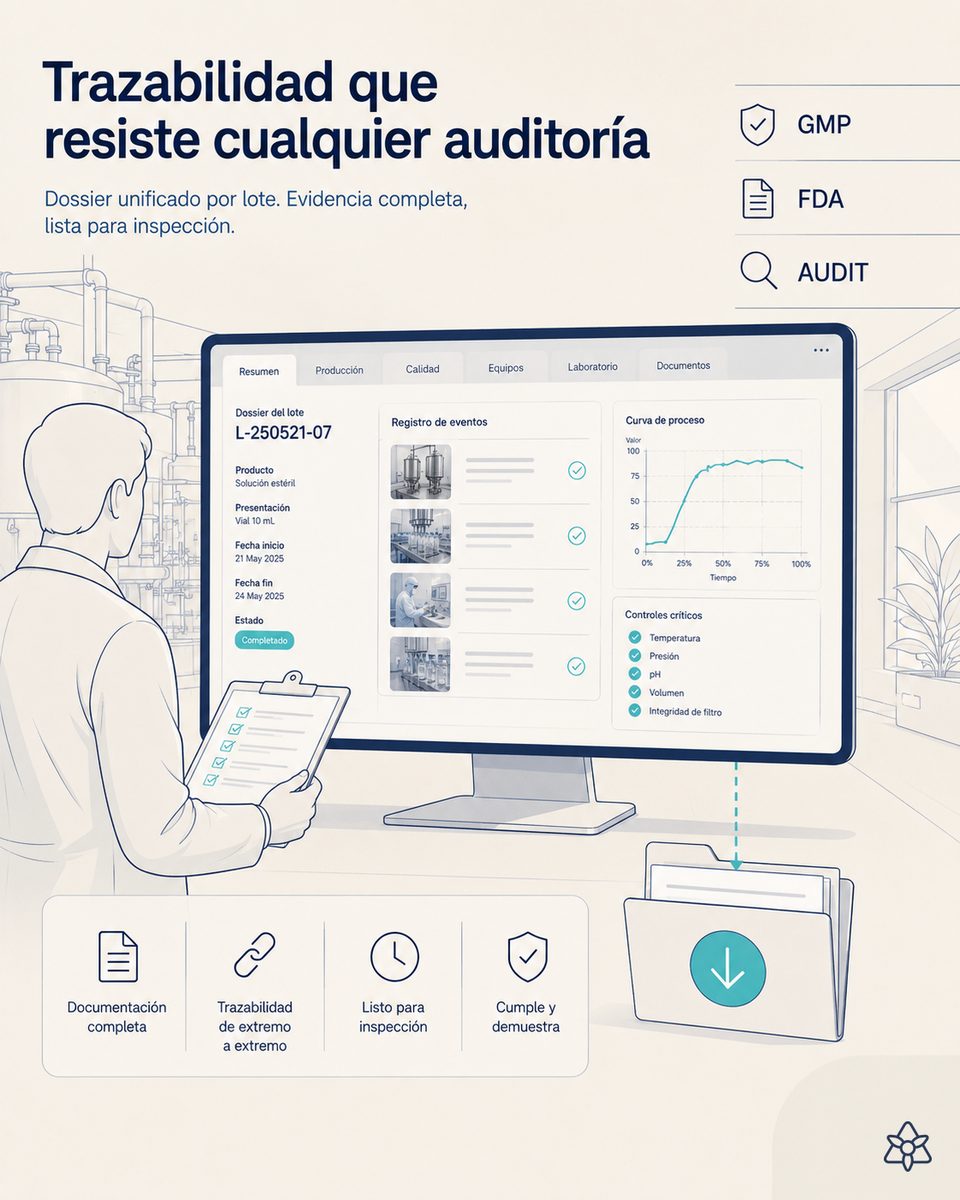
The CCS stopped being a document — and now you have to prove it is alive.
The quality manager of a sterile plant has been living with an uncomfortable truth since Annex 1 was revised: the inspector is no longer satisfied that the SOP exists. They want to see the Contamination Control Strategy at work, with real data proving the strategy is executed the way it says, and with the traceability of every QRM decision. In operational reality:
- The CCS is a PDF written two years ago, with an annex of procedures spread across QA, production and maintenance. Nobody has a single view of it.
- Grade A EM is continuous in theory, but integrating the particle counters, the microbiology plates, the log of operator interventions in the RABS and the isolator's decontamination cycle is done by the QA team by hand, at batch closure.
- QRM is a spreadsheet matrix updated once a year, with no direct link to the real events the system captures.
The result: when the inspector asks for the traceability of a quality decision, rebuilding it takes days — and sometimes you find an inconsistency between the CCS on paper and operational reality. The system is not failing: it is documented separately from the reality it controls.
iLEAN does not rewrite your CCS — it makes it live on the real data of your line.
The problem is not the strategy: it is that the strategy and operational reality speak different languages. iLEAN acts as the putty that joins the documented CCS with continuous EM, the RABS/isolator logs and the operator records. The architecture, applied to Annex 1 2023:
Edge sees every intervention in the isolator and every decontamination cycle. Tracer rebuilds the batch's journey, evidence included. Writer keeps the CCS alive with real data. The person signs — always.
- Edge — vision-equipped terminals over the critical points of the isolator or RABS: glove integrity, peroxide cycle, manual interventions, differential pressure. They detect inconsistencies in milliseconds (a glove with a pinhole, an undocumented opening) and raise the alert before it affects the batch. It works without a network.
- Connect / Tracer — rebuilds the complete journey of the batch: what went in, what happened in grade A, which interventions were made, which EM results came back, which decontamination cycle ran, which deviations occurred. It captures the islands (the microbiology spreadsheet, the DCS log, the maintenance email) at second zero.
- Agent / Writer — keeps the CCS and the QRM matrix alive: it drafts the periodic reviews with real events, proposes risk re-evaluations when a pattern repeats, and prepares the per-batch dossier for the auditor. The person validates and signs.
Annex 1 on paper vs. Annex 1 alive with iLEAN
| Aspect | Documented CCS + EM handled separately | With iLEAN Edge + Tracer + Writer |
|---|---|---|
| CCS | A PDF reviewed once a year | A live strategy built on real process data |
| Grade A EM | Continuous at the sensors, manual at consolidation | Continuous and consolidated in real time, per batch |
| Operator interventions | Shift notebook + log written after the fact | Visual + voice capture, traced to the batch |
| QRM (risk matrix) | An annual spreadsheet, unlinked to real events | A live matrix, fed by system events |
| Dossier for the inspector | Manual reconstruction taking several days | Automatic per-batch dossier, evidence included |
| Operation without a network | Critical system down | Edge keeps running on the panel's own power |
Impact estimate for your plant — to be validated with your numbers.
The block below is an estimate to be validated with your plant's data. We put it forward so the committee has an order of magnitude; we refine it during the diagnostic.
- One sterile packaging line (RABS or isolator), with a documented CCS that is not integrated with continuous EM, and a per-batch dossier rebuilt manually.
- Edge pilot over the critical points + Tracer/Writer over the line. First value expected within a few weeks: an automatic per-batch dossier and a CCS connected to real events.
- Reduction in per-batch dossier preparation time on the order of ≥30%, conservatively. Indicative payback between 4 and 9 months.
- Hard lever: a single deviation caught in time avoids the rework or the recall of a sterile batch. In sterile packaging, one batch pays for the pilot with room to spare.
And the quality bar set by the most demanding sector of all
In automotive, the quality standard is on the order of 25 PPM [1]. In sterile packaging the bar is even lower (this is injectable product; we are talking about zero defects), and that is exactly why anchored AI — not free-running AI — is the only reasonable route: in tasks where the AI recontextualizes a piece of data from one system into another, the best models brought error below 1.5% [2]. iLEAN never decides alone on anything critical: the three safety rings guarantee that a critical operation is only ever executed by a person.
[1] 25 PPM as the automotive quality standard — Symestic.
[2] OpenAI paper “Why Language Models Hallucinate”, 2025 — reliability of AI in anchored tasks.
What people ask about Annex 1 2023 and sterile packaging with AI
What did Annex 1 2023 change?
The revised Annex 1 raises three requirements that used to be recommendations: (1) a Contamination Control Strategy that is documented and alive, not a dead document in a drawer; (2) continuous environmental monitoring in grade A with metrics traced item by item; (3) QRM (quality risk management) applied to the design of the line, with every decision justified. The practical consequence is that meeting the metrics is no longer enough: you have to demonstrate control over the whole system, and that forces you to integrate data that used to live in islands.
How is the CCS implemented with iLEAN?
A CCS is not a module: it is a strategy that gets documented and executed. iLEAN provides the two hardest pieces: the continuous capture of particles, microbiology, operator interventions in the isolator, machine stops and pressure alerts — all traced to the batch — and Writer (the documentation agent) that keeps the CCS alive, drafting the periodic reviews with plant data. The person validates and signs. The auditor finds a CCS consistent with what actually happens, not with what the document said two years ago.
Does it work the same for RABS as for an isolator?
Yes, but with different configurations. In a RABS, capture centers on operator interventions (every opening, every manual action is a risk), continuous environmental monitoring and the glove check on every shift — iLEAN Edge records and cross-references. In an isolator, capture centers on hydrogen peroxide decontamination cycles, glove integrity and differential pressure — the Agent's logic changes, the architecture does not. The Tracer piece rebuilds the complete journey of the batch through the line, evidence included.
How do we meet QRM with AI assistance?
QRM (ICH Q9) requires every quality decision to be justified by risk. iLEAN maintains a live risk matrix per line, fed with real events (interventions, deviations, OOS results), and an agent proposes re-evaluations when a pattern repeats. The final decision is always signed by the QA lead — the AI does not decide, it assists. Traceability is automatic for the auditor: every change in the matrix carries the evidence of the data that prompted it.
What does it cost to bring a plant up to Annex 1 2023 with AI?
Estimate to be validated. The order of magnitude of an iLEAN pilot on one sterile packaging line (RABS or isolator) covers Edge terminals at the critical points, integration with your existing EM system, and the Writer/Tracer piece for the CCS and the per-batch dossier. Indicative payback between 4 and 9 months, first value within a few weeks. The hard lever is the deviation avoided on a sterile line — a single batch recalled for cross-contamination pays for the pilot several times over. We ask for your data and send back the ROI in 48h.
More cases in pharma
- AI for veterinary pharma — multi-species, multi-dose, a single safety net.How iLEAN cross-checks multi-species recipes, batch data, EMA-CVMP rules and traceability to release…
- AI control of pharma WFI water — the invisible utility that decides the batch.How iLEAN cross-references TOC, conductivity and endotoxins from the WFI loop with the batch in progress…
- An always-ready FDA/EMA audit — the inspection walks in “prepared” because the evidence is live, not filed away.iLEAN keeps GMP evidence live so an FDA/EMA inspection is prepared in hours, not in weeks of sprint.
- Annex 11 with AI — every change triggers revalidation, and your quality team can no longer keep up.iLEAN keeps continuous CSV and Annex 11 compliance running without falling back on heavy revalidation…
- Pharma traceability from API to patient — one pharmacovigilance alert and you have 24 hours to rebuild the full genealogy.iLEAN joins API, formulation, packaging, distribution and dispensing into a single batch identity that…
- API + excipient blending with AI — content uniformity is confirmed in the blender, not in the lab.iLEAN cross-checks NIR/vision imaging of the blend bed, blender parameters and the recipe to guarantee…
Tell us your case and in 48h we'll send you the estimated ROI of this AI project for your sterile line.
We work on your plant's real data, not ours. Diagnostic with no commitment.
Request estimated ROI in 48h See pharma