Aseptic eye drop filling with AI — contamination is not detected in QC, it is prevented at second zero.
Aseptic eye drop filling is Grade A under Annex 1: any particle excursion, filter integrity failure or manual intervention is potential contamination. iLEAN Edge sees the filling, Connect captures the room parameters and the particle counters, and the agent builds an inspector-ready batch file. The QP signs — the system hands over the evidence.
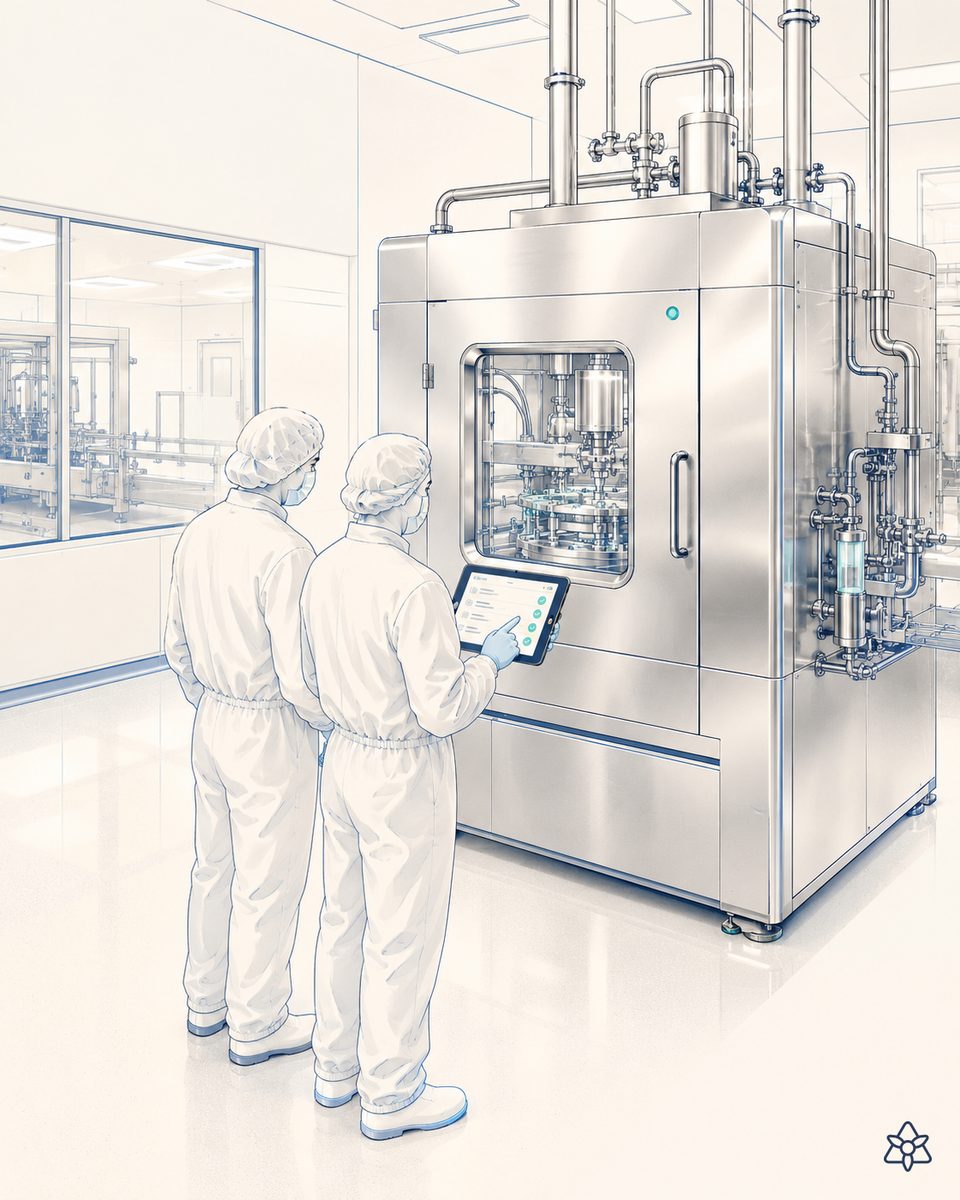
The Annex 1 file is rebuilt by hand — and that is why something is always missing.
An aseptic eye drop line has all the data. The problem is that it lives on islands:
- The BMS/EMS holds differential pressure, temperature, humidity, HEPA integrity. But it exports hourly CSVs that nobody cross-references with the batch.
- The particle counters (viable and non-viable) sit in another system, with their own software and their own clock. When an alarm fires, it is hard to know which batch was being filled and what was happening on the line.
- The intervention log is on paper or in an old SCADA. Every time someone enters the Grade A zone, it gets written down — if they remember.
- Filter integrity before and after is tested, signed, and the data lives in yet another PDF.
When the QP closes the batch, one person pulls all of that together by hand. When the Annex 1 inspection comes around, the same thing on a bigger scale. The problem is not missing data: it is that the batch file is built by hand every single time, and that is why a column or a timestamp is always missing. An unrecorded intervention during a particle peak is exactly the question the inspector will ask first.
iLEAN is not one more system in the room — it is the putty between the BMS, the counters and the filling line.
The problem with the Annex 1 file is not a lack of measuring equipment — it is information living on islands that never reaches the batch cross-referenced. iLEAN acts as the putty that fills the gaps between the BMS/EMS, the particle counters, filter integrity and the filling line, without asking you to change any of them.
Connect captures the BMS, the EMS and the counters. Edge sees the filling and the interventions. The agent builds the batch file continuously. The QP signs with evidence, not with good faith.
The three iLEAN pieces applied to aseptic eye drop filling:
- Edge — a terminal with machine vision (CNN) over the critical zone. It sees every vial/strip being filled and detects visible particles, under- or overfill and defective closing. It detects interventions in the critical zone and timestamps them. It works with no network. If the plant loses connectivity, Edge keeps watching and rejecting units.
- Connect — captures the BMS/EMS, the particle counters, the autoclave data and filter integrity results whichever way it can (direct integration, reading the local computer, a camera on the panel). And it captures excipient CoAs and the MES recipe.
- Agent — cross-references all the data at second zero. When there is a deviation, it flags the event, ties it to the batch, proposes the most likely cause and assembles the file section ready for the QP. The three safety rings guarantee that the release decision stays with the person — the agent proposes, the QP signs.
A manual Annex 1 file vs. a continuous file with iLEAN
| Aspect | Manual batch reconstruction | With iLEAN Edge + Connect + Agent |
|---|---|---|
| BMS/EMS data | Hourly CSVs, filed away | Continuous, cross-referenced with the batch in progress |
| Particle counters | Separate system, alarms with no context | Cross-referenced with recipe, line and interventions |
| Interventions in the critical zone | Paper or an old SCADA | Timestamped by Edge vision |
| Filter integrity | A PDF per batch, signed by hand | Captured and cross-referenced with the batch timeline |
| Batch file for the QP | Rebuilt by hand, hours | Dossier ready when the batch closes |
| Annex 1 re-inspection | A dedicated team for weeks | History already cross-referenced and searchable |
Impact estimate for your plant — to be validated with your numbers.
The block below is an estimate to be validated with the specific data of your plant. We put it forward so the QP and the committee have an order of magnitude; we refine it during the diagnostic.
- Pharmaceutical plant with one aseptic eye drop line (BFS or classic Grade A filling), environmental monitoring already in place, batch file rebuilt by hand.
- iLEAN Connect pilot (BMS/EMS/counters) + Edge (critical filling zone). First value expected within a few weeks: the first batch dossier assembled automatically.
- Batch file close-out time cut by ≥ 30% against the documented history.
- Indicative payback between 4 and 9 months. The hard lever: a single Annex 1 deviation avoided in a re-inspection — plus the recurring QA hours saved on every release.
And the CAIO's or the CIO's reasonable doubt
“What if the AI hallucinates while assembling the file?” — hallucination is a problem of free generation, not of anchored tasks. In tasks where the AI merely takes a data point from the BMS and puts it in the right section of the dossier, the best models brought error below 1.5% [1]. And even so, release is not decided by the agent: it is decided by the QP, with evidence. iLEAN's three safety rings are designed so the human signature stays where it belongs — and so the critical OT of the filling line stays isolated from the outside.
[1] OpenAI paper “Why Language Models Hallucinate”, 2025 — on the reliability of AI in anchored tasks.
What people ask about aseptic eye drop filling with AI
What does Annex 1 require for aseptic eye drop filling?
The revised EU GMP Annex 1 requires a Contamination Control Strategy (CCS) that cross-references facility design, continuous environmental monitoring, personnel interventions and batch traceability. For eye drops in BFS or classic Grade A filling, that means: continuous viable and non-viable particle counters, differential pressure, filter integrity, and a record of every intervention in the critical zone. The data cannot stay in isolated systems — it has to be cross-referenced in real time with the batch being filled.
How do you detect an unauthorized manual intervention in a Grade A room?
iLEAN Edge with machine vision (CNN) in the critical zone detects that an intervention has taken place — no tag or RFID needed — and records the event with a timestamp. It does not replace your intervention SOP: it feeds the batch file with the continuous evidence that today is rebuilt by hand. If an intervention coincides with a particle or pressure excursion, the agent cross-references them and flags it for QP review. What is critical is never decided alone: the person signs.
Can iLEAN read HVAC data and particle counter data?
Yes, whichever way is available. iLEAN Connect has three graduated capture modes: direct integration with the BMS/EMS if it has a modern interface; reading the old system's local computer even if it is isolated; a camera that reads the analog panel if there is nothing else. The data is cross-referenced at second zero with the recipe of the batch being filled, and the agent builds the normal operating corridor. Any excursion outside the corridor is flagged before the batch is closed.
What happens if the network goes down in the middle of aseptic filling?
Edge keeps running. It is a physical terminal with its own embedded neural network: as long as it has power, it keeps watching the line, detecting filling defects and logging the event locally. When the network comes back, it syncs. In an aseptic suite, what is critical cannot depend on there being WiFi — and that is why Edge does not depend on it. The HVAC data captured by Connect is also buffered locally if the bus drops.
Does the system replace the QA manager's double signature?
No. iLEAN is designed for the opposite: to let the QP sign with continuous evidence instead of good faith. iLEAN's three safety rings guarantee that the agent proposes and the person decides on what is critical — batch release, deviation approval, CAPA closure. Automation goes where it is honest (capturing data, cross-referencing sources, assembling the dossier); the signature stays exactly where the law says it has to be.
Other related topics: Syrup filling with AI · Prefilled syringe with AI · Aseptic packaging with AI vision.
More cases in pharma
- Pharma traceability from API to patient — one pharmacovigilance alert and you have 24 hours to rebuild the full genealogy.iLEAN joins API, formulation, packaging, distribution and dispensing into a single batch identity that…
- API + excipient blending with AI — content uniformity is confirmed in the blender, not in the lab.iLEAN cross-checks NIR/vision imaging of the blend bed, blender parameters and the recipe to guarantee…
- Pharma API weighing control with AI — one misplaced decimal is one lost batch.How iLEAN cross-checks the API weighing, the supplier batch and the GMP recipe in real time to remove…
- Aseptic eye drops control with AI — sterility is not tested at the end: it is built into every minute of the fill.How iLEAN cross-checks environmental monitoring, 0.22 µm sterilizing filtration and Grade A…
- Aseptic packaging with AI vision — a vial with a particle is not an incident, it is a recalled batch.iLEAN Vision inspects every vial leaving the aseptic filler: level, particles, sealing. Without stopping…
- ATMP vein-to-vein custody chain — a lost CAR-T is not an incident, it is a patient without treatment.iLEAN traces the autologous ATMP custody chain from apheresis to infusion without ever losing the…
Tell us your case and in 48h we'll send you the estimated ROI of this AI project for your aseptic line.
We work on your plant's real data, not ours. Diagnostic with no commitment.
Request estimated ROI in 48h See pharma