Syrup filling control with AI — one milliliter out of range is not an incident, it is an OOS deviation.
Syrup filling means cross-checking three realities in real time — volumetric dosing, product viscosity and a clean bottle closure. iLEAN automates that cross-check with in-line vision, data capture from the filler however old it is, and an agent that holds the batch before sealing if something does not add up. The person signs.
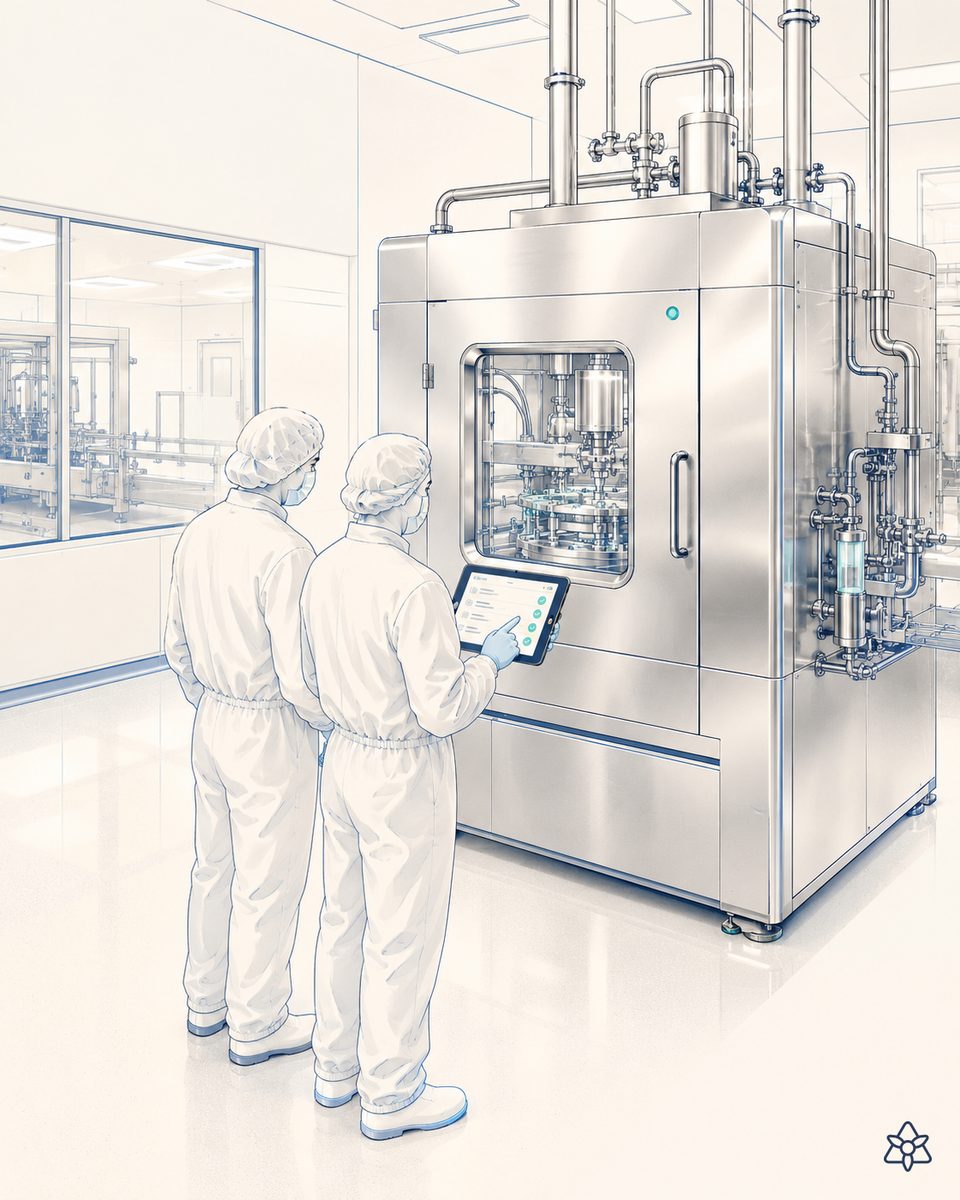
Three plant-floor realities that almost never reach the same person in time.
On a syrup filling line — solution or suspension, pediatric or adult — the guarantee of a correct dose rests on three pieces of data that in most plants each live on their own island:
- The filler setpoint and curve — what volume the machine is calling for and how it is varying bottle by bottle. Sometimes in the PLC, sometimes only on an old local panel, sometimes in a spreadsheet kept by the formulation lead.
- The real viscosity of the product in the hopper — temperature, agitation, API batch, sugar excipient batch. Almost never correlated in real time with the dose coming out.
- The image of the bottle before the cap — real level, meniscus, bubbles, a drop hanging from the neck. The only thing the operator can see, and only on the bottles they have time to look at.
The quality manager knows everything adds up for 99% of the batch. It is that 1% that triggers the OOS investigation, the rework, and the doubt over the rest of the batch. Caught late it is a deviation; caught in line, it is nothing.
iLEAN does not add a fourth system — it seals the cracks between the three you already have.
The syrup filling problem is not a lack of information: it is information living on islands that, at the critical moment (a change in syrup temperature, a new API batch, an agitator losing torque), does not reach the person who decides in time. iLEAN acts as the putty that fills those gaps, without asking you to change the dosing unit or the filler.
Edge sees the dose and the bottle neck before the cap. Connect reads the filler wherever it lives — modern PLC, legacy panel, forgotten spreadsheet. The agent cross-checks against the recipe and the GMP specification and, if something does not add up, holds the run. The person signs — never the other way round.
The three iLEAN pieces applied to syrup filling:
- Edge — a terminal with machine vision (CNN) over the filling carousel. It reads level, meniscus, bubbles and neck cleanliness in milliseconds and fires the actuator (bottle reject gate, stack light, selective stop) before the cap goes on. It works with no network. If the plant loses its Internet connection, Edge keeps reading and holding, because what is critical cannot depend on WiFi.
- Connect — captures the dosing unit whether the data comes from the PLC over OPC-UA, from an old terminal via screen OCR, or from the formulation lead's setpoint spreadsheet. And it also captures what arrives from outside (an email from the validation lead with a change to the viscosity range, a WhatsApp from the supplier about a deviation in the API batch) at second zero, without anyone having to forward anything.
- Agent — cross-checks the requested dose, the real viscosity, the image of the bottle, the MES recipe and the GMP specification. If there is a deviation, it does not send an email at 10 p.m.: it holds the run and alerts the quality manager on whatever channel they use. The person validates and signs; the line does not restart on its own.
Filling controlled by checklist vs. filling cross-checked with iLEAN
| Aspect | Manual control + sampling IPC | With iLEAN Edge + Connect + Agent |
|---|---|---|
| Dose verification | Periodic sample on a balance, the rest assumed | Every bottle verified in line, in milliseconds |
| Product viscosity | Measured at batch start, assumed stable | Correlated with the dose bottle by bottle |
| Dirty neck / drop | Detected if the operator happens to see it | CNN vision before the cap, selective reject gate |
| Deviation detection | At IPC or, worse, at release | Before sealing, with an automatic hold |
| Operation with no network | n/a | Edge keeps running on the cabinet's own power |
| File for an FDA/EMA auditor | Rebuilt from paper, days of work | Per-batch dossier, automatic, with images and traces |
Impact estimate for your plant — to be validated with your numbers.
The block below is an estimate to be validated with the specific data of your plant. We put it forward so the committee has an order of magnitude; we refine it during the diagnostic.
- Mid-sized pharma plant, one pediatric syrup filling line (solution + suspension), 40-60 bottles per minute, multi-SKU with format changeovers.
- Edge pilot on one line (camera over the carousel + actuator + integration with the dosing unit and the MES). First value expected within a few weeks: detection of dose deviation, dirty necks and bubbles above the manual standard.
- Reduction of OOS deviations caused by filling of ≥ 30% in the first pilot batch, depending on initial severity and the current spread of the dosing unit.
- Indicative payback between 4 and 9 months, depending on the frequency of documented OOS incidents in recent years and the average cost of rework/destruction in your plant.
- The hard lever is one single OOS deviation avoided: investigation, rework, risk of a scrapped batch, the auditor's attention. One major deviation pays for the pilot.
And the quality manager's reasonable doubt
"What if the AI gets it wrong and lets a badly filled bottle through?" — hallucination is a problem of free generation, not of anchored tasks. In tasks where the AI merely recontextualizes a piece of data from one system into another (reading the meniscus and comparing it with the setpoint), the best models brought error below 1.5% [1]. And even so, what is critical is never decided alone: iLEAN holds the batch and the person signs. The three safety rings exist precisely for this.
[1] OpenAI paper "Why Language Models Hallucinate", 2025 — on the reliability of AI in anchored tasks.
What people ask about syrup filling control with AI
What goes wrong in syrup filling that AI can see before an operator does?
Three defect families that on a syrup line happen faster than a human eye can follow: dose deviation (over/under-filling caused by a viscosity change when the syrup temperature in the hopper varies), neck drag (a hanging drop that soils the thread and compromises the closure) and a bubble in the bottle (apparent volume correct but real mass out of tolerance). iLEAN Edge sees the level, the meniscus line and the neck before the cap goes on — and the agent cross-checks against the in-line checkweigher and the filler setpoint.
How do you guarantee the batch meets GMP Annex 1 / Annex 15 if AI decides?
AI does not decide — it proposes and holds. iLEAN is designed with three safety rings: in the critical ring (the OT of the filler and the line) only what the quality manager signs is accepted. The agent assembles the batch file with the process data, the Edge images and the Connect traceability; the person validates the release. In GMP language: documented in-process control, high criticality with human-in-the-loop, a complete audit trail ready for FDA/EMA.
Does it work for pediatric suspension syrups (not just solutions)?
Yes, and that is where it adds the most. A suspension syrup requires homogeneity of the active ingredient in every bottle: if hopper agitation drifts, the first and the last bottles of the run can have different concentrations. Connect reads agitator speed and torque wherever they live (a modern PLC, an old local terminal, the formulation lead's spreadsheet), Edge sees the opacity/color of the syrup at the bottle neck, and the agent correlates the two. If variance rises, the run is held before packing.
Do we have to replace the current dosing unit or filler?
No. iLEAN sits on top of the existing line. Edge is installed as a camera and actuator over the filling carousel (it does not touch the mechanics). Connect hooks into the dosing unit even if it is old: over OPC-UA or Modbus if it has a PLC; by capturing the local panel via OCR if that is all there is; by reading the shift lead's setpoint spreadsheet in a shared folder if that is the only source. The integration is real work, not a magic button — but it no longer requires replacing a six-figure machine.
How much does an AI filling pilot cost on a pharma line?
The order of magnitude of an iLEAN Edge pilot on a syrup filling line is in line with any Edge pilot in a regulated pharma plant: an initial investment covering terminals + cameras + actuator + MES/ERP integration and GMP validation of the software, plus an annual license. The reasonable payback to put in front of the committee is several months — the hard lever is a single OOS deviation avoided (rework, investigation, risk of a scrapped batch). We ask for your plant's data and send you the estimated ROI in 48h.
← Pharma blister control with AI · Suppository manufacturing control → · Nasal spray control with AI →
More cases in pharma
- Rapid microbiology with AI — release batches sooner without touching the reference method.How iLEAN cross-checks plating, environmental monitoring and rapid methods (PCR, ATP, flow) to release…
- Spray drying with AI — process drift shows up half an hour early, not after the batch.iLEAN cross-checks temperatures, flow rates, residual moisture and the recipe to anticipate spray drying…
- AI suppository manufacturing control — one degree less in the mass is a run of weights out of spec.How iLEAN cross-checks mass temperature, cavity dosing and strip sealing to guarantee the right…
- Tablet coating with AI — the defect is not visible in the lab: it is visible in the pan.iLEAN cross-references the coating pan image, process parameters and batch recipe to catch picking,…
- Pharmaceutical topical cream manufacturing with AI — the emulsion does not break during packing, it breaks on the previous shift.How iLEAN cross-checks viscosity, emulsion homogeneity and GMP specs to guarantee consistent…
- Transdermal patch control with AI — one micron of thickness out is one dose released out.How iLEAN cross-checks laminate thickness, API content in the matrix and pouch die-cutting to secure the…
Tell us your case and within 48h we'll send you the estimated ROI of this AI project for your filling line.
We work on your plant's real data, not ours. Diagnostic with no commitment.
Request estimated ROI in 48h See pharma