GMP biotech with AI environmental monitoring — particles, microbiology and bioreactor on a single platform.
Biotech environmental monitoring mixes particles, microbiology and bioreactor — three worlds that almost never talk to each other. iLEAN unifies them on a single GMP platform, with continuous capture, an alert before the impact and a batch record ready for the auditor. The person signs.
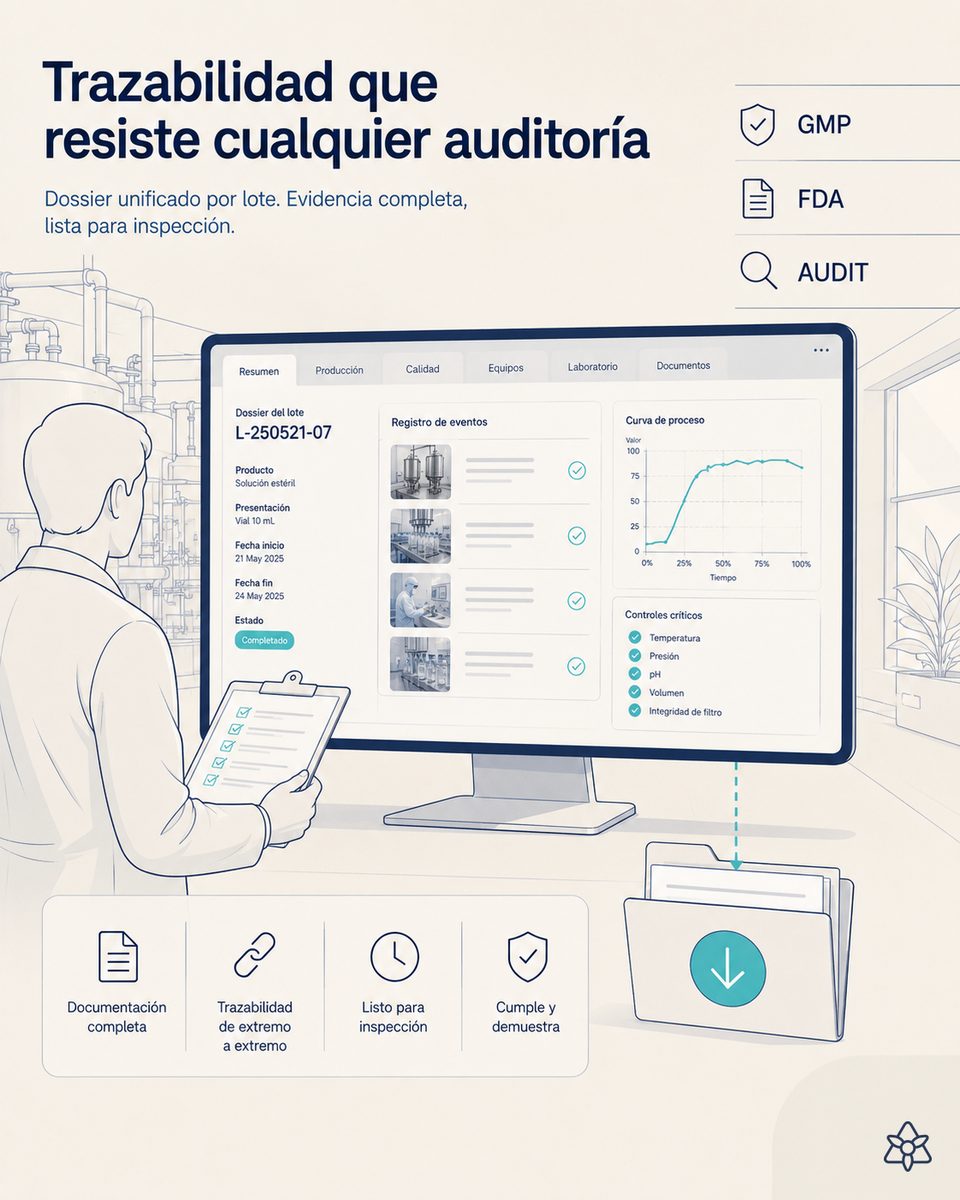
Three GMP worlds the auditor wants cross-referenced — and that nobody has cross-referenced.
The quality director of a biotech plant lives with a daily contradiction: Annex 1 and GMP demand an integrated view of contamination (Contamination Control Strategy), but the operational reality is three systems that do not talk to each other:
- Particles and environmental monitoring — optical counters per room, microbiology plates read at 5 and 7 days, records in Excel sheets that a technician transcribes into a LIMS that not every user handles the same way.
- Bioreactor and process — the manufacturer's DCS or panel (Sartorius, Applikon, Pall, in-house units), with a history of pH, DO, temperature and feed that lives on the equipment and gets dumped weekly onto a server almost nobody looks at.
- Physical conditions and utilities — differential pressure, HVAC, WFI water — in their own separate BMS, with alarms handled through a ticketing tool.
When a deviation lands, the QA team pieces the batch back together by hand across the three worlds, and often finds the root cause two weeks late. When the auditor arrives, the dossier gets rebuilt by hand all over again. It is not that the team does not know what is going on; it is that the knowledge does not reach the place where the decision is made in time.
iLEAN does not replace your LIMS or your DCS — it seals the cracks between particles, microbiology and bioreactor.
The problem is not missing data; it is data living on islands in heterogeneous formats. iLEAN acts as the putty that binds the three realities together, without asking you to throw away anything you already have. The architecture, applied to a biotech cleanroom:
Edge watches the particle counters and the bioreactor panel in real time. Connect reads the microbiology spreadsheets and the environmental quality control emails. The agent cross-references them with the batch recipe and the CCS — and if a trend points to a deviation, it warns before the impact. The person signs.
- Edge — terminals with vision and serial capture in the room. They read the optical counter display, the bioreactor panel with no modern API, the microbiology clock when the plate is changed. They carry a CNN to detect visible inconsistencies (a plate with anomalous growth, a compromised isolator seal). They work with no network: if the WiFi drops, Edge keeps recording and retaining.
- Connect (Brain in the pilot's naming) — captures the islands the LIMS never integrated: the microbiology lab's Excel file, the environmental quality manager's email, the WhatsApp from the HVAC technician flagging a filter change. Everything enters at second zero, without anyone having to forward anything.
- Agent — cross-references the three families (particles, micro, bioreactor) with the batch recipe, the CCS and the risk matrix. If a particle trend in grade C points to an excursion within 4h, the agent warns the responsible person before the excursion happens. It prepares the draft dossier per batch — the person validates and signs.
Traditional EM vs. environmental monitoring cross-referenced with iLEAN
| Aspect | Classic EM (LIMS + Excel + isolated DCS) | With iLEAN Edge + Connect + Agent |
|---|---|---|
| Particle data | Weekly dump into the LIMS, reviewed after the fact | Continuous, with a proactive alert on trend |
| Microbiology | Lab Excel file, transcribed by hand | Automatic capture via Connect, linked to the batch |
| Bioreactor | History on the equipment, checked weekly | Integrated via Edge, cross-referenced with EM in real time |
| Deviation detected | After the impact, during QA review | Before the impact, by the agent on the trend |
| Batch record | Rebuilt by hand, weeks per batch | Automatic dossier with traced evidence |
| Operation with no network | Critical processes stopped | Edge keeps running on the panel's own power |
Impact estimate for your plant — to be validated with your numbers.
The block below is an estimate to be validated with the specific data of your plant. We put it forward so the committee has an order of magnitude; we refine it during the diagnostic.
- Mid-sized biotech plant with 2-4 bioreactors, grade B + C cleanrooms, EM spread across LIMS + Excel + paper.
- Edge pilot in one critical room + Connect over microbiology and the bioreactor. First value expected within a few weeks: a consolidated batch record and the first anticipated environmental trend.
- Reduction in QA effort per batch on the order of ≥30%, conservatively. Indicative payback between 4 and 9 months, depending on batches per year and the cost of the deviations avoided.
- Hard lever: a single deviation caught with room to spare avoids reprocessing an entire batch — and one biotech batch pays for the pilot.
And the CAIO's doubt about AI reliability
“What if the AI hallucinates on the data of a GMP batch?” — hallucination is a problem of free generation, not of anchored tasks. In tasks where the AI merely recontextualizes a piece of data from one system into another (reading the particle counter, cross-referencing it with the recipe, drafting the dossier), the best models brought error below 1.5% [1]. And even so, what is critical is never decided alone: iLEAN's three safety rings guarantee that the critical operation is only executed by a person — the AI proposes, the person signs.
[1] OpenAI paper “Why Language Models Hallucinate”, 2025 — on the reliability of AI in anchored tasks.
What people ask about GMP biotech and environmental monitoring with AI
What signals does iLEAN monitor in a biotech cleanroom?
The three families that Annex 1 and biotech GMP require, today typically living in three different systems: viable and non-viable particles (optical counters + microbiology plates), physical conditions (differential pressure between rooms, temperature, humidity, air change rate) and bioreactor parameters (pH, DO, temperature, feed, off-gas). iLEAN Edge captures the in-line signals, Connect integrates the legacy systems and the microbiology spreadsheets, and an Agent cross-references them to catch the deviation before it hits the batch.
Does it work the same for grades A, B, C and D?
Yes, and that is exactly why a single platform makes sense: the alert logic changes by grade (A is continuous and critical, D is tolerant), but the data model is the same. iLEAN applies different rules per room (grade A → a particle excursion triggers immediate intervention; grade C/D → 24h trending with a proactive alert), all configured plant by plant, without touching code. The batch record aggregates what each room saw, in the format the auditor asks for.
How is it validated under Annex 1?
iLEAN sits inside the Contamination Control Strategy (CCS) that Annex 1 2023 requires you to document. The Edge piece is qualified as an instrument (IQ/OQ/PQ) with its detection limits and calibration traceability; the Agent piece is documented as a computerized system under GAMP 5 category 4 or 5 depending on the case, with the validation dossier, the user requirements, the risk matrix and the regression test. What keeps you off the endless validation road is that the system is designed for the CCS, not against it.
Does it work with multiple bioreactors?
Yes. The biotech reality is a fleet of bioreactors from different manufacturers (Sartorius, Applikon, Pall, in-house units) with their own DCSs or panels. Connect has three capture modes: native integration when the bioreactor has an API; screen reading when it only has a local panel; and assisted manual entry (photo of the display + dictation) for the oldest ones. The Agent unifies everything and applies the same process quality rules, whatever the bioreactor model.
How much does the QA effort go down?
Estimate to be validated with your plant. On biotech batches where the bottleneck is rebuilding the batch record by hand (cross-referencing EM, microbiology, bioreactor and deviations), a first conservative estimate is a reduction in QA effort per batch on the order of ≥30%, with first value in a few weeks and payback between 4 and 9 months, depending on batches per year and the loaded cost of the QA team. We ask for your plant's data and send you the estimated ROI in 48h.
More cases in pharma
- EBR with AI — the batch ships in hours because QA only sees what departs from what was approved.iLEAN generates the electronic batch record with review by exception. QA only looks at what is anomalous.
- Pharma FMD/DSCSA serialization with AI — one badly aggregated serial is a pallet held at the border.iLEAN covers serialization, aggregation and reporting to the EU Hub and DSCSA on a single platform,…
- Galenic formulation with AI — from bench to plant without losing the conversation along the way.iLEAN cross-checks R&D notes, the scale-up file, real plant parameters and the regulatory dossier so the…
- GMP validation with continuous AI evidence — IQ/OQ/PQ alive, with no sprints before every audit.iLEAN keeps IQ/OQ/PQ alive and GMP validation always audit-ready, with no sprints before every…
- Visual inspection of injectables with AI — the eye must not blink, and by the end of the shift it blinks.iLEAN Vision inspects 100% of injectables at industrial cadence, without the false rejects that come…
- Pharma QC glassware control with AI — lose the lineage of the vial and you lose the batch.How iLEAN traces pharma QC vials, volumetric flasks and pipettes — calibration, integrity and…
Tell us your case and in 48h we'll send you the estimated ROI of this AI project for your biotech plant.
We work on your plant's real data, not ours. Diagnostic with no commitment.
Request estimated ROI in 48h See pharma