GMP validation with continuous AI evidence — IQ/OQ/PQ alive, with no sprints before every audit.
GMP validation is not an event — it is continuous. iLEAN keeps IQ/OQ/PQ alive, captures process evidence continuously under 21 CFR Part 11 and leaves the audit always ready. The QA person approves — the system does not declare itself validated; it brings the data properly prepared.
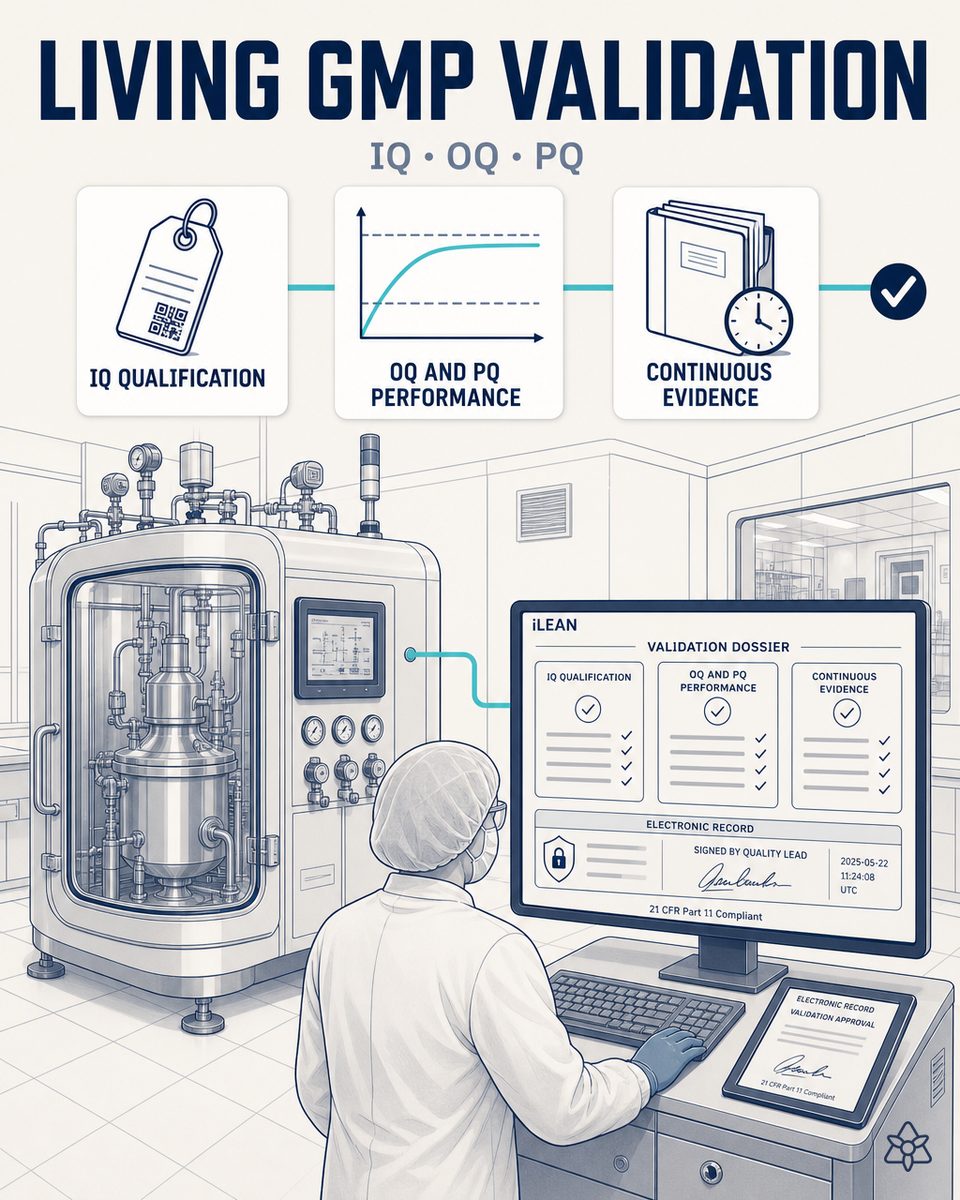
Validation as an event: sprints, paper, and the uncertainty of whether the validated state is still there.
The QA manager of a pharmaceutical plant knows the cycle: when a line is qualified or a change is introduced, a validation project is set up that runs for months. IQ, OQ, PQ, signed protocols, PDF reports, file into the cabinet. And between one validation and the next, the "validated state" rests on a declaration from the quality system — not on continuous evidence that the process is still inside the validated ranges.
- The initial IQ/OQ/PQ is done properly — a dedicated validation team, protocols in a specialist tool, RP signatures. Then it is frozen in the cabinet.
- The quarterly change control — a PLC parameter changes, an equipment component is replaced, a new SKU is introduced — triggers a mini-project of partial revalidation. Each one gets its own sprint.
- The FDA/EMA audit arrives — the QA team spends three weeks gathering evidence that the process has stayed in range between the PQ and today. The evidence exists (SCADA, BMS, LIMS), but it is scattered.
The result in a GMP plant: the real cost of validation is not the first one (that one gets budgeted) — it is the continuous work of keeping the validated state alive. And the QA manager's recurring feeling is: “if the FDA turns up tomorrow, can I prove in a week that the process has been compliant on every one of the last 365 days?”. The second edition of GAMP 5 asks for exactly that: continuous validation.
iLEAN does not replace your quality system — it turns the validated state into an always-on layer.
The problem is not a lack of protocols or validation tools: there are plenty, and good ones. The problem is that the real process evidence that supports the validated state lives in separate systems (SCADA, BMS, LIMS, MES) and is only cross-referenced during the audit sprint. iLEAN acts as the putty that fills that crack, without replacing your eQMS, your DMS, your LIMS or your validation system.
Tracer keeps IQ/OQ/PQ linked to the live process. The Agent sees every deviation against the validated range before it affects the batch. Writer prepares the revalidation or audit dossier. The QA person signs — always, under 21 CFR Part 11.
The three iLEAN pieces applied to GMP validation:
- iLEAN Tracer — keeps the traceability URS → design → IQ/OQ/PQ protocol → real process evidence → batch produced alive. When something changes (a component, PLC software, a new SKU), Tracer identifies which protocol is affected and prepares the revalidation scope.
- iLEAN Agent — sees the critical process parameters (temperature, pressure, mixing, cycle) continuously, compares them with the ranges validated in the PQ, detects drift trends before a batch is at risk and alerts the QA manager through the right channel. It proposes; the person signs. The Agent does not release batches or authorize restarts on its own.
- iLEAN Writer — prepares the revalidation dossier when there is a change control, and the continuous evidence package when the FDA/EMA inspection arrives. Formatted against GAMP 5, EU GMP Annex 11 and 21 CFR Part 11. The QA team reviews and signs; the reconstruction sprint disappears.
Classic sprint-based validation vs. continuous validation with iLEAN
| Aspect | Classic validation (event + sprints) | With iLEAN Tracer + Writer + Agent |
|---|---|---|
| IQ/OQ/PQ | Frozen in a PDF at the end | Linked to the live process |
| Validated state between events | A declaration from the quality system | Continuous evidence under Part 11 |
| Change control | A revalidation mini-sprint | Scope identified, dossier prepared |
| Detection of process drift | In the OOS after the batch | As a trend, before it affects the batch |
| FDA/EMA audit | 3 weeks of QA team time | Package prepared, human review |
| CSV of new systems | A heavy project per system | CSA approach, risk-proportional |
Impact estimate for your plant — to be validated with your numbers.
The block below is an estimate to be validated with the specific data of your plant. We put it forward so the committee has an order of magnitude; we refine it during the diagnostic.
- GMP plant (oral solids, sterile products, biotech) with 2-5 lines, active quarterly change control, periodic FDA/EMA audits, a QA team partly dedicated to gathering evidence by hand.
- Tracer + Writer + Agent pilot on one critical process (a granulation/compression line, a lyophilization cycle, an aseptic filler). First value expected within a few weeks.
- Reduction in manual QA effort spent gathering evidence: ≥30% in the first 6 months.
- Indicative payback between 4 and 9 months, driven by the cost of the QA team in validation sprints and, above all, by the avoided risk of a launch delay when a revalidation blocks a new SKU.
And the QA manager's reasonable doubt
“What if the AI invents a conclusion about a process parameter, or misses a real deviation?” — hallucination is a problem of free generation, not of anchored tasks. When the AI merely reads the real data from SCADA/BMS/LIMS and compares it with the range validated in the PQ (pure recontextualization, one of the tasks AI performs best at), the best models brought error below 1.5% [1]. And even so, the Agent proposes; the QA person signs, under 21 CFR Part 11. The three safety rings protect critical OT — batch release is not done by an AI.
[1] OpenAI paper “Why Language Models Hallucinate”, 2025 — on the reliability of AI in anchored tasks.
What people ask about GMP validation with AI evidence
What does GAMP 5 require in process validation?
GAMP 5 (Good Automated Manufacturing Practice, second edition) sets out a risk-based approach to validating computerized systems and GMP processes: it classifies the system by category, requires a user requirements specification (URS), functional design, IQ/OQ/PQ testing proportional to process risk, and maintenance of the validated state throughout the system's life. The second edition introduces continuous validation and iterative life-cycle models — which is exactly where iLEAN contributes: it stops treating validation as a project event and turns it into an always-on layer.
How are IQ/OQ/PQ kept alive?
iLEAN Tracer maintains the link between each protocol (IQ = installation, OQ = operational, PQ = performance) and the real process evidence that protocol covers. The Agent sees the critical process parameters continuously (temperature, pressure, mixing, cycle) and raises a flag when a parameter drifts away from the range validated in the PQ, before the batch is at risk. If something changes (an equipment component, a PLC software version, an analytical deviation on a parameter), Tracer marks the affected protocol and Writer prepares the revalidation delta. The QA person approves; the system does not declare itself validated.
What about computerized system validation (CSV)?
CSV under GAMP 5 plus the FDA's CSA approach (Computer Software Assurance) aim at the same thing: validate what matters, with rigor proportional to risk, and stop generating documentation nobody reads. iLEAN supports full CSV: traceability from URS → design → test → evidence of real use in production, with an electronic audit trail under 21 CFR Part 11 and compliant electronic signatures. iLEAN itself is validated under GAMP 5: a system validation package deliverable to the customer's QA team.
Is it 21 CFR Part 11 compliant?
Yes. Every record generated by iLEAN meets the requirements of the FDA's 21 CFR Part 11 and EU GMP Annex 11 for electronic records and electronic signatures: ALCOA+ integrity (attributable, legible, contemporaneous, original, accurate, complete, consistent, enduring, available), a complete audit trail of any change to or reading of critical data, and an electronic signature authenticating the QA person or RP (Responsible Person). Process data is cryptographically signed as it enters ring 2 — traceability is native, not bolted on afterwards.
What reduction in validation effort can I expect?
Estimate to be validated with your numbers: in a GMP plant with classic sprint-based validation (every change control triggers a mini-project of partial revalidation, every new line demands a full IQ/OQ/PQ package that takes months), first value with iLEAN shows up within a few weeks — usually by automating continuous evidence capture on one critical process and the preparation of the revalidation dossier. Expected reduction in manual QA effort spent gathering evidence: ≥30% at 6-12 months. Indicative payback between 4 and 9 months, driven by the cost of the QA team in validation sprints and by the cost of launch delays when a revalidation blocks a new SKU.
More cases in pharma
- Pharma FMD/DSCSA serialization with AI — one badly aggregated serial is a pallet held at the border.iLEAN covers serialization, aggregation and reporting to the EU Hub and DSCSA on a single platform,…
- Galenic formulation with AI — from bench to plant without losing the conversation along the way.iLEAN cross-checks R&D notes, the scale-up file, real plant parameters and the regulatory dossier so the…
- GMP biotech with AI environmental monitoring — particles, microbiology and bioreactor on a single platform.iLEAN covers particles, microbiology and bioreactor in a GMP biotech cleanroom, with no broken…
- Visual inspection of injectables with AI — the eye must not blink, and by the end of the shift it blinks.iLEAN Vision inspects 100% of injectables at industrial cadence, without the false rejects that come…
- Pharma QC glassware control with AI — lose the lineage of the vial and you lose the batch.How iLEAN traces pharma QC vials, volumetric flasks and pipettes — calibration, integrity and…
- LAL/rFC endotoxin testing with AI — faster parenteral release, a firmer dossier.How iLEAN cross-checks kinetic reader data, sample identity and method (LAL/rFC) with LIMS and OOS…
Tell us about your case and in 48h we'll send you the estimated ROI of continuous GMP validation for your plant.
We work on your plant's real data, not ours. Diagnostic with no commitment.
Request estimated ROI in 48h See pharma