Pharma lyophilization with AI predictive control — a 48-hour cycle, and a deviation takes 5 minutes to destroy the batch.
A freeze-drying cycle runs 24-48 h and one deviation ruins the batch. iLEAN follows it continuously and predicts equipment failures before the deviation becomes irreversible. Every batch ends up with its complete thermal and vacuum profile, ready for the inspector. The person signs — the cycle does not restart on its own.
The most expensive batch in your plant spends 48 hours looking at itself. And nobody is looking the whole time.
Lyophilization is the pharma process with the highest concentration of value per minute of cycle and, at the same time, the most opaque to sustained human attention. The reality for a biotech production manager is this:
- The cycle lasts between 24 and 48 hours. Nobody watches the SCADA closely for 48 hours straight. Shifts change, screens get muted, alarms pile up, and the corners of the process (condenser profile, residual pressure at stoppering) become invisible.
- The deviation is obvious once it is already too late. A vacuum micro-leak at the end of primary sublimation, a shelf temperature running 0.5 °C low for two hours, a miscalibrated product thermocouple — these are things a veteran operator feels when looking at the curve, but by the time they come over to look, the curve has already collapsed the cake.
- The veteran's knowledge is in no system at all. The judgment of the operator who has spent 30 years watching that specific machine is worth more than the SCADA, and it is documented nowhere. The day they retire, part of the freeze dryer's performance walks out with them.
The financial consequence is severe: a single freeze-dried batch of a high-value SKU (vaccine, monoclonal antibody, biologic) is worth on the order of hundreds of thousands to millions of euros. The classic system works almost every time — and that “almost” is what puts the annual lost-batch figure into the committee's report.
iLEAN captures the veteran's eye and holds it without blinking for 48 hours.
The lyophilization problem is not a lack of sensors: the freeze dryer's SCADA already has 50 capture points. The problem is that nobody cross-references those 50 points against the historical twin of the same SKU on the same freeze dryer, and nobody projects them forward to see 30 minutes ahead. iLEAN acts as the putty that covers that dead zone, without asking you to change the SCADA, the freeze dryer or the quality system.
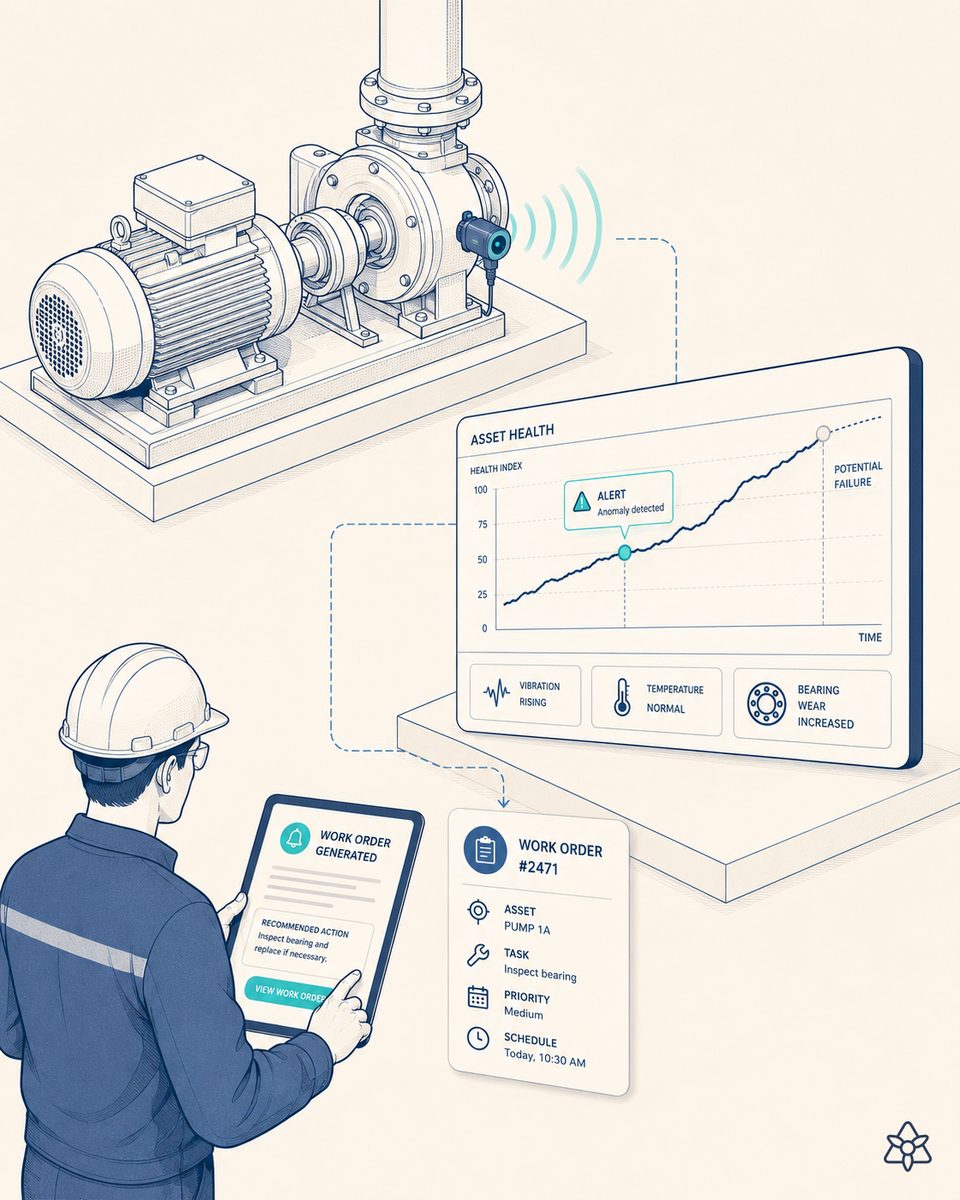
Edge captures the cycle in real time. Brain compares it against the historical twin. The agent anticipates the deviation and warns before it collapses the cake. The person signs; the cycle does not restart on its own.
The three iLEAN pieces applied to pharma lyophilization:
- iLEAN Edge — a terminal on the floor that ingests every freeze dryer signal in real time (thermocouples, Pirani/capacitance, condenser, valves, profile). It works with no network: if the plant loses WiFi, Edge keeps capturing and holding the cycle locally; when the network returns, it syncs. What is critical cannot depend on connectivity.
- iLEAN Brain — the multi-agent brain. It ingests the full batch history for the same SKU and builds a digital twin of expected behavior. It detects when the running cycle starts to separate from that twin, early enough to correct. What the veteran operator did on intuition, sustained by the machine without a break.
- iLEAN Agent — cross-references the detected deviation with the rest of the context (raw material quality, primary vial batch, pending maintenance on the freeze dryer, history of micro-leaks) and proposes an action. If the deviation is critical, it holds the cycle at an acceptable phase and alerts the responsible person. The person validates and signs; the cycle does not restart on its own.
Classic lyophilization vs. lyophilization with iLEAN Edge + Brain + Agent
| Aspect | Classic lyophilization (SCADA + one operator per shift) | With iLEAN Edge + Brain + Agent |
|---|---|---|
| Cycle attention | An operator who comes and goes, alarms muted during the night peak | Continuous, without blinking, for the full 48 h |
| Micro-leak detection | When the residual vacuum fails to close at the end — already too late | On the vacuum rise curve, with room to correct |
| Miscalibrated thermocouple | Discovered during the post-mortem of the ruined batch | Cross-referenced against the other thermocouples in real time |
| The veteran's knowledge | Lives in the head of the operator who retires | Captured as a model, stays in the plant |
| Operation with no network | Local SCADA with no remote access | Edge keeps capturing, syncs when the network returns |
| 21 CFR Part 11 dossier per batch | Export from the SCADA + cross-reference with quality by hand | Generated automatically, with a complete audit trail |
Impact estimate for your plant — to be validated with your numbers.
The block below is an estimate to be validated with the specific data of your plant. We put it forward so the committee has an order of magnitude; we refine it during the diagnostic.
- 2 GEA/Telstar/IMA freeze dryers running a mid-to-high value SKU (vaccine or biologic), typical cycle 36 h, average batch 50-200 thousand vials.
- Deployment of iLEAN Edge over the SCADA + Brain with the history of previous batches. First value expected within a few weeks: detection of a micro-deviation against the historical twin.
- Indicative payback between 4 and 9 months, depending on the documented frequency of lost batches over recent years and the unit value of the SKU.
- Expected reduction of batches lost to cycle deviation of ≥ 30% in the first year, with enough lead time to correct.
- The hard lever is a single batch saved per year. For a high-value biologic SKU, one intervention pays for the pilot and leaves margin to scale to the rest of the freeze dryers.
And the reasonable doubt of the technical director / Qualified Person
“What if the AI tells me to change the recipe and gets it wrong?” — hallucination is a problem of free generation, not of anchored tasks. In tasks where the AI merely compares signals against a historical twin (what Brain does with every cycle), the best models brought error below 1.5% [1]. And even so, the iLEAN architecture does not decide alone: the agent proposes, holds at an acceptable phase, and the technical director signs. Digitalization done right in capital-intensive industries is what separates those who grow from those who fall behind — the most digitalized sectors raised productivity by up to 40% [2].
[1] OpenAI paper “Why Language Models Hallucinate”, 2025 — on the reliability of AI in anchored tasks. [2] Fundación BBVA / Ivie, productivity and digitalization 2000-2021.
What people ask about AI control of pharma lyophilization
Which cycle signals are tracked?
Every signal the lyophilization recipe requires, plus several that in many plants are not cross-referenced in real time today: shelf and product thermocouples, chamber pressure (Pirani vs capacitance, to infer comparative pressure measurement), condenser temperature, condenser pressure, inert gas flow, valve positions, residual vacuum at stoppering, and programmed vs actual ramp profile. iLEAN Edge captures the whole set, cross-references it with the batch recipe and projects it forward to anticipate the deviation.
Does it comply with 21 CFR Part 11?
Yes. Every capture, cross-reference and alert is recorded with timestamp, user, value and electronic signature in line with 21 CFR Part 11 and EU GMP Annex 11. The audit trail is complete and tamper-evident. Validation is delivered under GAMP 5 (category 5: configured software) — URS, FS, DS, IQ, OQ, PQ, with protocols ready for your QA team to execute.
Does it learn from batch history?
Yes, and that is where the game is won. iLEAN Brain ingests the full history of previous batches of the same SKU on the same freeze dryer and builds a model of expected behavior. When a running batch starts to drift away from its historical twin — subtly at first, clearly later — the system warns before the deviation damages the product. It is not magic: it is what a veteran operator did by watching the screen for 30 years, sustained by the machine without blinking across the 24-48 h of the cycle.
Does it work across equipment brands?
Yes. Freeze dryers from GEA, Telstar, IMA, Optima, SP Scientific, Martin Christ — each brand with its own SCADA and protocol (OPC UA, Modbus, proprietary drivers). iLEAN Connect plugs in where there is a modern API, reads over OPC UA where it is supported, and where there is only a local screen it reads by visual capture (a photo of the panel) or a serial connection. Without scrapping the machine or replacing the SCADA. The putty between the systems you already have — not their replacement.
How many lost batches does it prevent?
The conservative estimate, to be validated with your data: a reduction in batches lost to cycle deviation of ≥ 30% in the first year, with typical lead time that leaves room to correct before the deviation becomes irreversible. The hard lever is brutal: a single freeze-dried batch of a high-value SKU (monoclonal antibody, vaccine) pays for the entire pilot. Payback is measured in batches saved, not in labor hours avoided.
More cases in pharma
- Visual inspection of injectables with AI — the eye must not blink, and by the end of the shift it blinks.iLEAN Vision inspects 100% of injectables at industrial cadence, without the false rejects that come…
- Pharma QC glassware control with AI — lose the lineage of the vial and you lose the batch.How iLEAN traces pharma QC vials, volumetric flasks and pipettes — calibration, integrity and…
- LAL/rFC endotoxin testing with AI — faster parenteral release, a firmer dossier.How iLEAN cross-checks kinetic reader data, sample identity and method (LAL/rFC) with LIMS and OOS…
- mAb/ATMP bioreactor control — anticipate drift minute by minute and hold per-patient traceability.iLEAN monitors pH, DO, glucose and critical bioreactor metrics, plus per-patient traceability for ATMP.
- MDI inhaler control with AI — one gram of propellant out of range is one delivered dose out of range.How iLEAN cross-checks propellant fill, valve crimping and leak testing to secure the right MDI inhaler…
- AI mRNA vaccine control — a batch is not signed off on hunches.How iLEAN cross-checks mRNA synthesis, LNP encapsulation and the Annex 1 CCS to secure mRNA vaccine…
Tell us your case and in 48h we'll send you the estimated ROI of this AI predictive control project for your freeze dryers.
We work on your plant's real data, not ours. Diagnostic with no commitment.
Request estimated ROI in 48h See pharma