mAb/ATMP bioreactor control — anticipate drift minute by minute and hold per-patient traceability.
Producing a mAb or an ATMP demands controlling the bioreactor minute by minute and keeping the per-patient custody chain unbroken. iLEAN combines continuous process control (pH, DO, glucose, lactate, VCD) with per-patient traceability for autologous products and MCB batch traceability for allogeneic ones, with a Part 11 audit trail and the three safety rings sitting over the bioreactor DCS. The person signs the setpoint changes — the AI observes and anticipates.
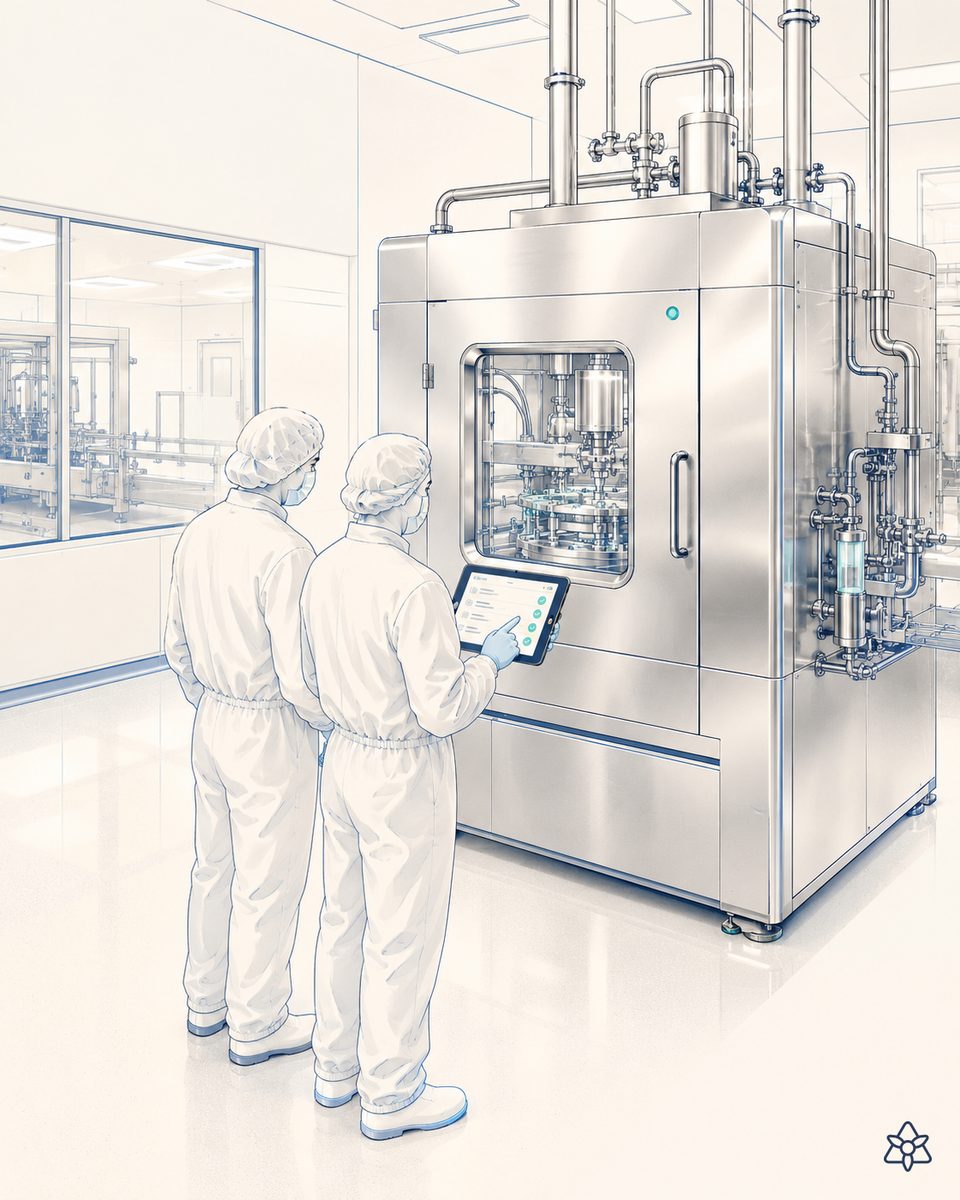
A bioreactor does not forgive — and the critical data sits scattered across four systems.
Producing mAb or ATMP in a bioreactor (single-use or stainless steel, allogeneic or autologous) means living with three pressures at once:
- Minute-by-minute process control. The bioreactor holds a living culture — CHO cells producing mAb, T cells in autologous expansion, iPSCs in a master bank. A pH or DO drift that goes unnoticed for 4 hours degrades the culture and compromises the batch. The DCS has alarms, but alarms are reactive — they fire once the damage has started.
- Critical data in islands. The CPPs are in the bioreactor DCS; the offline CQAs (HPLC, MALS, glycan analysis) are in the LIMS; the feed batch parameters are in the process engineer's spreadsheet; the shift observations are in the operator's notebook; the apheresis acknowledgements for the CAR-T patient are in the donor hospital's system. Cross-referencing all of that by hand is what the QA person does after the batch — not before, when there was still time to intervene.
- Non-negotiable per-patient traceability. In autologous production, breaking the vein-to-vein custody chain means losing the patient — not just the batch. Correctly identifying which cell bag belongs to which donor is an absolute human responsibility, and today it rests on a label plus a checklist plus a second signature at every point. It works — and every error makes headlines.
The result: a typical lost-batch rate of 5-15% caused by drift not detected in time, and a custody-chain error rate that trends toward zero but never gets there. Every mAb batch costs tens to hundreds of thousands of euros; every autologous ATMP batch, even more. The classic setup (operator + DCS + checklist) works — and every failure is either hard cost or irreparable harm to a patient.
iLEAN does not replace the DCS — it anticipates drift and holds per-patient traceability without touching it.
Bioreactor control suffers because the data lives in islands (DCS, LIMS, feed spreadsheet, notebook) and because alarms are reactive. iLEAN acts as the putty between the bioreactor DCS, the LIMS, the ERP, the notebook and the hospital's apheresis system — without touching the validated DCS, without replacing the LIMS. It captures continuously, cross-references CPPs and CQAs, anticipates drift using the batch's real data and holds per-patient traceability with a Part 11 audit trail.
Edge sees and captures at the bioreactor. Brain cross-references CPPs and CQAs and anticipates drift. Tracer holds per-patient traceability. The person signs any setpoint change — the AI proposes with evidence.
The three iLEAN pieces applied to mAb/ATMP bioreactor control:
- iLEAN Edge — a local terminal in the culture suite. It reads the bioreactor DCS over OPC-UA, ProfiNet or Modbus, integrates with online probes (pH, DO, glucose, lactate, NIR biomass, Raman where available), and applies vision to the bioreactor panel or to the SUB bag when integration does not reach. It works without a network. Inference happens in the box — the data never leaves the OT ring.
- iLEAN Brain (Central + Agents) — cross-references the CPPs from Edge with the CQAs from the LIMS (HPLC, glycan, host cell protein), the feed batch parameters from the spreadsheet and the observations from the notebook. The agent trained on your culture (CHO mAb, autologous T cell, iPSC, gene-modified ATMP) anticipates drift before the DCS alarm fires: it spots the Crabtree pattern, the lactate rise that precedes the viability drop, the osmolality drift that is about to compromise titer. It proposes the adjustment to the supervisor; QA signs.
- iLEAN Tracer — holds per-patient traceability for autologous products (vein-to-vein: donor apheresis → cryogenic transport → bioreactor → expansion → harvest → cryopreservation → shipment → infusion) and MCB batch traceability for allogeneic ones, with a Part 11 audit trail and validation at every transfer point. Patient identification is verified by two factors at every step; the system does not move forward without the human signature that belongs there.
Classic bioreactor control vs. control with iLEAN
| Aspect | Classic control (DCS + LIMS + spreadsheet) | With iLEAN Edge + Brain + Tracer |
|---|---|---|
| Process alarms | Reactive — they fire once damage has started | Drift anticipation with CPPs and CQAs cross-referenced |
| CPP + CQA cross-reference | Manual, after the batch | Continuous, during the culture |
| Feed batch spreadsheet | Shared folder, the "good" version | Captured at second zero, linked to the batch |
| Autologous traceability | Label + checklist + second signature | Two-factor at every point + Part 11 audit trail |
| Allogeneic traceability (MCB) | Manual link back to the bank | Automatic chain batch → MCB → WCB → product |
| Batches lost to drift | 5-15% (typical industry range) | ≥30% fewer in the first 6-12 months |
Impact estimate for your plant — to be validated with your numbers.
The block below is an estimate to be validated with the specific data of your plant. We put it forward so the committee has an order of magnitude; we refine it during the diagnostic.
- Biotech facility with one or several bioreactors (200L-2000L SUB for mAb, autologous ATMP at patient scale, cell-bank allogeneic ATMP), standard DCS, validated LIMS.
- First value expected within a few weeks: the first bioreactor instrumented with Edge and the drift-anticipation agent live on the Pareto culture.
- Expected reduction in batches lost to drift not detected in time: ≥30% in the first 6-12 months.
- Indicative payback between 4 and 9 months, dominated by the cost of a single recovered batch (tens to hundreds of thousands of euros, depending on the product and the clinical phase).
- Industry reference figure: +40% productivity in the more digitalized sectors compared with the least digitalized ones [1]. The gap is widening; whoever does not anticipate loses ground in biotech.
And the process manager's reasonable doubt
“What if the AI proposes a setpoint change and compromises the culture or product integrity?” — the rule is strict: the agent proposes with evidence (which CPPs/CQAs trigger the drift, which setpoint to adjust, within which validated range); the culture supervisor decides; QA signs the setpoint change in the DCS. The three rings exist for exactly this: the bioreactor DCS lives in ring 1 (critical OT) and never accepts inbound connections; the AI observes from ring 3, validates in ring 2, and the person executes. And in anchored tasks (reading a culture pattern and comparing it with the product's golden batch) the best models brought error below 1.5% [2].
[1] +40% productivity in the more digitalized sectors (2000-2021). Source: Fundación BBVA/Ivie.
[2] OpenAI paper “Why Language Models Hallucinate”, 2025 — on the reliability of AI in anchored tasks.
What people ask about AI bioreactor control for mAb/ATMP
Which signals does iLEAN monitor on a bioreactor?
The critical process parameters (CPPs) that are already in the bioreactor's DCS/SCADA: pH, dissolved oxygen (DO), temperature, agitation, pressure, glucose feed, lactate, ammonium, glutamine/glutamate, viable cell density (VCD), viability, osmolality and product titer if there is an online sensor. And also everything that lives outside the DCS and nobody cross-references: offline lab results (HPLC, MALS, glycan analysis), feed batch parameters in a spreadsheet, the operator's notebook with the shift observation, a photo of the panel of an old single-use unit. The Brain cross-references CPPs and CQAs (Critical Quality Attributes) continuously and warns before the batch is at risk.
Does the flow change between autologous and allogeneic?
Yes, and that is exactly why per-patient traceability is non-negotiable. In autologous production (autologous CAR-T, personalized therapy), every batch is a patient — the vein-to-vein custody chain requires knowing at all times which cells from which donor are in which bioreactor in which plant. In allogeneic production (mAb, cell-bank ATMP, universal therapy) the batch serves many patients and traceability runs at the Master Cell Bank batch level. iLEAN maintains both traces with a Part 11 audit trail and links every bioreactor step to the patient traceability that applies.
How is ATMP / EMA Annex 1 compliance met?
By design: the Part 11 + Annex 11 audit trail covers ALCOA+ integrity for every CPP reading and signature; change control traced to the living dossier covers Annex 1 and the EMA guidance on ATMPs (CAT); per-patient traceability in autologous products covers the required custody chain; iLEAN's own validation under GAMP 5 category 4-5 is handed over to the customer's QA team. The three safety rings keep the bioreactor DCS (ring 1, critical OT) isolated: the AI proposes and observes from ring 3, validates in ring 2, and the person signs any setpoint change.
Does it work with a single-use bioreactor (SUB)?
Yes. Single-use bioreactors (SUB) such as the Xcellerex XDR, BIOSTAT STR, Mobius, HyPerforma SUB, Allegro STR and others all expose their CPPs over OPC-UA, ProfiNet or Modbus to the plant DCS — Tracer integrates through whichever protocol the SUB uses. If the unit is very specific or very old and only has a closed local PC, Tracer reads from that local PC or, as a last resort, from the panel by vision. The time granularity of the data (seconds for CPPs, the offline interval for lab results) is preserved in the dossier.
How much does it cut lost batches?
An estimate to be validated with your numbers: in a facility producing mAb or ATMP with a typical lost-batch rate of 5-15% caused by drift not detected in time (contamination, pH/DO drift, feed failure, glucose depletion before harvest), the first value with iLEAN shows up within a few weeks — usually with the first instrumented bioreactor and the drift-anticipation agent live. Expected reduction in lost batches: ≥30% in the first 6-12 months. Indicative payback between 4 and 9 months, dominated by the cost of a single recovered mAb/ATMP batch (tens or hundreds of thousands of euros, depending on the product and the clinical phase).
More cases in pharma
- Pharma QC glassware control with AI — lose the lineage of the vial and you lose the batch.How iLEAN traces pharma QC vials, volumetric flasks and pipettes — calibration, integrity and…
- LAL/rFC endotoxin testing with AI — faster parenteral release, a firmer dossier.How iLEAN cross-checks kinetic reader data, sample identity and method (LAL/rFC) with LIMS and OOS…
- Pharma lyophilization with AI predictive control — a 48-hour cycle, and a deviation takes 5 minutes to destroy the batch.iLEAN tracks the freeze-drying cycle in real time and predicts equipment failures. Every batch keeps its…
- MDI inhaler control with AI — one gram of propellant out of range is one delivered dose out of range.How iLEAN cross-checks propellant fill, valve crimping and leak testing to secure the right MDI inhaler…
- AI mRNA vaccine control — a batch is not signed off on hunches.How iLEAN cross-checks mRNA synthesis, LNP encapsulation and the Annex 1 CCS to secure mRNA vaccine…
- AI nasal spray control — a crimp out of height is a dose out of specification.How iLEAN cross-checks volumetric dose, pump actuation testing and valve crimping to secure the right…
Tell us your case and in 48h we'll send you the estimated ROI of mAb/ATMP bioreactor control for your plant.
We work on your biotech plant's real data, not ours. Diagnostic with no commitment.
Request estimated ROI in 48h See pharma